

 contact@canrd.com
 +86 18928276992
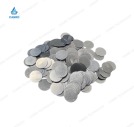
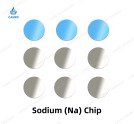
Sodium Chip (Battery negative piece/Na Chip)
Details
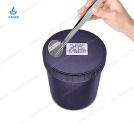
This product is designed as a ready-to-use sodium negative electrode chip for coin cell assembly, specifically developed for research on sodium-ion batteries and related energy storage systems. The chip features a composite structure consisting of a transparent protective film, a high-purity sodium layer (≥99.7%), an aluminum foil current collector, and a blue protective film. Available in standard diameters such as 15.6 mm, 14 mm, and 18 mm, with a uniform thickness of 0.45 mm, the chip ensures consistent surface smoothness and dimensional accuracy. This design minimizes common issues like surface burrs, uneven size, or micro-short circuits that can arise from manually prepared electrodes. The product is supplied in a vacuum-sealed can with argon protection, requiring handling inside a glove box. Common applications include use as the anode in CR2032, CR2025, or CR2016 button cells for evaluating electrode materials or electrolytes in sodium-based battery research.
- This product is sold by Huizhou Canrd New Materials Technology Co., Ltd.
- A video must be recorded before unpacking the product. This video must include the dew point in the dry room or glove box, water and oxygen levels, the product production date, and a clear appearance. Any abnormal appearance after unpacking without video evidence will not be handled (appearance abnormalities after the expiration date will not be accepted).
1. There is air inside the plastic black can. Open the can outside the glove box, and take the aluminum foil bag into the glove box before unpacking (it is recommended to unpack the aluminum foil bag before use, it is better for storage, and it is not recommended to stock too much, buy as needed).
2. Hold the flat and widened tweezers with your left hand, and use the pointed stainless steel tweezers with your right hand. It is best not to use rubber tweezers to remove the film.
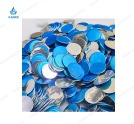
3. Both sides of the film (blue film, transparent film) should be removed. You can also remove the film with the help of the instructional video (remove the blue film first, then remove the transparent film). Install one battery per peeled piece, and tightly seal the remaining products in a white bottle for long-term storage.
4. The side with the blue film is aluminum foil, and the transparent film is sodium piece. Install it facing the separator and avoid installing it in reverse.
5. Both sides of the film should be removed (aluminum foil can be left unpeeled).
The composite sodium electrode piece is divided into four layers, from top to bottom: transparent protective film, sodium piece, aluminum foil, blue protective film. The diameter of the sodium electrode piece is 15.6/14/18mm (commonly used specification is 15.6mm), with an overall thickness of 0.45-0.55mm (pure sodium piece thickness is 0.4-0.5mm), purity is above 99.7%, specially designed for button batteries (2032, 2025, 2016).
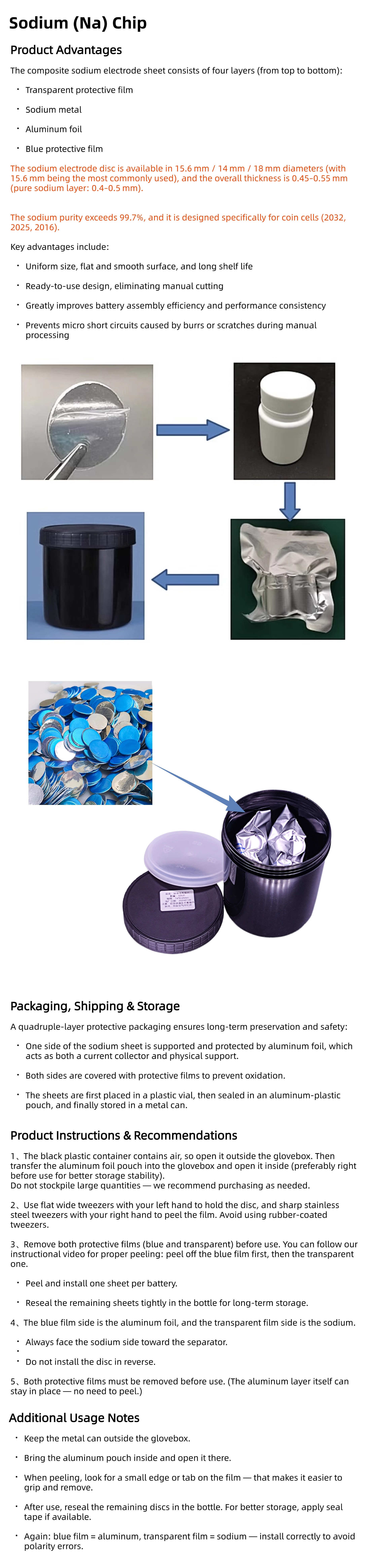
Supplementary Instructions for Use:
The size is uniform, the surface is smooth and bright, it can be stored for a long time, used as needed, greatly improving the efficiency and performance consistency and stability of battery assembly, avoiding low efficiency of self-made discs, inconsistent performance caused by uneven size, and micro short circuit caused by burrs and scratches on the surface.
Need R&D Support?
Browse key product categories and connect battery materials with Canrd's R&D services for testing, fabrication, and project support.
Experimental Materials
CategoryCathode, anode, electrolyte, separator, and other materials for battery research.
Shop cathode, anode & electrolyte materials →Lab Equipment
CategoryBattery lab equipment for pilot lines, fixtures, and testing workflows.
Browse battery lab equipment →Electrodes & Cells
CategoryCustom electrodes, dry cells, and battery cell components for R&D validation.
View custom battery electrodes & cells →Sodium Electrolyte
CategorySodium-ion electrolyte options for sodium battery research and validation.
Shop sodium battery electrolytes →R&D Services
ServiceFull-chain battery R&D services from material evaluation to cell fabrication and failure analysis.
Explore Canrd R&D services →Material Evaluation
ServiceCharacterization, electrochemical testing, and compatibility evaluation for battery materials.
Evaluate your battery materials →Electrode Fabrication
ServiceCustom electrode sheets and rolls based on your target chemistry and process needs.
Request electrode fabrication →Cell Fabrication
ServiceDry cells, assembled cells, and custom-format cell builds for R&D validation.
Build custom research cells →Contact
PageAsk Canrd to match products, materials, and services for your project.
Get product and R&D support →