

 contact@canrd.com
 +86 18928276992

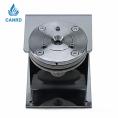
Details
Raman spectra is a type of scattering spectrum. Raman spectroscopy is based on the Raman scattering effect discovered by Indian scientist C.V. Raman, and analyzes the scattering spectrum with different frequencies of incident light to obtain information on molecular vibration and rotation, and applies it to molecular structure An analytical method of research.
1. Product use
(1) It is widely used for electrochemical in-situ Raman spectroscopy of positive/negative electrode materials of various lithium-ion batteries, positive/negative electrodes of sodium-ion batteries and positive/negative electrodes of potassium-ion batteries.
(2) The mold is not only suitable for in-situ Raman characterization during charging and discharging, but also for testing phase transition studies in cyclic voltammetry and linear scanning voltammetry.
(3) The mold can be used for vertical imaging of the electrode surface.
(4) The mold is suitable for lithium battery three-electrode testing.
Features:
(1) Cavity diameter 50 mm, thickness 28 mm, window 6 mm (customizable), minimum focusing distance is less than 2.5mm, the sample can be attached to the window.
(2) The cavity is sealed with an O-ring, so that the product has good sealing performance at the light window.
(3) The cavity adopts PEEK as the main body, which is resistant to acid and alkali and high temperature.
(4) Easy to operate, small size, easy to disassemble and assemble.
(5) Widely applicable to all kinds of current collector materials, the window material can be replaced as needed.
(6) The window of this product can be replaced: quartz window, sapphire, quartz glass.
(7) It can be equipped with high and low temperature devices.
(8) Raman signal can be strongest by laser spot focusing. It is widely used in all major Raman brands, without the need to modify the instrument, and is widely used for various wavelengths of lasers.
(9) The electrode area is adjustable.
(10) The optical window has high light transmittance and small signal loss.
Besoin de support R&D ?
Parcourez les categories produits cles et reliez les materiaux batterie aux services R&D de Canrd.
Materiaux experimentaux
CategorieCathodes, anodes, electrolytes, separateurs et autres materiaux de recherche batterie.
Acheter des materiaux cathode, anode et electrolyte →Equipement de laboratoire
CategorieEquipements de laboratoire batterie pour lignes pilotes, outillages et workflows de test.
Parcourir les equipements de laboratoire batterie →Electrodes et cellules
CategorieElectrodes personnalisees, cellules seches et composants de cellules pour validation R&D.
Voir les electrodes et cellules batterie personnalisees →Electrolyte sodium
CategorieElectrolytes sodium-ion pour recherche et validation de batteries sodium.
Acheter des electrolytes sodium →Services R&D
ServiceServices R&D batterie complets, de l evaluation materiaux a la fabrication de cellules et analyse de defaillance.
Explorer les services R&D Canrd →Evaluation de materiaux
ServiceCaracterisation, tests electrochimiques et evaluation de compatibilite des materiaux batterie.
Evaluer vos materiaux batterie →Fabrication d electrodes
ServiceFeuilles et rouleaux d electrodes personnalises selon votre chimie cible et vos besoins process.
Demander une fabrication d electrodes →Fabrication de cellules
ServiceCellules seches, cellules assemblees et formats personnalises pour validation R&D.
Construire des cellules de recherche personnalisees →Contact
PageDemandez a Canrd d associer produits, materiaux et services a votre projet.
Obtenir un support produit et R&D →
