

 contact@canrd.com
 +86 18928276992
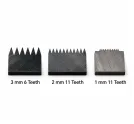


Details
Technical Specifications:
1. Spacing between multi-edged cutting blades: 1+0.01mmL, 2+0.01mm, 3+0.01mm.
2. Straightness of multi-edged cutting blades: ≯0.003mm, ≯0.006mm.
3. Width of working teeth of multi-edged cutting blades: ≯0.05mm.
4. Distance between teeth:
- 1mm blade: Film thickness: below 60um.
- 2mm blade: Film thickness: below 120um.
- 3mm blade: Film thickness: above 120um.
Operation and Usage Instructions:
1. The test samples must be prepared according to the requirements of ISOR1514 and ISO2808.
2. Place the test sample on a sufficiently hard flat surface.
3. Hold the handle of the grid cutter and make the multi-edged cutting blades perpendicular to the plane of the sample.
4. Cut with a uniform pressure, balanced and non-vibrating technique, and a cutting speed of 20-50mm/s.
5. Rotate the specimen 90 degrees and repeat the above operation on the cut grid to form a grid pattern.
6. Gently brush the diagonal lines of the grid pattern backward 5 times and forward 5 times with a soft brush.
7. The test should be performed at least at three different positions on the sample. If the test results at the three positions are different, repeat the test at more than three positions and record all results.
8. If it is necessary to replace the multi-edged cutting blades, use a screwdriver to loosen the two screws on the blade body, replace the blade, align the blade edge with one side of the handle, and tighten the screws.
Notes:
1. All incisions should penetrate the coating, but the depth of cut into the substrate should not be too deep.
2. If the coating is too thick and hard to penetrate the substrate, the test is invalid, but this should be indicated in the test report.
3. In special cases or with special requirements, the tape method should be used for testing. The tape is generally a 25mm wide semi-transparent tape with a backing of polyester film or acetate fiber. Stick the tape on the entire grid and then peel it off at the smallest angle. The result can be obtained by calculating the proportion of the area of the coating surface covered by the adhesive.
4. The test should be conducted at a temperature of 23±2°C and relative humidity of 50±5%.
Adhesion Testing Standards:
|
ISO Grade |
ASTM Grade |
Test Result |
|
0 |
5B |
The edges of the incision are completely smooth, and there is no peeling at the edges of the grid. |
|
1 |
4B |
Small flakes and no more than 5% actual damage at the intersection of the incisions in the grid area. |
|
2 |
3B |
Peeling at the edges and/or intersections of the incision with an area greater than 5%, but less than 15%. |
|
3 |
2B |
2B Partial peeling along the edges of the incision or large pieces of peeling, and/or partial grid squares completely peeled. |
|
Peeling area is more than 15%, but less than 35%. |
||
|
4 |
1B |
Large peeling at the edges of the incision or some grid squares partially or completely peeled with an area greater than 35%, but not exceeding 65%. |
|
5 |
0B |
Greater than the previous grade. |
1. The surface density of the coating does not include fluid collection;
2. Theoretical surface capacity mAh/cm2=Coating surface density mg/cm2 * Ratio of active substances * Gram capacity mAh/g ÷ 1000
3. Theoretical amount of active substance (mg)=coating surface density mg/cm2 * proportion of active substance * small circular area cm2
4. Calculate the amount of active substance by actual weighing (mg)=(weight of small disk mg - density of flow collecting surface mg/cm2 * area of small disk cm2) * proportion of active substance
5. When calculating the capacity in grams, the actual weight of the active substance shall be used. Due to the tolerance in the density of the coating surface, the actual weight shall prevail
Questions Fréquemment Posées
Recherchez ou parcourez les questions courantes pour trouver rapidement des réponses

Besoin de support R&D ?
Parcourez les categories produits cles et reliez les materiaux batterie aux services R&D de Canrd.
Materiaux experimentaux
CategorieCathodes, anodes, electrolytes, separateurs et autres materiaux de recherche batterie.
Acheter des materiaux cathode, anode et electrolyte →Equipement de laboratoire
CategorieEquipements de laboratoire batterie pour lignes pilotes, outillages et workflows de test.
Parcourir les equipements de laboratoire batterie →Electrodes et cellules
CategorieElectrodes personnalisees, cellules seches et composants de cellules pour validation R&D.
Voir les electrodes et cellules batterie personnalisees →Electrolyte sodium
CategorieElectrolytes sodium-ion pour recherche et validation de batteries sodium.
Acheter des electrolytes sodium →Services R&D
ServiceServices R&D batterie complets, de l evaluation materiaux a la fabrication de cellules et analyse de defaillance.
Explorer les services R&D Canrd →Evaluation de materiaux
ServiceCaracterisation, tests electrochimiques et evaluation de compatibilite des materiaux batterie.
Evaluer vos materiaux batterie →Fabrication d electrodes
ServiceFeuilles et rouleaux d electrodes personnalises selon votre chimie cible et vos besoins process.
Demander une fabrication d electrodes →Fabrication de cellules
ServiceCellules seches, cellules assemblees et formats personnalises pour validation R&D.
Construire des cellules de recherche personnalisees →Contact
PageDemandez a Canrd d associer produits, materiaux et services a votre projet.
Obtenir un support produit et R&D →
