

 contact@canrd.com
 +86 18928276992

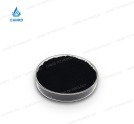
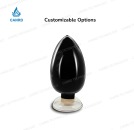
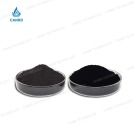
Details
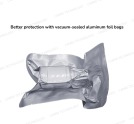
The material needs to be stored in vacuum seal
The electrolyte used during the test is: ternary electrolyte (KLD-1230C)
Baking conditions for pole slices: 85℃ bake for 4h
High capacity, high magnification, low expansion
Physicochemical Properties:
| No. | Category | Test Item | Unit | Specification | Measured Result | Test Method / Instrument |
| 1 | Physical Properties | Particle Size Distribution — D10 | μm | ≥6.0 | 6.12 | Laser Particle Size Analyzer |
| 2 | Particle Size Distribution — D50 | μm | 15.0 ± 2.0 | 14.44 | ||
| 3 | Particle Size Distribution — D90 | μm | ≤29.0 | 27.28 | ||
| 4 | BET Specific Surface Area | m²/g | 1.2 ± 0.2 | 1.36 | Specific Surface Area Analyzer | |
| 5 | Tap Density (TD) | g/cm³ | 1.1 ± 0.1 | 1.12 | Tap Density Tester | |
| 6 | Electrochemical Performance | Initial Reversible Specific Capacity | mAh/g | ≥450.0 | 461.8 | CR2032 coin cell; stepwise discharge (0.10–0.01) / constant-current charge at 0.1C; voltage range: 0.005–2.000 V |
| 7 | Initial Coulombic Efficiency (ICE) | % | ≥86.0 | 87.0 |
Half-Cell Testing:
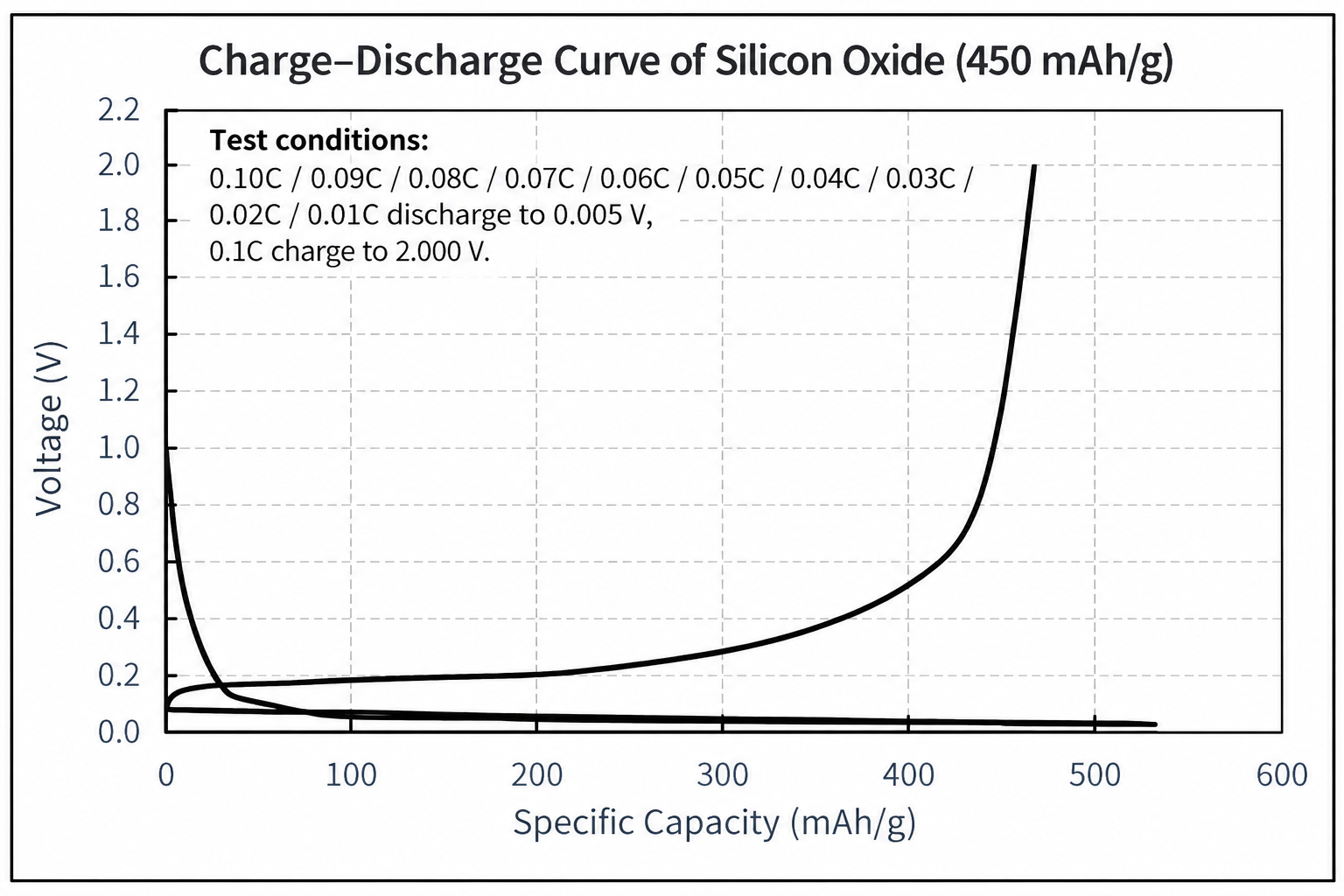
Test Procedure:
Ambient temperature: 25°C; rest for 4 h.
0.10C constant-current (CC) discharge to 0.005 V, 0.09C constant-current (CC) discharge to 0.005 V,
0.08C constant-current (CC) discharge to 0.005 V, 0.07C constant-current (CC) discharge to 0.005 V,
0.06C constant-current (CC) discharge to 0.005 V, 0.05C constant-current (CC) discharge to 0.005 V,
0.04C constant-current (CC) discharge to 0.005 V, 0.03C constant-current (CC) discharge to 0.005 V,
0.02C constant-current (CC) discharge to 0.005 V, 0.01C constant-current (CC) discharge to 0.005 V,
Rest for 3 min,
0.1C constant-current (CC) charge to 2.00 V, followed by a 3-min rest.
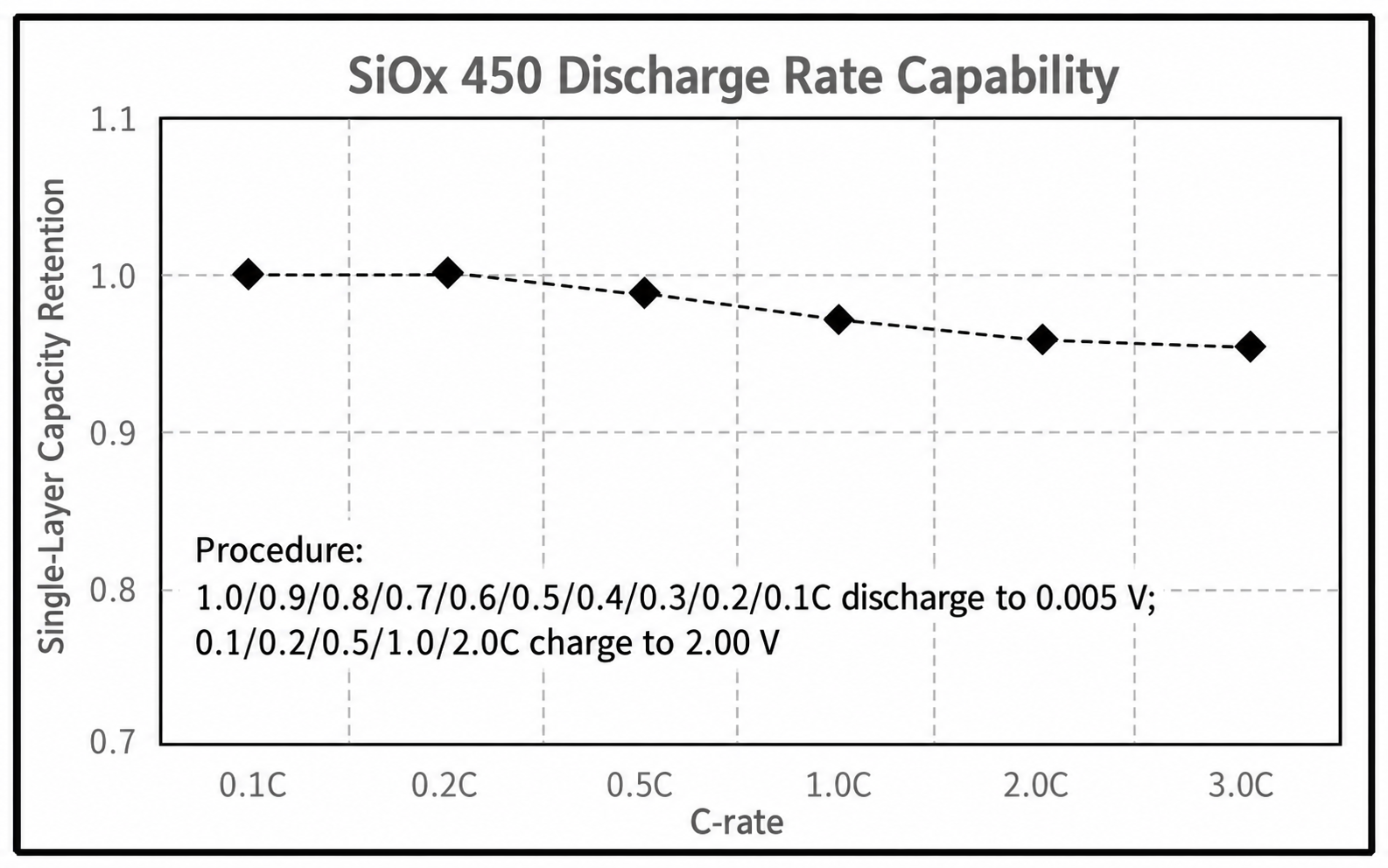
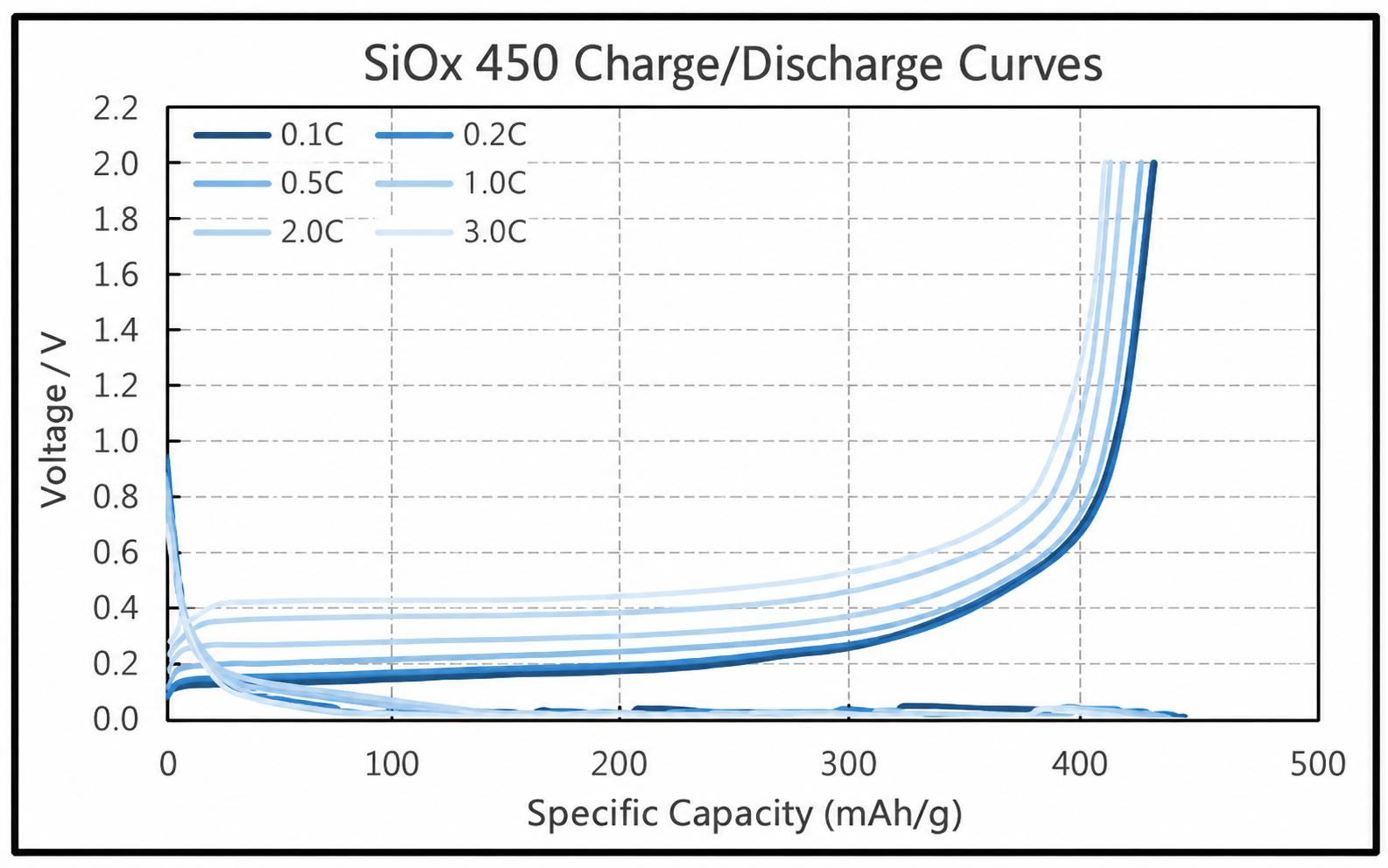
Test Procedure:
Ambient temperature: 25°C; rest for 1 min.
1.0C constant-current (CC) discharge to 0.005 V, 0.9C constant-current (CC) discharge to 0.005 V,
0.8C constant-current (CC) discharge to 0.005 V, 0.7C constant-current (CC) discharge to 0.005 V,
0.6C constant-current (CC) discharge to 0.005 V, 0.5C constant-current (CC) discharge to 0.005 V,
0.4C constant-current (CC) discharge to 0.005 V, 0.3C constant-current (CC) discharge to 0.005 V,
0.2C constant-current (CC) discharge to 0.005 V, 0.1C constant-current (CC) discharge to 0.005 V,
Rest for 3 min.
0.1C constant-current (CC) charge to 2.00 V, rest for 3 min.
......
1.0C constant-current (CC) discharge to 0.005 V, 0.9C constant-current (CC) discharge to 0.005 V,
0.8C constant-current (CC) discharge to 0.005 V, 0.7C constant-current (CC) discharge to 0.005 V,
0.6C constant-current (CC) discharge to 0.005 V, 0.5C constant-current (CC) discharge to 0.005 V,
0.4C constant-current (CC) discharge to 0.005 V, 0.3C constant-current (CC) discharge to 0.005 V,
0.2C constant-current (CC) discharge to 0.005 V, 0.1C constant-current (CC) discharge to 0.005 V,
Rest for 3 min.
3.0C constant-current (CC) charge to 2.00 V, rest for 3 min.
Benötigen Sie R&D-Unterstützung?
Entdecken Sie wichtige Produktkategorien und verbinden Sie Batteriematerialien mit Canrds R&D-Services.
Experimentelle Materialien
KategorieKathoden, Anoden, Elektrolyte, Separatoren und weitere Materialien für Batterieforschung.
Kathoden-, Anoden- und Elektrolytmaterialien kaufen →Laborgeräte
KategorieBatterielaborgeräte für Pilotlinien, Vorrichtungen und Testabläufe.
Batterielaborgeräte ansehen →Elektroden und Zellen
KategorieKundenspezifische Elektroden, Trockenzellen und Zellkomponenten für R&D-Validierung.
Kundenspezifische Batterieelektroden und Zellen ansehen →Natrium-Elektrolyt
KategorieNatrium-Ionen-Elektrolyte für Natriumbatterieforschung und Validierung.
Natrium-Batterieelektrolyte kaufen →R&D-Services
ServiceGanzheitliche Batterie-R&D-Services von Materialbewertung bis Zellfertigung und Fehleranalyse.
Canrd R&D-Services entdecken →Materialbewertung
ServiceCharakterisierung, elektrochemische Tests und Kompatibilitätsbewertung für Batteriematerialien.
Batteriematerialien bewerten lassen →Elektrodenfertigung
ServiceKundenspezifische Elektrodenblätter und -rollen für Ihre Zielchemie und Prozessanforderungen.
Elektrodenfertigung anfragen →Zellfertigung
ServiceTrockenzellen, montierte Zellen und kundenspezifische Zellformate für R&D-Validierung.
Kundenspezifische Forschungszellen bauen →Kontakt
SeiteCanrd kann Produkte, Materialien und Services passend zu Ihrem Projekt kombinieren.
Produkt- und R&D-Support erhalten →
