

 contact@canrd.com
 +86 18928276992
Details
This graphite type has high capacity and high compaction density. It is recommended for research and use in high-capacity CE-class batteries.
Recommended double-sided compaction density is 1.65g/cm3, and single-sided compaction density is recommended to be below 1.2g/cm3 to prevent curling.
1. Application scope: High-capacity batteries
2. EL-GRE-001 Graphite with high capacity and high compaction density
3. High energy density artificial graphite with excellent comprehensive performance
| Characteristics |
High specific capacity, minimal expansion, long cycle life, high initial efficiency, etc. |
| Applicable range |
High-capacity polymer batteries, cylindrical batteries, etc |
| Application field | 3C |
SEM:
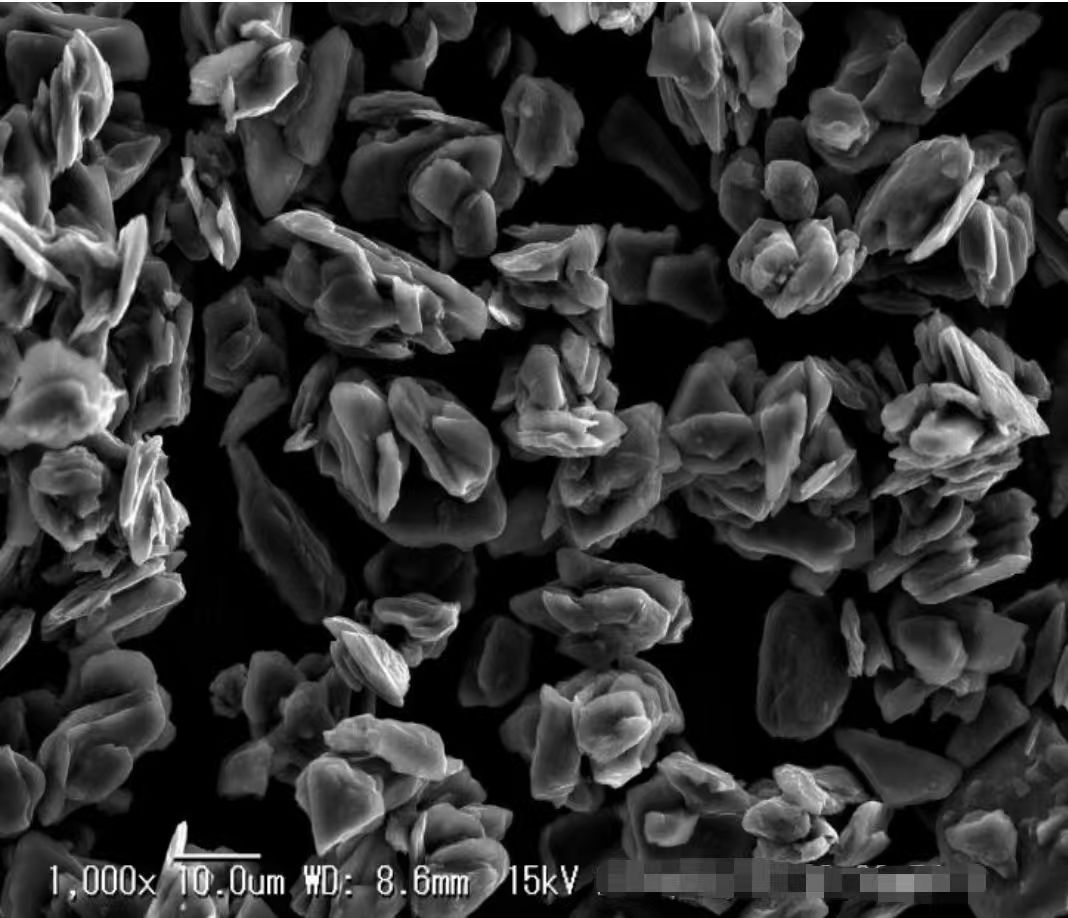
Performance indicators:
| No. | Test Item | Sub-item | Unit | Specification | Test Result |
|---|---|---|---|---|---|
| 1 | Physical Properties | Particle Size Distribution - D10 | (μm) | 11.0±2.0 | 11.02 |
| 2 | Particle Size Distribution - D50 | (μm) | 20.0±2.0 | 20.08 | |
| 3 | Particle Size Distribution - D90 | (μm) | 33.0±3.0 | 33.28 | |
| 4 | BET | (m²/g) | 1.3±0.3 | 1.48 | |
| 5 | TD (Tap Density) | (g/cm³) | 0.9±0.1 | 0.92 | |
| 6 | Ash Content | (%) | ≤0.05 | 0.01 | |
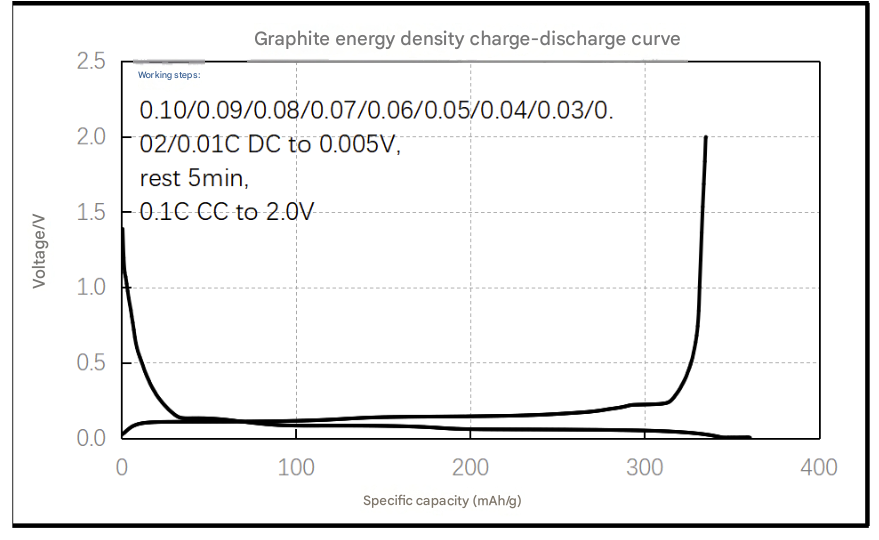
| 7 | Electrochemical Performance | First Reversible Capacity | (mAh/g) | ≥320.0 | 334.9 |
| 8 | First Efficiency | (%) | ≥92.0 | 93.0 |
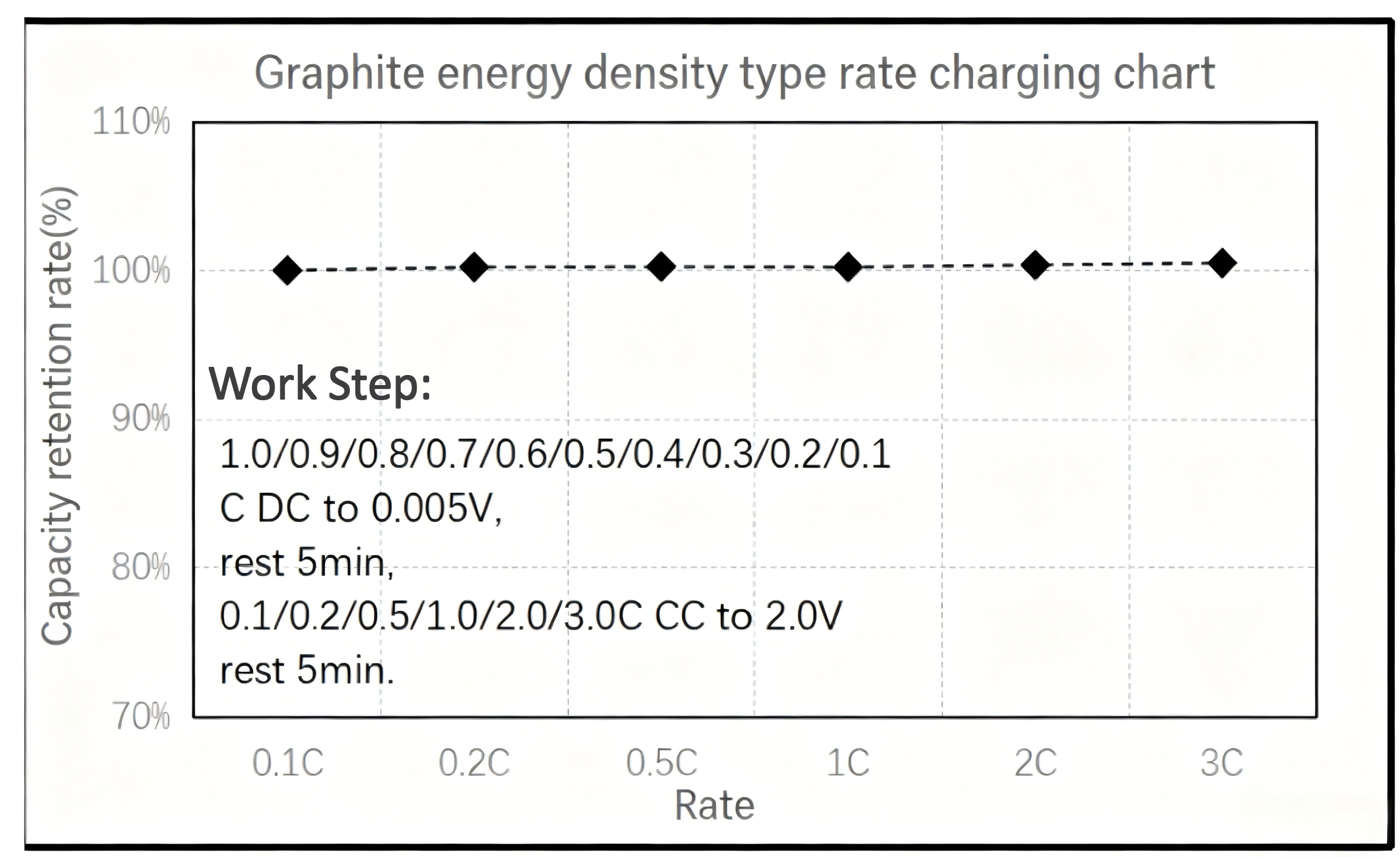
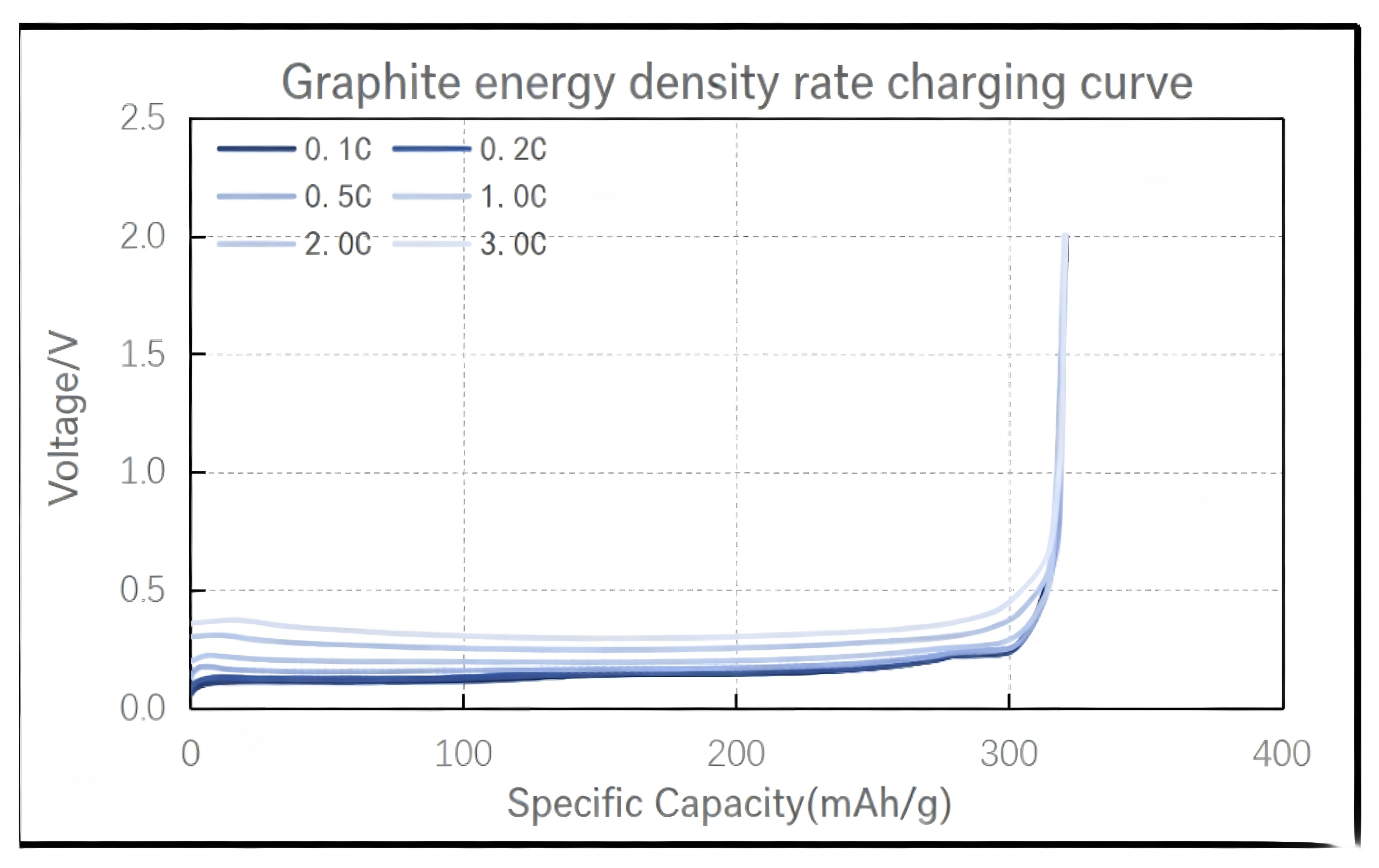
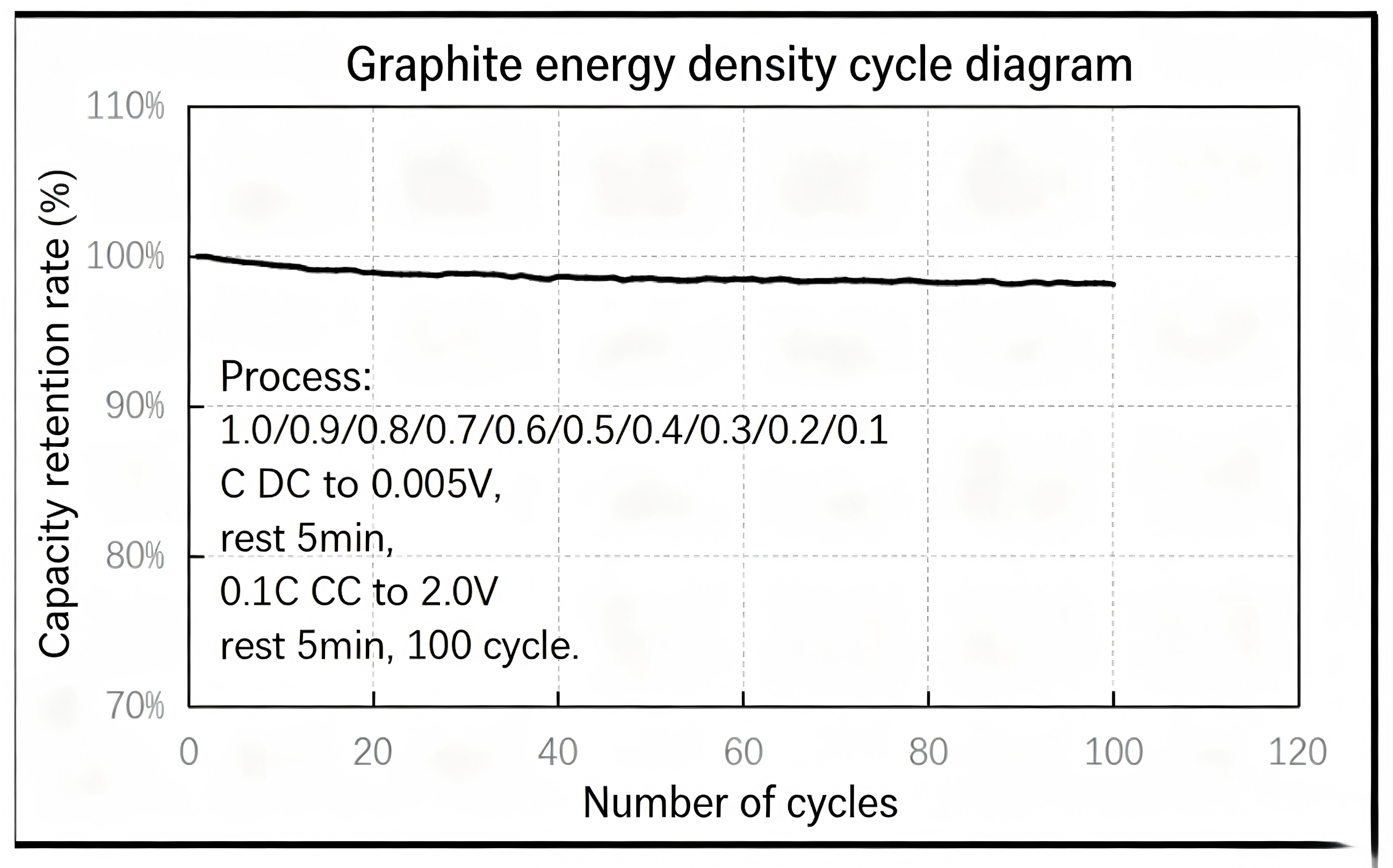
Half battery test:
Overview
Graphite (High Energy Density Type)
Graphite is an allotrope of carbon, closely related to it. Allotropes refer to different structural forms of the same element. Graphite is the most stable form of carbon. (Diamond is a metastable allotrope of carbon, which, although much harder than graphite and the hardest natural material, is less stable than graphite.)
The term "graphite" is derived from the Greek word "graphein." This material is heat-resistant, corrosion-resistant, has excellent electrical conductivity, thermal conductivity, and stable chemical properties, while being lighter than aluminum. In addition to being used as an anode material in lithium-ion batteries, high-quality graphite is also used in fuel cells, solar cells, semiconductors, light-emitting diodes, and nuclear reactors in various fields.
Basic Introduction
The main components of a lithium-ion battery include the cathode, anode, electrolyte, and separator, collectively known as the four major materials of lithium batteries. These materials account for different proportions of the battery cost. The cathode material accounts for about 40%, the electrolyte about 16%, the separator about 21%, and the anode material only about 5%. Therefore, it can be said that the cost of the cathode material directly determines the overall cost of the lithium battery.
Among the four major materials of lithium batteries, the technology for anode materials is relatively mature. Lithium-ion battery anode materials are typically divided into two categories: carbon-based materials and non-carbon-based materials. Among carbon-based materials, there are graphite and amorphous carbon, such as natural graphite, synthetic graphite, mesocarbon microbeads, soft carbon (e.g., coke), and some hard carbon. Non-carbon-based anode materials include nitrides, silicon-based materials, tin-based materials, titanium-based materials, alloy materials, etc.
Types and Classifications
Currently, graphite materials only account for 5% of the global battery demand. There are two main ways to obtain graphite: natural mining and synthetic from coal tar. The graphite used in lithium-ion batteries is typically prepared by mixing 55% synthetic graphite with 45% low-purity natural graphite.
Manufacturers once favored synthetic graphite because its uniformity and purity were superior to natural graphite. However, this has changed, as modern chemical purification methods now allow natural graphite to achieve 99.9% purity through heat treatment, compared to the 99% purity of synthetic graphite. As a result, natural graphite is now more popular. Compared to synthetic graphite, purified natural flake graphite has higher crystallinity, demonstrating better conductivity and thermal conductivity. Moreover, natural graphite is expected to reduce the production cost of lithium-ion batteries while achieving equal or even superior battery performance.
Applications
Anode materials are one of the four key materials in lithium-ion batteries, accounting for about 15% of the total cost of the cell. Currently, anode materials are still dominated by graphite, but the development direction of lithium-ion batteries is towards high capacity, high discharge rate, and high safety. High capacity is mainly achieved by using anode and cathode materials with higher specific capacity. Graphite anode materials are increasingly unable to meet the growing performance requirements of downstream cells, so new types of anodes are needed.
New types of anode materials are constantly emerging, such as lithium titanate, amorphous carbon, silicon-carbon composites, tin-based alloys, metal alloys, and graphene. Each new anode material has its own unique features, and currently, no single material has an absolute advantage. Enterprises and institutions are still conducting research and development on various new materials.
Related Products / Related Materials / Browse Similar Products
Theoretical specific capacity for graphite-based anode materials is 372mAh/g, while high-performance graphite anode materials on the market can reach 360mAh/g, and their specific capacity is approaching the theoretical limit. Although graphite has some disadvantages as an anode material, such as lower specific capacity and cycling instability, it will not be immediately replaced by new materials due to its high cost-performance ratio. First, because the technology for new anode materials is not mature and still requires a long time for performance improvement; second, because new anode materials are more expensive, while graphite anode materials have a clear price advantage; and third, because anode materials need to be used in combination with cathode materials, electrolytes, etc., and currently, the specific capacity of cathode materials is generally low.
Hot Articles / References
In-depth Research Report on Lithium Battery Anode Materials
Overview
Graphite (High Energy Density Type)
Graphite is an allotrope of carbon, closely related to it. Allotropes refer to different structural forms of the same element. Graphite is the most stable form of carbon. (Diamond is a metastable allotrope of carbon, which, although much harder than graphite and the hardest natural material, is less stable than graphite.)
The term "graphite" is derived from the Greek word "graphein." This material is heat-resistant, corrosion-resistant, has excellent electrical conductivity, thermal conductivity, and stable chemical properties, while being lighter than aluminum. In addition to being used as an anode material in lithium-ion batteries, high-quality graphite is also used in fuel cells, solar cells, semiconductors, light-emitting diodes, and nuclear reactors in various fields.
Basic Introduction
The main components of a lithium-ion battery include the cathode, anode, electrolyte, and separator, collectively known as the four major materials of lithium batteries. These materials account for different proportions of the battery cost. The cathode material accounts for about 40%, the electrolyte about 16%, the separator about 21%, and the anode material only about 5%. Therefore, it can be said that the cost of the cathode material directly determines the overall cost of the lithium battery.
Among the four major materials of lithium batteries, the technology for anode materials is relatively mature. Lithium-ion battery anode materials are typically divided into two categories: carbon-based materials and non-carbon-based materials. Among carbon-based materials, there are graphite and amorphous carbon, such as natural graphite, synthetic graphite, mesocarbon microbeads, soft carbon (e.g., coke), and some hard carbon. Non-carbon-based anode materials include nitrides, silicon-based materials, tin-based materials, titanium-based materials, alloy materials, etc.
Types and Classifications
Currently, graphite materials only account for 5% of the global battery demand. There are two main ways to obtain graphite: natural mining and synthetic from coal tar. The graphite used in lithium-ion batteries is typically prepared by mixing 55% synthetic graphite with 45% low-purity natural graphite.
Manufacturers once favored synthetic graphite because its uniformity and purity were superior to natural graphite. However, this has changed, as modern chemical purification methods now allow natural graphite to achieve 99.9% purity through heat treatment, compared to the 99% purity of synthetic graphite. As a result, natural graphite is now more popular. Compared to synthetic graphite, purified natural flake graphite has higher crystallinity, demonstrating better conductivity and thermal conductivity. Moreover, natural graphite is expected to reduce the production cost of lithium-ion batteries while achieving equal or even superior battery performance.
Applications
Anode materials are one of the four key materials in lithium-ion batteries, accounting for about 15% of the total cost of the cell. Currently, anode materials are still dominated by graphite, but the development direction of lithium-ion batteries is towards high capacity, high discharge rate, and high safety. High capacity is mainly achieved by using anode and cathode materials with higher specific capacity. Graphite anode materials are increasingly unable to meet the growing performance requirements of downstream cells, so new types of anodes are needed.
New types of anode materials are constantly emerging, such as lithium titanate, amorphous carbon, silicon-carbon composites, tin-based alloys, metal alloys, and graphene. Each new anode material has its own unique features, and currently, no single material has an absolute advantage. Enterprises and institutions are still conducting research and development on various new materials.
Related Products / Related Materials / Browse Similar Products
Theoretical specific capacity for graphite-based anode materials is 372mAh/g, while high-performance graphite anode materials on the market can reach 360mAh/g, and their specific capacity is approaching the theoretical limit. Although graphite has some disadvantages as an anode material, such as lower specific capacity and cycling instability, it will not be immediately replaced by new materials due to its high cost-performance ratio. First, because the technology for new anode materials is not mature and still requires a long time for performance improvement; second, because new anode materials are more expensive, while graphite anode materials have a clear price advantage; and third, because anode materials need to be used in combination with cathode materials, electrolytes, etc., and currently, the specific capacity of cathode materials is generally low.
Hot Articles / References
In-depth Research Report on Lithium Battery Anode Materials
Overview
Graphite (High Energy Density Type)
Graphite is an allotrope of carbon, closely related to it. Allotropes refer to different structural forms of the same element. Graphite is the most stable form of carbon. (Diamond is a metastable allotrope of carbon, which, although much harder than graphite and the hardest natural material, is less stable than graphite.)
The term "graphite" is derived from the Greek word "graphein." This material is heat-resistant, corrosion-resistant, has excellent electrical conductivity, thermal conductivity, and stable chemical properties, while being lighter than aluminum. In addition to being used as an anode material in lithium-ion batteries, high-quality graphite is also used in fuel cells, solar cells, semiconductors, light-emitting diodes, and nuclear reactors in various fields.
Basic Introduction
The main components of a lithium-ion battery include the cathode, anode, electrolyte, and separator, collectively known as the four major materials of lithium batteries. These materials account for different proportions of the battery cost. The cathode material accounts for about 40%, the electrolyte about 16%, the separator about 21%, and the anode material only about 5%. Therefore, it can be said that the cost of the cathode material directly determines the overall cost of the lithium battery.
Among the four major materials of lithium batteries, the technology for anode materials is relatively mature. Lithium-ion battery anode materials are typically divided into two categories: carbon-based materials and non-carbon-based materials. Among carbon-based materials, there are graphite and amorphous carbon, such as natural graphite, synthetic graphite, mesocarbon microbeads, soft carbon (e.g., coke), and some hard carbon. Non-carbon-based anode materials include nitrides, silicon-based materials, tin-based materials, titanium-based materials, alloy materials, etc.
Types and Classifications
Currently, graphite materials only account for 5% of the global battery demand. There are two main ways to obtain graphite: natural mining and synthetic from coal tar. The graphite used in lithium-ion batteries is typically prepared by mixing 55% synthetic graphite with 45% low-purity natural graphite.
Manufacturers once favored synthetic graphite because its uniformity and purity were superior to natural graphite. However, this has changed, as modern chemical purification methods now allow natural graphite to achieve 99.9% purity through heat treatment, compared to the 99% purity of synthetic graphite. As a result, natural graphite is now more popular. Compared to synthetic graphite, purified natural flake graphite has higher crystallinity, demonstrating better conductivity and thermal conductivity. Moreover, natural graphite is expected to reduce the production cost of lithium-ion batteries while achieving equal or even superior battery performance.
Applications
Anode materials are one of the four key materials in lithium-ion batteries, accounting for about 15% of the total cost of the cell. Currently, anode materials are still dominated by graphite, but the development direction of lithium-ion batteries is towards high capacity, high discharge rate, and high safety. High capacity is mainly achieved by using anode and cathode materials with higher specific capacity. Graphite anode materials are increasingly unable to meet the growing performance requirements of downstream cells, so new types of anodes are needed.
New types of anode materials are constantly emerging, such as lithium titanate, amorphous carbon, silicon-carbon composites, tin-based alloys, metal alloys, and graphene. Each new anode material has its own unique features, and currently, no single material has an absolute advantage. Enterprises and institutions are still conducting research and development on various new materials.
Related Products / Related Materials / Browse Similar Products
Theoretical specific capacity for graphite-based anode materials is 372mAh/g, while high-performance graphite anode materials on the market can reach 360mAh/g, and their specific capacity is approaching the theoretical limit. Although graphite has some disadvantages as an anode material, such as lower specific capacity and cycling instability, it will not be immediately replaced by new materials due to its high cost-performance ratio. First, because the technology for new anode materials is not mature and still requires a long time for performance improvement; second, because new anode materials are more expensive, while graphite anode materials have a clear price advantage; and third, because anode materials need to be used in combination with cathode materials, electrolytes, etc., and currently, the specific capacity of cathode materials is generally low.
Hot Articles / References
In-depth Research Report on Lithium Battery Anode Materials
Need R&D Support?
Browse key product categories and connect battery materials with Canrd's R&D services for testing, fabrication, and project support.
Experimental Materials
CategoryCathode, anode, electrolyte, separator, and other materials for battery research.
Shop cathode, anode & electrolyte materials →Lab Equipment
CategoryBattery lab equipment for pilot lines, fixtures, and testing workflows.
Browse battery lab equipment →Electrodes & Cells
CategoryCustom electrodes, dry cells, and battery cell components for R&D validation.
View custom battery electrodes & cells →Sodium Electrolyte
CategorySodium-ion electrolyte options for sodium battery research and validation.
Shop sodium battery electrolytes →R&D Services
ServiceFull-chain battery R&D services from material evaluation to cell fabrication and failure analysis.
Explore Canrd R&D services →Material Evaluation
ServiceCharacterization, electrochemical testing, and compatibility evaluation for battery materials.
Evaluate your battery materials →Electrode Fabrication
ServiceCustom electrode sheets and rolls based on your target chemistry and process needs.
Request electrode fabrication →Cell Fabrication
ServiceDry cells, assembled cells, and custom-format cell builds for R&D validation.
Build custom research cells →Contact
PageAsk Canrd to match products, materials, and services for your project.
Get product and R&D support →