

 contact@canrd.com

 +86 18928276992

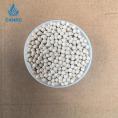
Details
Product Introduction:
The functional differences of 3A, 4A and 5A molecular sieve (zeolite structure) are mainly reflected in the following aspects:
1. Chemical formula and pore size:
3A molecular sieve: chemical formula2/3K2O·1/3Na2O·AI2O3·2SiO2·4.5H2O,The aperture is approximately 0.3nm (3 Å, where 1 Å=0.1nm).
4A molecular sieve: chemical formulaNa2O·Al2O3·2SiO2·4.5H2O,The aperture is approximately 0.4nm.
5A molecular sieve: chemical formula 3/4CaO·1/4Na2O·Al2O3·2SiO2·4.5H2O,The aperture is approximately 0.5-0.57nm.
2. Adsorption capacity:
3A molecular sieve: mainly used for adsorbing water, does not adsorb any molecules with a diameter greater than 0.3nm.
4A molecular sieve: In addition to adsorbing water molecules, it can also adsorb non-ionic surfactants. Its adsorption capacity is very meaningful for adding more surfactants in the production of high concentration laundry detergent through agglomeration molding.
5A molecular sieve: With a larger pore size, it can adsorb not only water and molecules with a diameter less than 0.5nm, but also C3-C4 normal alkanes, chloroethane, bromoethane, butanol, etc.
3. Adsorption capacity:
3A molecular sieve: Due to its small pore size and relatively small adsorption capacity, it is only suitable for low water content scenarios.
4A molecular sieve: With a large adsorption capacity, it is suitable for scenarios with medium water content. Its pore size is slightly larger, which can more effectively adsorb water from the electrolyte.
5A molecular sieve: With a larger adsorption capacity, it is suitable for high water content scenarios. However, in terms of electrolyte dehydration, due to the larger pore size of 5A molecular sieve, it may not be as precise in adsorbing water as 4A molecular sieve.
4. Application characteristics:
3A molecular sieve: Due to its small pore size and strong selectivity, it is suitable for electrolyte systems with extremely low requirements for moisture content.
4A molecular sieve: It is one of the most commonly used molecular sieves for electrolyte water removal. Its pore size is moderate, which can effectively remove moisture from the electrolyte without adsorbing other useful components. In addition, studies have shown that adding 4A molecular sieve to the electrolyte can improve the electrochemical performance of batteries, such as improving the cycling performance of graphite electrodes and reducing impedance.
5A molecular sieve: Although it can also be used for electrolyte dehydration, due to its large pore size, it may not be as precise in adsorbing water as 4A molecular sieve. In addition, 5A molecular sieves are mainly used to adsorb larger molecules such as C3-C4 n-alkanes, and their application in electrolyte dehydration is relatively limited. They are mainly used for gas dehydration.
Summary:
In terms of electrolyte dehydration, 4A molecular sieve has become the most commonly used choice due to its moderate pore size and large adsorption capacity. It can effectively remove moisture from the electrolyte without adsorbing other useful components. In contrast, 3A molecular sieves are suitable for scenarios with extremely low water content requirements, while 5A molecular sieves have relatively fewer applications in electrolyte dehydration.

Instructions for using water removal molecular sieve:
1. The addition amount is generally between 5% and 15% of the solvent's mass, depending on the solvent's moisture content. If the moisture content is high, more should be added, and if the moisture content is low, less should be added;
2. The soaking time should be determined according to the situation. During the soaking process, it is necessary to shake for a period of time to improve the effect. The soaking time for low moisture is about 4-8 hours, and for high moisture, it needs to be soaked for 12-24 hours; After the water removal is completed, it needs to be filtered;
3. If there are high requirements for moisture or moisture cannot be removed, the molecular sieve needs to be replaced to continue removing water. The replacement process does not require filtration;
Usage environment:
1. It can be used in both open environments and glove boxes;
2. To improve the effectiveness of use, it can be vacuum dried at 120 degrees for 5-10 hours;
3. After use in an open environment, seal it properly; When used in a glove box, it is important to note that transferring to the glove box may cause an increase in water and oxygen levels;
matters needing attention:
1. Molecular sieves are often used for removing water from solvents or additives. If added to electrolytes, it may cause metal leaching, and caution should be exercised;
2. Long term immersion of molecular sieves in solvents may lead to solvent decomposition.
هل تحتاج إلى دعم البحث والتطوير؟
تصفح فئات المنتجات الرئيسية واربط مواد البطاريات بخدمات البحث والتطوير من Canrd.
مواد تجريبية
فئةكاثودات وأنودات وإلكتروليتات وفواصل ومواد أخرى لأبحاث البطاريات.
تصفح مواد الكاثود والأنود والإلكتروليت →معدات المختبر
فئةمعدات مختبر البطاريات لخطوط التجربة والتركيبات وسير عمل الاختبار.
تصفح معدات مختبر البطاريات →الأقطاب والخلايا
فئةأقطاب مخصصة وخلايا جافة ومكونات خلايا بطارية للتحقق في البحث والتطوير.
عرض أقطاب وخلايا البطاريات المخصصة →إلكتروليت الصوديوم
فئةخيارات إلكتروليت أيون الصوديوم لأبحاث بطاريات الصوديوم والتحقق منها.
تصفح إلكتروليتات بطاريات الصوديوم →خدمات البحث والتطوير
خدمةخدمات بحث وتطوير كاملة من تقييم المواد إلى تصنيع الخلايا وتحليل الأعطال.
استكشف خدمات البحث والتطوير من Canrd →تقييم المواد
خدمةتوصيف واختبارات كهروكيميائية وتقييم توافق لمواد البطاريات.
قيّم مواد البطارية لديك →تصنيع الأقطاب
خدمةصفائح ولفائف أقطاب مخصصة حسب الكيمياء المستهدفة واحتياجات العملية.
اطلب تصنيع الأقطاب →تصنيع الخلايا
خدمةخلايا جافة وخلايا مجمعة وتنسيقات مخصصة للتحقق في البحث والتطوير.
اصنع خلايا بحثية مخصصة →اتصل بنا
صفحةاطلب من Canrd مطابقة المنتجات والمواد والخدمات مع مشروعك.
احصل على دعم المنتج والبحث والتطوير →
