

 contact@canrd.com
 +86 18928276992
Why Does the Fermi Level Shift? Causes & Battery Applications
Lithium-ion battery performance depends on electrode electronic structure as well as particle morphology, electrode architecture and electrolyte chemistry. The Fermi level describes the electron electrochemical potential at equilibrium and provides a useful framework for understanding carrier occupation, interfacial charge transfer and electrode energetics. Its influence on electrolyte stability must be considered alongside surface chemistry, reaction kinetics and interphase formation.
1. What Is the Fermi Level?
The Fermi level E_F refers to the electron electrochemical potential of a material under thermal equilibrium. The Fermi–Dirac distribution defines electron occupation probability at different energy states:
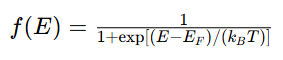
At finite temperature, the occupation probability equals 0.5 at E=E_F. This does not guarantee an allowed electronic state exists at this energy.
Key distinction:
- For metals at 0 K, the Fermi energy corresponds to the highest occupied electronic energy. At finite temperature, electron occupation follows the Fermi–Dirac distribution.
- For semiconductors: Fermi level can sit inside the bandgap, where no available electronic states exist.
Related terms are often mixed up:
- Fermi level: Equivalent electrochemical electron potential
- Work function: Energy needed to extract an electron from Fermi level to vacuum level, Φ=E_vac-E_F
- Band bending: Spatial change of band edge energy near surface/interface
- Quasi-Fermi levels: Separate electron/hole potentials under non-equilibrium conditions such as illumination
2. Core Mechanisms: What Shifts Fermi Level Up or Down
The trends below primarily describe conventional semiconductor behavior. In battery electrodes, dopants may also change transition-metal valence, defect chemistry, localized electronic states and phase stability. Therefore, donor–acceptor terminology and simple band models should be applied according to the material’s electronic structure.
| Mechanism | Fermi Level Trend | Critical Notes |
|---|---|---|
| Donor doping | Shifts up, toward conduction band | Compensation defects and incomplete ionization can reduce carrier concentration |
| Acceptor doping | Shifts down, toward valence band | Doping effect depends on dopant solubility and activation |
| Electrical gating | Surface Fermi level shift, direction determined by voltage polarity | Changes surface carrier density and band-edge positions relative to the contact Fermi level; interpretation depends on device geometry and bias reference |
| Temperature change | Doped semiconductors gradually move toward intrinsic Fermi level | At sufficiently high temperature, when intrinsic carriers dominate, the Fermi level approaches its intrinsic position |
| Interfacial contact & charge transfer | He is a mighty one, and an equal one; he has a band of bendings. | Fermi level pinning, surface dipoles and defects can override ideal predictions |
| Surface adsorption | Can shift up or down | May change carrier populations, surface dipoles and band bending; the observed direction depends on adsorption chemistry and the energy reference |
| Illumination | Creates separate quasi-Fermi levels | Not from a simple single equipment Fermi level shift |
3. Why Fermi Level Shift Matters for Battery Research
3.1 Open-circuit voltage & electrode potential
Battery open-circuit voltage originates from the difference in electron electrochemical potential between anode and cathode.
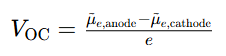
Dry-powder work functions alone cannot predict full-cell voltage. Equilibrium voltage depends on electrode composition, state of charge and the activities of the reacting species, while interfacial kinetics and polarization influence the voltage measured before complete relaxation.
3.2 Electrolyte compatibility and interfacial stability
At a common energy reference, a higher electron electrochemical potential generally increases the thermodynamic driving force for electrolyte reduction, whereas a lower value can favor electrolyte oxidation. However, actual decomposition depends on electrolyte composition, surface chemistry, reaction barriers and the passivating properties of the Solid Electrolyte Interphase (SEI) or Cathode Electrolyte Interphase (CEI).
An upward or downward shift is therefore not inherently beneficial. The target is a suitable electrode potential combined with stable interfaces and acceptable reaction kinetics.
3.3 Evaluate modified battery materials
For doped, coated or carbon-modified electrode powders, always verify whether Fermi level movement delivers practical gains. A measured work function change should be paired with test data: conductivity, reversible capacity, initial Coulombic efficiency, rate performance and long-term cycling stability.
4. Characterization Methods to Detect Fermi Level Shifts
- UPS (Ultraviolet Photoelectron Spectroscopy) Measures occupied valence states and surface work function. Can estimate valence band onset relative to Fermi level. Limitation: Sensitive to surface contamination, sample charging and electrical contact quality.
- XPS (X-ray Photoelectron Spectroscopy) Detects elemental and chemical state changes via core-level peak shifts. Limitation: Core-level binding-energy shifts can reflect changes in chemical state, local electrostatic potential, band bending or charging. A peak shift alone does not establish either the existence or direction of a Fermi level shift. Chemical bonding, band bending and differential charging can produce similar or overlapping peak shifts. Multiple complementary tests are required.
- KPFM (Kelvin Probe Force Microscopy) KPFM maps the contact potential difference between a conductive probe and the sample. Quantitative work-function analysis requires probe calibration and controlled measurement conditions. Measurements on ionic or mixed-conducting battery materials require additional care, particularly under bias. Limitation: Surface layers, trapped charge and test environment heavily affect interpretation for electrochemical samples.
5. Practical R&D Workflow for Battery Material Screening
- Define hypothesis: Compare modified material vs raw control, target conductivity / interface stability / side reaction suppression
- Confirm material consistency: XRD, SEM/EDS, particle size, BET to rule out morphological differences
- Characterize electronic properties: Select UPS, XPS, KPFM or conductivity measurement based on your hypothesis
- Prepare electrodes under matched conditions: Keep mass loading, slurry formula, thickness and processing consistent, and record deviations in porosity and other physical parameters
- Validate electrochemical performance in suitable test cells. Use half-cells for initial material screening, followed by full-cell testing with controlled electrode balancing, electrolyte quantity, formation protocol and operating conditions.
Canrd supports battery material characterization, custom electrode fabrication and cell-level performance evaluation, helping researchers connect material modifications with practical electrochemical results.
FAQ
Q1: Does a higher Fermi level always equal higher conductivity?
A: No. Conductivity depends on both carrier concentration and carrier mobility. Doping may add charge carriers while introducing defects that scatter carriers and reduce mobility. Conductivity must be measured separately.
Q2: Lower work function = n-type bulk doping?
A: No. Surface dipoles or adsorbed contaminants can reduce work function without changing bulk carrier concentration. Combine surface and bulk characterization for confirmation.
Q3: Can I confirm Fermi level shift only by XPS?
A: Usually no. Chemical shift, sample charging and energy referencing artifacts easily mimic Fermi level movement. Use multiple characterization techniques together.
Q4: Which test should I run first?
A: Match measurement to your hypothesis. Use UPS for work function and valence band information, XPS for chemical state analysis, KPFM for local surface potential mapping. Follow surface characterization with controlled electrode and cell testing.
Produtos e servicos relacionados
Use produtos e servicos de I&D da Canrd para transformar conhecimento de baterias em experiencias praticas.
Caixa coin cell
ProdutoCaixas coin cell para validar materiais e conceitos eletroquimicos do artigo.
Usar caixas coin cell no proximo teste →Eletrolito de sodio
CategoriaEletrolitos para investigacao sodium-ion, testes de compatibilidade e validacao de celulas.
Comprar eletrolito de sodio para validacao →Fabricacao de celulas
ServicoObtenha suporte para construir celulas secas, celulas montadas ou formatos personalizados.
Solicitar suporte de fabricacao de celulas →Materiais experimentais
CategoriaExplore materiais para experiencias seguintes, benchmarking e desenvolvimento de produto.
Ver materiais experimentais de bateria →
