

 contact@canrd.com
 +86 18928276992


Details
High voltage lithium nickel manganate, voltage up to 4.8V, high voltage platform
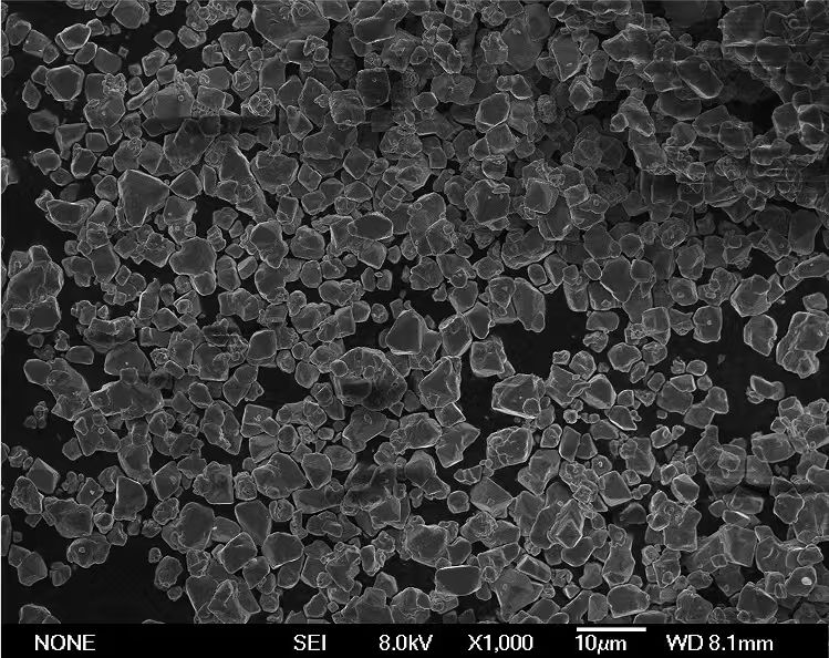
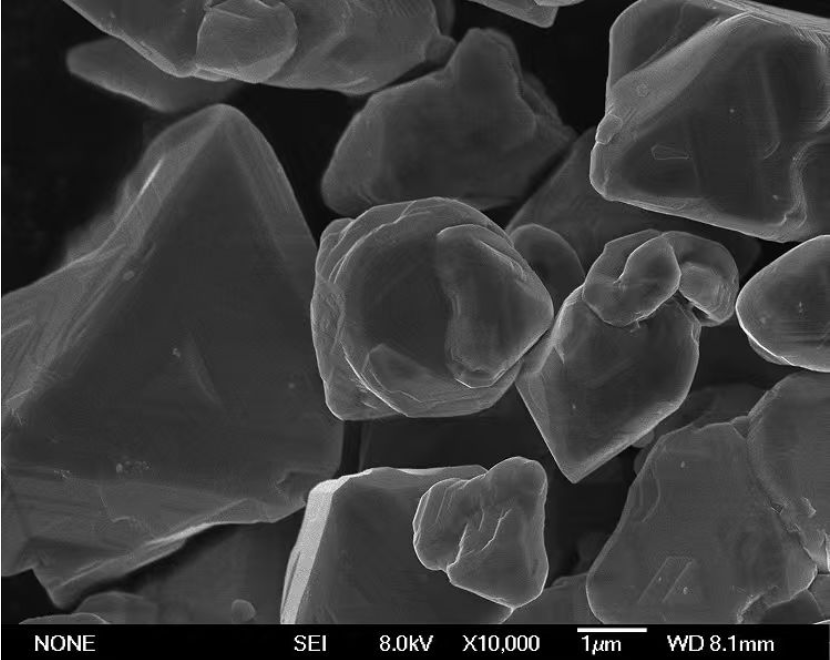
Single crystal, spinel structure
| No. | Test Item | Unit | Specification | Measured Result | Test Method / Instrument | |
|---|---|---|---|---|---|---|
| 1 | Chemical Composition | Li | wt% | 60.0±2.0 | 4.05 | ICP |
| 2 | Ni | wt% | 50.5±2.0 | 15.47 | ||
| 3 | Mn | wt% | 3.2±1.0 | 42.52 | ||
| 4 | Physical Properties | Particle Size Distribution - D10 | μm | ≥2.0 | 3.43 | Laser Particle Size Analyzer |
| 5 | Particle Size Distribution - D50 | μm | 4.0~8.0 | 6.25 | ||
| 6 | Particle Size Distribution - D90 | μm | ≤15.0 | 11.03 | ||
| 7 | BET Specific Surface Area | m²/g | 0.3~0.7 | 0.48 | Fully Automatic Specific Surface Area & Porosity Analyzer | |
| 8 | Electrochemical Performance | Initial Discharge Capacity | mAh/g | ≥125.0 | 131.6 | CR2032, 0.1/0.1C (4.95-3.00V) |
| 9 | Initial Coulombic Efficiency | % | ≥92.0 | 93.1 |
Half-cell test 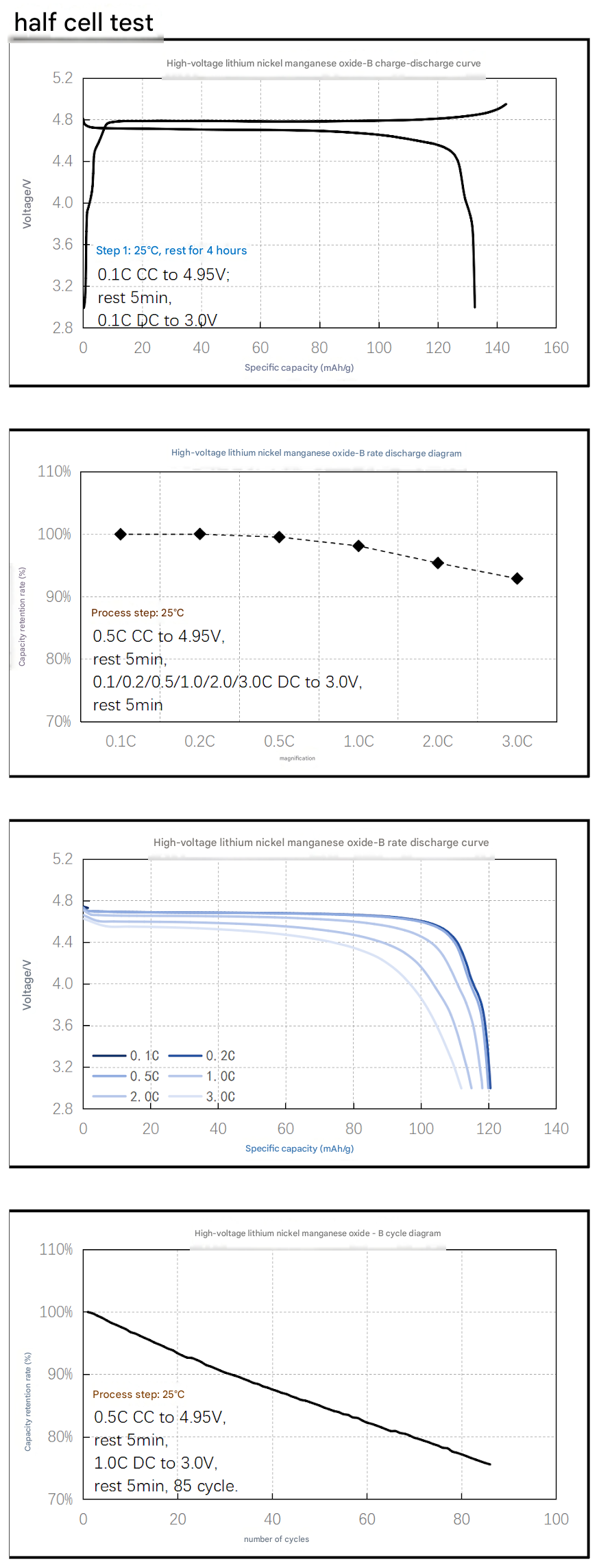
Material specificity, first 5 turns require 0.1C activation
SEM:
Packaging Requirements: Inner plastic bottle sealed; outer layer enclosed in aluminum-plastic film.
Storage Requirements: Keep sealed and store in a cool, dry place.
The material must be stored under vacuum-sealed conditions.
The material is highly hygroscopic; humidity must be strictly controlled throughout the entire electrode fabrication process.
Electrolyte used for testing: Ternary Electrolyte (KLD-1230C).
Electrode Baking Conditions: Bake at 85°C for 4 hours.
Need R&D Support?
Browse key product categories and connect battery materials with Canrd's R&D services for testing, fabrication, and project support.
Experimental Materials
CategoryCathode, anode, electrolyte, separator, and other materials for battery research.
Shop cathode, anode & electrolyte materials →Lab Equipment
CategoryBattery lab equipment for pilot lines, fixtures, and testing workflows.
Browse battery lab equipment →Electrodes & Cells
CategoryCustom electrodes, dry cells, and battery cell components for R&D validation.
View custom battery electrodes & cells →Sodium Electrolyte
CategorySodium-ion electrolyte options for sodium battery research and validation.
Shop sodium battery electrolytes →R&D Services
ServiceFull-chain battery R&D services from material evaluation to cell fabrication and failure analysis.
Explore Canrd R&D services →Material Evaluation
ServiceCharacterization, electrochemical testing, and compatibility evaluation for battery materials.
Evaluate your battery materials →Electrode Fabrication
ServiceCustom electrode sheets and rolls based on your target chemistry and process needs.
Request electrode fabrication →Cell Fabrication
ServiceDry cells, assembled cells, and custom-format cell builds for R&D validation.
Build custom research cells →Contact
PageAsk Canrd to match products, materials, and services for your project.
Get product and R&D support →