

 contact@canrd.com
 +86 18928276992


Details
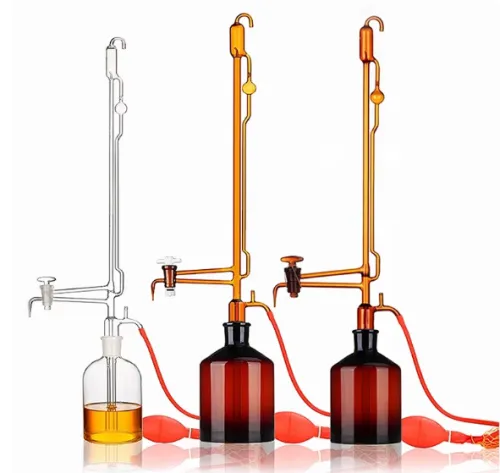
Product Name: Automatic Burette
Material: Borosilicate Glass
Specification: 10 mL ~ 50 mL
Color: Clear, Amber
Features: Heat resistant; good sealing performance
About the Automatic Burette
Also known as an automatic zeroing burette, it uses air pressure to force the titrant from the storage bottle into the burette. When the meniscus reaches the zero mark, the excess liquid automatically flows back to the storage bottle through the overflow port.
Care Instructions
- This is a glass product; handle with care and avoid impact or dropping it.
- Do not place the product near an open flame, as the glass may crack or burst.
- It is recommended to clean it thoroughly with a neutral detergent in warm water.
- Never use steel wool or other abrasive cleaning tools on the glassware.
Operation Steps
- Clean the burette.
- Remove the stopcock and wipe it together with the inner wall of the bushing dry. Apply a thin, even layer of petroleum jelly to both ends of the stopcock, but do not coat the areas directly beside the stopcock bore to avoid blocking it. Reinsert the stopcock and rotate it several times in the same direction until the petroleum jelly spreads evenly and appears transparent; then turn the stopcock to the reflux position.
- Pour the titrant into the storage bottle, making sure the lower end of the burette is immersed in the titrant, and insert the upper assembly of the instrument into the storage bottle.
- Connect the double bulb to the nozzle head. Squeeze the double bulb continuously (about 10–12 times); stop pumping air once the liquid in the side capillary has reached the buffer tube.
- Once the liquid levels in the graduated burette and the side capillary are approximately level, squeeze the double bulb another 1–3 times (2–3 seconds apart; watch that the liquid in the buffer tube does not overflow) until liquid flows out through the overflow port of the graduated burette; then turn the stopcock to the closed position.
- If the liquid level in the buffer tube has risen above the top small opening of the overflow port, tap the automatic stopcock 1–2 times to lower the level below that opening. Zeroing is complete; turn the stopcock to the titration position and begin titration.
- For the next titration and re-zeroing: turn the stopcock to the reflux position; once the levels in both tubes are approximately level, decide how many times to squeeze the double bulb according to the required volume, and repeat steps 5–6.
- After titration is complete, first press the automatic stopcock to fully release the air pressure in the bottle (do not press it all the way down; press to the halfway position, where you can feel the air below pushing up against the stopcock, and hold for 2–3 seconds). Then turn the stopcock to the reflux position so the titrant flows back through branches A and B into the storage bottle. Finally, disassemble the instrument and clean it.

Need R&D Support?
Browse key product categories and connect battery materials with Canrd's R&D services for testing, fabrication, and project support.
Experimental Materials
CategoryCathode, anode, electrolyte, separator, and other materials for battery research.
Shop cathode, anode & electrolyte materials →Lab Equipment
CategoryBattery lab equipment for pilot lines, fixtures, and testing workflows.
Browse battery lab equipment →Electrodes & Cells
CategoryCustom electrodes, dry cells, and battery cell components for R&D validation.
View custom battery electrodes & cells →Sodium Electrolyte
CategorySodium-ion electrolyte options for sodium battery research and validation.
Shop sodium battery electrolytes →R&D Services
ServiceFull-chain battery R&D services from material evaluation to cell fabrication and failure analysis.
Explore Canrd R&D services →Material Evaluation
ServiceCharacterization, electrochemical testing, and compatibility evaluation for battery materials.
Evaluate your battery materials →Electrode Fabrication
ServiceCustom electrode sheets and rolls based on your target chemistry and process needs.
Request electrode fabrication →Cell Fabrication
ServiceDry cells, assembled cells, and custom-format cell builds for R&D validation.
Build custom research cells →Contact
PageAsk Canrd to match products, materials, and services for your project.
Get product and R&D support →
