

 contact@canrd.com
 +86 18928276992
Full PTFE H-type Membrane-Replaceable Photoelectrochemical Cell
Details
Product Description & Recommendations
Model: C032-1
- Working electrodes, counter electrodes and reference electrodes can be matched as required; all matched electrodes must be extended type.
- The cell body is made of polytetrafluoroethylene (PTFE).
- Widely applied to three-electrode systems. Available volumes are 25mL and 40mL; customized volumes are acceptable upon request.
- It adopts a relatively sealed cell structure. The cathode compartment (for working electrode) and anode compartment (for counter electrode) are separated by an ion exchange membrane (to be prepared by users). The two compartments are hermetically connected via piercing bolts for convenient membrane replacement. The reference electrode shares the same compartment with the working electrode to effectively lower IR drop.
- The cell body sealing section adopts a pressing plate structure to realize tight sealing between the lid and cell body.
- Electrode sealing is realized on PTFE stoppers, with sealing screws compressing O-rings to achieve sealing performance.
- Equipped with submerged gas bubbling assemblies. Bubblers of different shapes can be selected according to experimental requirements: straight bubbler for carbon reduction experiments, L-shaped bubbler for nitrogen reduction experiments.
- Optical windows can be additionally installed on the cell.
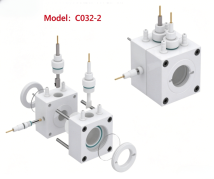
Model: C032-2
- Working electrodes, counter electrodes and reference electrodes can be matched as required; all matched electrodes must be extended type.
- The cell body is made of polytetrafluoroethylene (PTFE).
- Designed for three-electrode systems, with standard volumes ranging from 30mL to 40mL; customized volumes are supported.
- Relatively sealed cell system. The cathode compartment (working electrode side) and anode compartment (counter electrode side) are separated by user-supplied ion exchange membranes. The two compartments are sealed and connected by piercing bolts for easy membrane replacement. The reference electrode is placed in the working electrode compartment to reduce IR drop efficiently.
- The sealing part of the cell body features an internal thread design. Electrode sealing is completed on the PTFE cell body by compressing O-rings with sealing screws.
- Fitted with a submerged gas supply assembly to adjust the atmosphere for different experiments.
- Quartz windows can be quickly disassembled and replaced to fit various experimental demands.
- Diameter of the photoelectrochemical cell optical window: 37 mm
Need R&D Support?
Browse key product categories and connect battery materials with Canrd's R&D services for testing, fabrication, and project support.
Experimental Materials
CategoryCathode, anode, electrolyte, separator, and other materials for battery research.
Shop cathode, anode & electrolyte materials →Lab Equipment
CategoryBattery lab equipment for pilot lines, fixtures, and testing workflows.
Browse battery lab equipment →Electrodes & Cells
CategoryCustom electrodes, dry cells, and battery cell components for R&D validation.
View custom battery electrodes & cells →Sodium Electrolyte
CategorySodium-ion electrolyte options for sodium battery research and validation.
Shop sodium battery electrolytes →R&D Services
ServiceFull-chain battery R&D services from material evaluation to cell fabrication and failure analysis.
Explore Canrd R&D services →Material Evaluation
ServiceCharacterization, electrochemical testing, and compatibility evaluation for battery materials.
Evaluate your battery materials →Electrode Fabrication
ServiceCustom electrode sheets and rolls based on your target chemistry and process needs.
Request electrode fabrication →Cell Fabrication
ServiceDry cells, assembled cells, and custom-format cell builds for R&D validation.
Build custom research cells →Contact
PageAsk Canrd to match products, materials, and services for your project.
Get product and R&D support →