

 contact@canrd.com
 +86 18928276992



Details
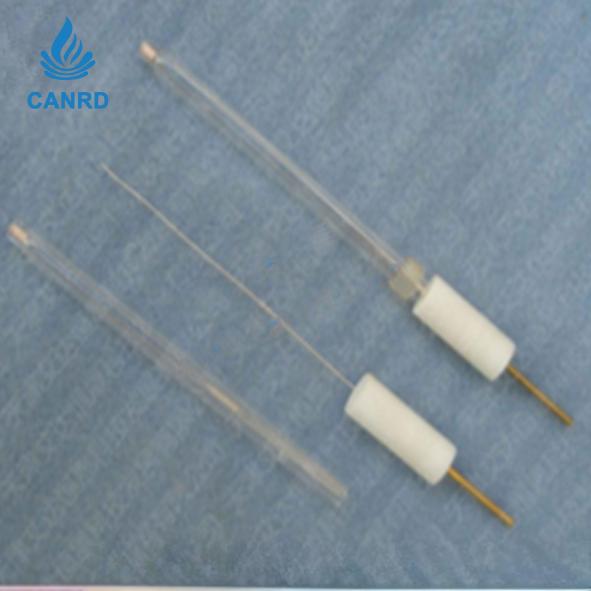
Non-aqueous-mercury-ion electrode【RO201/R0202】
Product dimensions:
【RO201】 Diameter:6mm,Length:120mm
【RO202】 Diameter:4mm,Length:95mm
Product features
Electrolyte inside the salt bridge: If it is to protect the measured solution, the measured solution is placed inside the salt bridge; if it is to stabilize the reference electrode, the solution is placed inside the reference electrode. The salt bridge prevents direct contact between the solution inside the reference electrode and the measured solution.
Product Warranty: The reference electrode is warranted for 2 months, with an average lifespan of 1 year.

Leakage Rate: The bottom of the electrode contains a ceramic sand core, and the solution will slowly seep out at a certain rate. The standard leakage rate is one drop every 10 to 20 minutes. The electrode solution is a few milliliters, and with normal usage and continuous experimentation, it can last approximately one day.
Silver-Chloride Reference Electrode [R0302 Diameter: 4mm]
Product Size:
Approximately 4mm outer diameter of the glass, 6mm outer diameter of the plastic at the top, total length 95mm.
Product Features:
1) Electrode is detachable.
2) Filled with 3.5M potassium chloride solution as the reference solution upon factory delivery (The difference between this electrode and the RO305 Saturated Silver Chloride Reference Electrode lies only in their appearance, the performance is the same).
3) Maximum operating temperature is 60 degrees Celsius.
Product Usage Instructions (Key Points Summarized):
1) Electrode Leakage Rate: The bottom of the electrode contains a ceramic sand core, and the solution will slowly seep out at a certain rate. The standard leakage rate is one drop every 10 to 20 minutes. The electrode solution is a few milliliters, and with normal usage and continuous experimentation, it can last approximately one day.
2) Crystal Formation on Electrode: There might be a small amount of crystallization on the outer wall of the glass tube, and the sealing part is not completely sealed. This is the slow leakage of KCl solution from the glass tube. It can be rinsed with water and does not affect usage.
3) Filling Solution Inside the Salt Bridge: The electrode should not be used to test media that react with the salt bridge solution; a salt bridge must be used between the electrode and the measured solution in such cases. Otherwise, if protecting the measured solution, put the measured solution inside the salt bridge; if protecting the reference electrode to make it more stable, put the solution inside the reference electrode. The salt bridge serves to protect the liquid inside the reference electrode from direct contact with the measured solution.
4) Air Bubbles Inside the Electrode: There should be no air bubbles inside the electrode, as they can block the electron measurement circuit and affect conductivity. If there are air bubbles, gently tap with a finger to make them rise. If they cannot be removed, the electrode liquid should be replaced using a syringe.
5) Replacing Electrode Solution with a Syringe: Slowly remove the white PTFE sleeve and directly inject or exchange the solution. There are small holes on the PTFE sleeve, and if too much solution is injected, some liquid may flow out, which can be wiped away with water.
6) Long-term Storage of the Electrode: When the electrode is not in use for an extended period, replace the KCl solution, seal it, and store it away from light.
7) "Whitening of the Silver Wire": It refers to the detachment of the silver-ammonia coating on the surface of the silver wire. If the electrode potential is accurate, it can still be used even if some detachment occurs.
8) Product Warranty: The reference electrode is warranted for 2 months, with an average lifespan of 1 year.
Ag-AgCl Electrode Standard Electrode Potential (relative to NHE) at Different Temperatures (°C) with 3.5mol/L KCl Solution:
10°C - 0.2152
15°C - 0.2117
20°C - 0.2082
25°C - 0.2046
30°C - 0.2009
35°C - 0.1971
40°C - 0.1933
Note: (1) The potential values of each electrode are relative to the standard hydrogen electrode at 25°C.
(2) The temperature coefficient indicates the change in electrode potential per 1°C change in temperature.
R&D 지원이 필요하신가요?
주요 제품 카테고리를 확인하고 배터리 소재를 Canrd R&D 서비스와 연결하세요.
실험 소재
카테고리배터리 연구용 양극, 음극, 전해액, 분리막 및 기타 소재.
양극, 음극 및 전해액 소재 보기 →실험 장비
카테고리파일럿 라인, 지그 및 테스트 워크플로용 배터리 실험 장비.
배터리 실험 장비 보기 →전극 및 셀
카테고리R&D 검증을 위한 맞춤 전극, 드라이 셀 및 배터리 셀 부품.
맞춤 배터리 전극 및 셀 보기 →나트륨 전해액
카테고리나트륨 배터리 연구 및 검증을 위한 나트륨 이온 전해액 옵션.
나트륨 배터리 전해액 보기 →R&D 서비스
서비스소재 평가부터 셀 제작 및 고장 분석까지 전주기 배터리 R&D 서비스.
Canrd R&D 서비스 살펴보기 →소재 평가
서비스배터리 소재의 특성 분석, 전기화학 테스트 및 호환성 평가.
배터리 소재 평가하기 →전극 제작
서비스목표 화학계와 공정 요구에 맞춘 맞춤 전극 시트 및 롤.
전극 제작 요청하기 →셀 제작
서비스R&D 검증을 위한 드라이 셀, 조립 셀 및 맞춤 셀 형식.
맞춤 연구 셀 제작하기 →문의
페이지Canrd가 프로젝트에 맞는 제품, 소재 및 서비스를 연결해 드립니다.
제품 및 R&D 지원 받기 →
