

 contact@canrd.com
 +86 18928276992

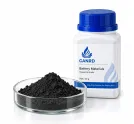


Details
Graphite crystal particle size: 1-2 μm
Characteristics: Microcrystalline graphite itself is formed by the random stacking of micron-sized graphite grains. The particle size distribution of this product is strictly controlled within 1-2 μm, meaning it does not require energy-intensive mechanical grinding and pulverization; its original particle size already meets the "sheet-like" threshold for graphene preparation.
Microstructure: Clusters, formed by the stacking of fine grains.
Application: Graphene precursor (non-anode material).
This product is made from carefully selected high-quality natural microcrystalline graphite minerals and is a high-performance precursor material specifically developed for the preparation of graphene and novel carbon materials. Unlike traditional battery-grade graphite anode materials, this product fully utilizes the inherently small crystallographic characteristics of microcrystalline graphite, aiming to provide a cost-effective and highly efficient raw material option for the large-scale preparation of graphene.
Graphite crystal particle size: 1-2 μm
Characteristics: Microcrystalline graphite itself is formed by the random stacking of micron-sized graphite grains. The particle size distribution of this product is strictly controlled within 1-2 μm, meaning it does not require energy-intensive mechanical grinding and pulverization; its original particle size already meets the "sheet-like" threshold for graphene preparation.
Microstructure: Clusters, formed by the stacking of fine grains.
Application: Graphene precursor (non-anode material).
Core Advantages: Why is it a superior graphene raw material?
High Reactivity and Easy Exfoliation: Microcrystalline graphite consists of extremely fine grains, resulting in a larger specific surface area and more abundant edge and defect sites compared to large-particle flake graphite. This makes it easier for reactants to penetrate and intercalate during chemical oxidation or electrochemical intercalation, leading to higher oxidation and exfoliation efficiency and reducing the cost of graphene preparation.
No Grinding Required, Native Particle Size: Preparing graphene from ordinary flake graphite often requires ultra-fine grinding, which easily introduces impurities and damages the crystal structure. The 1-2μm native particle size of this product directly meets the feed requirements for graphene preparation, maintaining crystal integrity.
Unique Product Characteristics: Graphene prepared from microcrystalline graphite typically has a smaller sheet size (less than 1 micrometer) and more edge active sites. This small-sized graphene has unique application advantages in conductive inks, coatings, high-efficiency adsorbents, and the reinforcement and toughening of composite materials.
Application Guide
| Application Areas | Recommended Directions | Technical Description |
| Graphene Preparation | Oxidation-Reduction Method | Fine particle size facilitates complete oxidation, improving the yield of graphene oxide. |
| Graphene Preparation | Electrochemical Exfoliation Method | The isotropic nature of microcrystals facilitates uniform exfoliation under an electric field. |
| Novel Carbon Materials | Graphene Microsheets, Conductive Additives | Can be used as intermediate products for further processing. |
Special Note
This product is a graphene-specific material and is not recommended for direct use as a negative electrode material in lithium-ion batteries. Although microcrystalline graphite can be used as a negative electrode after modification (such as surface coating, granulation, etc.), the original design logic of this product is to use it as a "raw material" to prepare thinner graphene, not as a "finished product" for lithium intercalation. Its 1-2μm particle size, without secondary granulation modification, may lead to significant irreversible capacity loss and poor cycle stability when used directly as a negative electrode.
R&D 지원이 필요하신가요?
주요 제품 카테고리를 확인하고 배터리 소재를 Canrd R&D 서비스와 연결하세요.
실험 소재
카테고리배터리 연구용 양극, 음극, 전해액, 분리막 및 기타 소재.
양극, 음극 및 전해액 소재 보기 →실험 장비
카테고리파일럿 라인, 지그 및 테스트 워크플로용 배터리 실험 장비.
배터리 실험 장비 보기 →전극 및 셀
카테고리R&D 검증을 위한 맞춤 전극, 드라이 셀 및 배터리 셀 부품.
맞춤 배터리 전극 및 셀 보기 →나트륨 전해액
카테고리나트륨 배터리 연구 및 검증을 위한 나트륨 이온 전해액 옵션.
나트륨 배터리 전해액 보기 →R&D 서비스
서비스소재 평가부터 셀 제작 및 고장 분석까지 전주기 배터리 R&D 서비스.
Canrd R&D 서비스 살펴보기 →소재 평가
서비스배터리 소재의 특성 분석, 전기화학 테스트 및 호환성 평가.
배터리 소재 평가하기 →전극 제작
서비스목표 화학계와 공정 요구에 맞춘 맞춤 전극 시트 및 롤.
전극 제작 요청하기 →셀 제작
서비스R&D 검증을 위한 드라이 셀, 조립 셀 및 맞춤 셀 형식.
맞춤 연구 셀 제작하기 →문의
페이지Canrd가 프로젝트에 맞는 제품, 소재 및 서비스를 연결해 드립니다.
제품 및 R&D 지원 받기 →
