

 contact@canrd.com
 +86 18928276992
Lithium-Ion Battery Self-Discharge: Causes & Testing Guide
Lithium-ion batteries gradually lose charge while sitting under open-circuit conditions. Many battery engineers rely on K-value (voltage drop test) to screen cells with abnormal self-discharge. However, open-circuit voltage decline does not always equal permanent capacity loss. Confusing OCV relaxation with genuine self-discharge often leads to false rejection of qualified cells or missed hidden defects.
This practical guide helps battery R&D and manufacturing teams understand self-discharge mechanisms, master standard K-value testing methods, distinguish reversible voltage relaxation from irreversible capacity loss, and systematically troubleshoot abnormal voltage decay.
What Is Self-Discharge? Self-Discharge vs OCV Relaxation vs Calendar Aging
Self-discharge refers to spontaneous charge loss of lithium cells under open-circuit conditions, with no external load connected. It is an inherent electrochemical phenomenon, but excessive self-discharge signals cell defects and potential safety risks.
Three easily mixed phenomena in cell shelf testing:
| Phenomenon | Core Behavior | Permanent Capacity Loss? |
|---|---|---|
| Self-Discharge | Internal electrochemical or leakage processes consume stored charge during rest | Some charge loss can be recovered; side reactions may also trigger irreversible degradation |
| OCV Relaxation | Voltage shifts as concentration polarization fades after charge/discharge | No |
| Calendar Aging | Usable capacity drops or impedance rises during long storage | Yes |
After charging, cell voltage naturally falls during relaxation; after discharge, voltage may rise. This voltage shift comes from electrochemical equilibrium adjustment, not genuine self-discharge.
OCV and SOC have a nonlinear correlation, especially for LFP cells with flat OCV-SOC curves. A tiny voltage fluctuation does not directly translate to capacity loss. So voltage screening must pair with capacity testing for accurate quantification.
Two metrics commonly used to evaluate self-discharge:
- Charge loss percentage (%)
- Open-circuit voltage drop: mV per day (used for K-value calculation)
Root Mechanisms of Lithium Battery Self-Discharge
Self-discharge occurs when a battery loses stored charge during rest through internal electrochemical or leakage processes. It should be distinguished from OCV relaxation, which can change the measured terminal voltage without an equivalent loss of stored charge.
Some self-discharge-related charge loss can be replenished by recharging, while irreversible degradation mechanisms may reduce the cell's recoverable capacity. These processes can coexist and require controlled testing to distinguish.
- Internal leakage & micro-short risk Metallic contaminants such as Fe, Cu and Ni can increase the risk of internal leakage or short circuits. Depending on particle chemistry, location and electrochemical conditions, contamination may cause mechanical separator damage or electrochemical dissolution and redeposition. Separator damage and electrode cutting burrs are also potential triggers for local leakage.
- Unstable interfacial side reactions SEI film undergoes slow evolution during storage and may consume cyclable lithium. Higher temperature accelerates interfacial reactions and exposes fresh anode surfaces to react with electrolyte. Interfacial stability is a major contributor to storage-related self-discharge.
- Cathode side reactions Surface residual lithium species and transition metal dissolution can trigger parasitic reactions and degrade anode interfacial layers.
- Electrolyte decomposition Slow electrolyte oxidation at high-potential cathode surfaces and reduction at low-potential anode surfaces.
Different electrode material systems show distinct interfacial stability and storage behavior. Self-discharge is jointly affected by anode, electrolyte, temperature, SOC, manufacturing defects and cell design, rather than determined solely by cathode crystal structure.
How to Run K-Value (Voltage Drop) Test
K-value test is the mainstream fast screening method in cell production to identify cells with abnormal self-discharge.
Test Workflow
- Fix consistent pre-test conditions Control cell chemistry, formation records, initial SOC, charge-discharge procedure, stabilization resting time, test temperature and voltage measurement method. Comparing cells under different SOC or temperature will produce misleading data.
- Record initial OCV after stabilization, store cells under controlled environment, recheck OCV at preset intervals.
- K-value calculation formula
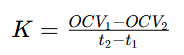
OCV1 = initial open-circuit voltage; OCV2 = later open-circuit voltage; t2 - t1 = test interval. Unit: mV/day. A positive K-value means voltage declines over time.
Note: K-value definition varies between manufacturers. Always specify calculation rules in test reports.
- Benchmark against reference batch Do not use universal fixed thresholds. Set acceptable limits based on cell design, reference batch, test uncertainty and product quality specs.
Important: Abnormal K-value is only a screening warning, not definitive proof of micro-short.
Two Supplementary Self-Discharge Test Methods
- Capacity measurement method (accurate but time-consuming) We separate two key indicators under identical reference test conditions:
Apparent Charge Loss during storage:

Irreversible Capacity Fade:

Where: Qref = baseline capacity before storage Qremaining = discharge capacity measured directly after storage Qrecovered = capacity measured after recharging to defined SOC following the same reference procedure
Charge loss may include measurement artifacts and reversible SOC drift, and cannot be directly interpreted as pure self-discharge. Capacity fade quantifies permanent performance degradation.
- EIS (Electrochemical Impedance Spectroscopy) Electrochemical Impedance Spectroscopy (EIS) can provide supporting information about changes in interfacial resistance, charge-transfer behavior and ion transport. However, impedance changes alone cannot establish the self-discharge rate or identify a specific failure mechanism. EIS results should be interpreted together with OCV monitoring, capacity measurements and other diagnostic evidence.
Key Factors Affecting Self-Discharge Rate
- Temperature Rising temperature usually accelerates some parasitic reactions, but the rate of change depends on the chemical system and test conditions.
- State of Charge (SOC) Higher SOC changes the electrode potentials and may increase parasitic reaction rates.
- Material system Different electrode material combinations show distinct interfacial stability and storage behavior. Self-discharge performance depends on the full cell system, not a single electrode material.
- Manufacturing quality Dry-room cleanliness, moisture control, electrode cutting quality and electrolyte filling directly affect cell consistency and baseline self-discharge.
CANRD Standard Storage Test Framework
These test conditions are reference specs for R&D storage evaluation, not universal pass/fail criteria. The 85°C test is high-temperature exposure requiring dedicated safety assessment, not routine storage testing.
| Storage Temperature | Test Duration | Evaluation Focus |
|---|---|---|
| 25°C | 28 days | Room temp shelf stability, voltage & capacity comparison |
| 45°C | 60 days | Elevated temperature degradation, interface stability |
| 60°C | 7 days | Short-term high-temperature storage performance |
| 85°C | 4–12 hours | Extreme high-temperature exposure with strict safety protocol |
Key data to log during storage test: Pre-storage: reference capacity, initial OCV/SOC, impedance, cell thickness, batch ID During storage: real temperature, periodic OCV reading, swelling/leakage observation Post-storage: residual capacity, recovered capacity, impedance change, physical defects
Troubleshooting High K-value / Abnormal Self-Discharge
Follow this structured investigation sequence when cells show excessive voltage drop:
- Verify measurement: check instrument accuracy, contact resistance, temperature and stabilization time; repeat test if needed.
- Compare with matched reference cells from identical batch, chemistry and SOC.
- Test residual & recovered capacity to separate reversible voltage drift and permanent capacity loss.
- Check AC impedance and physical appearance for swelling or leakage.
- Deep material & structure analysis: magnetic impurity test, trace element analysis, SEM/EDS, separator inspection and post-mortem disassembly.
Common root causes for abnormal self-discharge:
- Metallic foreign contamination (Fe, Cu particles)
- Excess moisture causing electrolyte side reactions
- Mechanical defects: electrode burrs, separator damage, coating unevenness
- Poor SEI formation from improper formation process
Hazards of High Self-Discharge & Control Solutions
Hazards
- Gradual charge depletion during shelf storage
- Consistency failure in battery packs: unbalanced cell voltage reduces pack performance and safety
- Calendar life shortening from consumption of cyclable lithium
- Thermal runaway risk for cells with severe internal micro-shorts
Mitigation Measures
Manufacturing Side
- Strict raw material incoming inspection: magnetic impurity, moisture test
- Optimize formation process to build dense, stable SEI film
- Apply validated K-value screening according to the cell quality-control plan
- Maintain high dry-room cleanliness to avoid metal contamination
Application & Storage Side
- Follow the cell manufacturer’s storage temperature and SOC requirements for long-term storage
- Follow manufacturer-specified storage SOC, inspection and maintenance procedures for idle ESS/EV batteries
- Avoid continuous high-temperature exposure
FAQs
Q: What is the difference between self-discharge and OCV relaxation?
A: OCV relaxation is voltage equilibrium shift without charge loss. Self-discharge means actual stored charge reduces during rest. Controlled timing and capacity testing are required to separate them.
Q: Does high K-value always mean internal micro-short?
A: No. High K-value only shows abnormal voltage decay. It may come from insufficient relaxation, measurement error or interfacial side reactions. Extra diagnosis tests are mandatory.
Q: Can LFP and NCM cells share the same K-value threshold?
A: No. LFP and NCM have different OCV-SOC curves. Set independent screening limits for each cell design.
Q: Can EIS directly measure self-discharge?
A: No. EIS characterizes impedance and interfacial status, it cannot quantify lost charge. Combine EIS with OCV and capacity tests.
Q: Is lower post-storage voltage equal to lower usable capacity?
A: No. Voltage drop may be caused by relaxation or temperature drift. Standard capacity test is required to confirm permanent capacity loss.
Q: Which tests are most useful when investigating abnormal self-discharge?
A: A practical diagnostic program may combine OCV/K-value screening, controlled storage testing, reference capacity measurements, impedance evaluation and material characterization. The exact combination should depend on the observed behavior and the intended failure-analysis objective.
Conclusion
K-value screening is a powerful fast quality tool, but it cannot replace capacity testing and material failure analysis. Engineers must separate normal OCV relaxation, temporary stored-charge loss and irreversible calendar aging.
Controlling self-discharge requires full-process quality management: incoming material characterization, electrode manufacturing contamination control, formation optimization, storage evaluation and systematic failure analysis.
CANRD provides battery material characterization, custom electrode fabrication and prototype pouch/coin cell validation services, helping R&D teams link raw material properties with cell shelf performance and self-discharge diagnosis.
Related Products & Services
Use Canrd products and R&D services to turn battery knowledge into practical experiments.
Coin Cell Case
ProductCoin cell cases for validating materials and electrochemical concepts from the article.
Use coin cell cases in your next test →Sodium Electrolyte
CategoryElectrolytes for sodium-ion battery research, compatibility tests, and cell validation.
Shop sodium electrolyte for validation →Cell Fabrication
ServiceGet support building dry cells, assembled cells, or custom formats for R&D validation.
Request cell fabrication support →Experimental Materials
CategoryBrowse materials for follow-up experiments, benchmarking, and product development.
Browse experimental battery materials →
