

 contact@canrd.com

 +86 18928276992


Details
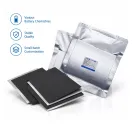
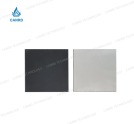
| Canrd | 10*10cm | 5 sheets/pack | Coating | ||||
| NO. | Electrode Name | Model | Main Material | Active Material Capacity (mAh/g) | Loading | Areal Density (mg/cm²) | Areal Capacity (mAh/cm²) |
| 1 | NCA Electrode | SY51 | NCA-S (Nickel Cobalt Aluminum Oxide) | 195 | 94.50% | 17.66 | 3.25 |
| 2 | Ni90 Electrode | SY41 | Ni90 Single Crystal NCM | 195 | 94.50% | 9.50 | 1.75 |
| 3 | NCM811 Electrode | SY33 | NCM811 Single Crystal | 188 | 94.50% | 9.20 | 1.63 |
| 4 | NCM811 Electrode | SY34 | — | 188 | 94.50% | 21.50 | 3.82 |
| 5 | NCM622 Electrode | SY25 | NCM622 Single Crystal-B | 168 | 96.70% | 10.00 | 1.62 |
| 6 | NCM622 Electrode | SY24 | — | 168 | 96.70% | 21.60 | 3.51 |
| 7 | NCM523 Electrode | SY15 | NCM523 | 165 | 94.00% | 19.70 | 3.06 |
| 8 | NCM523 Electrode | SY13 | NCM523 | 165 | 94.00% | 10.50 | 1.63 |
| 9 | LCO Electrode | LC02 | High Voltage Lithium Cobalt Oxide-Z-4.45V | 178 | 96.40% | 10.00 | 1.72 |
| 10 | LRM Electrode | FL01 | Lithium-rich Manganese-based-E | 280 | 95.00% | 5.96 | 1.59 |
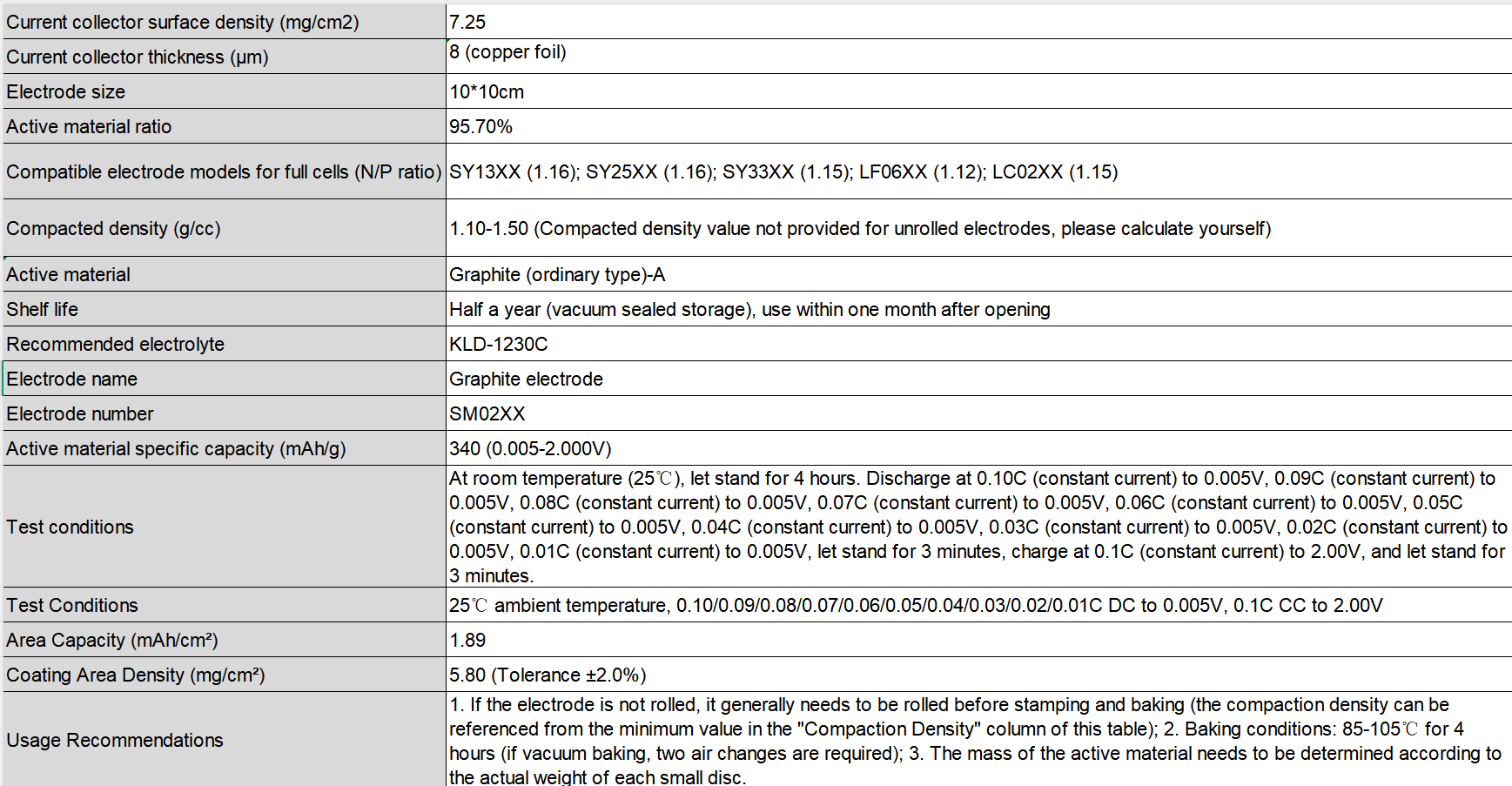
| 11 | Graphite Electrode | SM02 | Natural Graphite (Standard)-A | 340 | 95.70% | 5.80 | 1.89 |
| 12 | Fast Charging Graphite Electrode | SM04 | Fast Charging Graphite-B | 350 | 96.70% | 5.60 | 1.90 |
| 13 | Silicon Carbon Electrode | SC02 | Silicon Carbon Anode 1800 (Porous Carbon Deposited Silicon) | 420 | 95.00% | 4.80 | 1.92 |
| 14 | NFM Electrode | NT02 | Sodium Nickel Iron Manganese Oxide | 127 | 95.50% | 12.27 | 1.49 |
| 15 | NFM Electrode | NT03 | — | 127 | 95.50% | 8.00 | 0.97 |
| 16 | Hard Carbon Electrode | YT02 | Imported Hard Carbon (5 μm) | 300 | 95.50% | 6.00 | 1.72 |
| 17 | LFP Electrode | LF07 | Lithium Iron Phosphate (High Compaction Density) |
150 | 91.50% | 12.30 | 1.69 |
| 18 | LNMO Electrode | NM01 | High Voltage Lithium Nickel Manganese Oxide-B | 130 | 96.00% | 7.50 | 2.00 |
| 19 | NFPP Electrode | NF01 | Sodium Iron Phosphate Pyrophosphate | 100 | 93.50% | 15.30 | 1.43 |
| 20 | Vanadium Pentoxide Electrode | VO02 | Vanadium Pentoxide | 300 | 80.00% | 5.00 | 1.20 |
| 21 | Manganese Dioxide Electrode | MO01 | Manganese-based or Vanadium-based Material | 100 | 80.00% | 5.00 | / |
| 22 | Zinc Negative Electrode | ZA01 | Pure Zinc Powder / Alloy Zinc Powder | / | 70.0%–96.0% | 5.0–15.0 | / |
MOQ for Custom Small Electrode Sheets: 10*10cm/pcs,5cs/pack,1pack
To place an order or request a quotation, please Contact Us.
This product must be tested in accordance with the test methods and electrolytes recommended by
Coulter to achieve the corresponding performance.Since the test method and electrolyte have a great
influence on the performance of the battery, any change in the test method or electrolyte may reduce
the performance of the pole piece; be sure to check this information before purchasing.
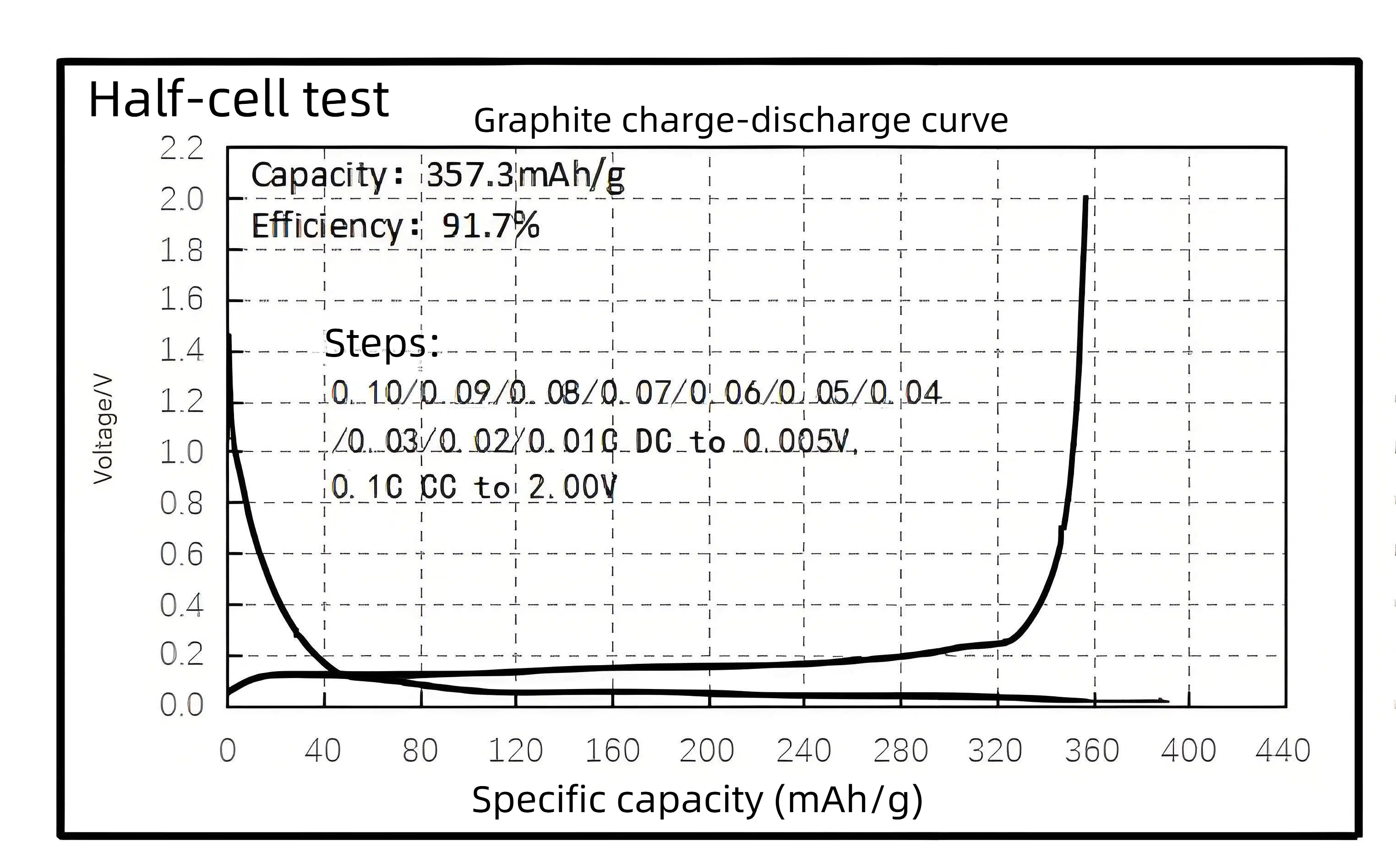
Operating Steps:
At room temperature (25℃), let stand for 4 hours.
Discharge at 0.10C rate (constant current) to 0.005V, then at 0.09C rate (constant current) to 0.005V.
Discharge at 0.08C rate (constant current) to 0.005V, then at 0.07C rate (constant current) to 0.005V.
Discharge at 0.06C rate (constant current) to 0.005V, then at 0.05C rate (constant current)... Discharge to 0.005V at a constant current rate.
Discharge to 0.005V at a constant current rate of 0.04C, and 0.005V at a constant current rate of 0.03C.
Discharge to 0.005V at a constant current rate of 0.02C, and 0.005V at a constant current rate of 0.01C.
Let stand for 3 minutes.
Charge to 2.00V at a constant current rate of 0.1C, and let stand for 3 minutes.
1. Vacuum storage or double-sealed storage in a glove box, especially for high-nickel and sodium cathode materials, can increase battery internal resistance if not properly stored.
2. Electrodes not rolled: Rolling is required according to the recommended compaction density.
3. Coating surface density must be determined based on actual weighing results. Coating surface density does not include the current collector.
4. Actual weighing calculation of active material mass (mg): = (Small disc weight (mg) - Current collector surface density (mg/cm²) * Small disc area (cm²)) * Active material ratio
5. Theoretical active material amount (mg): = Coating surface density (mg/cm²) * Active material ratio * Small disc area (cm²)
6. Theoretical surface capacity (mAh/cm²): = Coating surface density (mg/cm²) * Active material ratio * Specific capacity (mAh/g) ÷ 1000
7. Calculate specific capacity based on the actual weighed amount of active material. Due to tolerances in coating surface density, the actual weighing should be used as the standard.
8. Creases: Single-sided electrode sheets are prone to curling after rolling; flattening and packaging may result in creases.
R&Dサポートが必要ですか?
主要な製品カテゴリを確認し、バッテリー材料をCanrdのR&Dサービスにつなげます。
実験材料
カテゴリバッテリー研究向けの正極、負極、電解液、セパレーターなど。
正極・負極・電解液材料を見る →実験装置
カテゴリパイロットライン、治具、試験ワークフロー向けのバッテリー実験装置。
バッテリー実験装置を見る →電極とセル
カテゴリR&D検証向けのカスタム電極、乾燥セル、セル部材。
カスタムバッテリー電極とセルを見る →ナトリウム電解液
カテゴリナトリウム電池研究と検証向けのナトリウムイオン電解液。
ナトリウム電池電解液を見る →R&Dサービス
サービス材料評価からセル作製、故障解析までの一貫したバッテリーR&Dサービス。
Canrd R&Dサービスを見る →材料評価
サービスバッテリー材料の特性評価、電気化学試験、適合性評価。
バッテリー材料を評価する →電極作製
サービス対象化学系とプロセスに合わせたカスタム電極シートやロール。
電極作製を依頼する →セル作製
サービスR&D検証向けの乾燥セル、組立セル、カスタムセル形式。
カスタム研究セルを作製する →お問い合わせ
ページCanrdが製品、材料、サービスをプロジェクトに合わせて提案します。
製品とR&Dサポートを受ける →
