

 contact@canrd.com
 +86 18928276992

Details
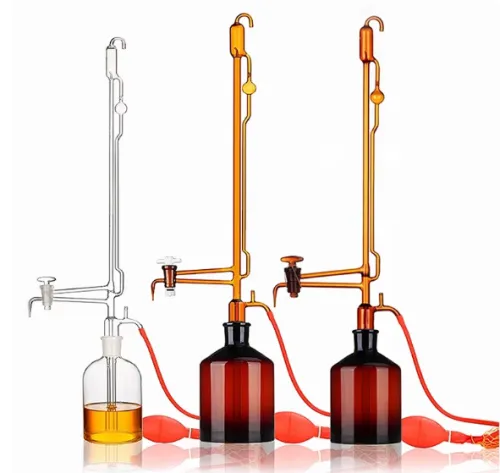
Product Name: Automatic Burette
Material: Borosilicate Glass
Specification: 10 mL ~ 50 mL
Color: Clear, Amber
Features: Heat resistant; good sealing performance
About the Automatic Burette
Also known as an automatic zeroing burette, it uses air pressure to force the titrant from the storage bottle into the burette. When the meniscus reaches the zero mark, the excess liquid automatically flows back to the storage bottle through the overflow port.
Care Instructions
- This is a glass product; handle with care and avoid impact or dropping it.
- Do not place the product near an open flame, as the glass may crack or burst.
- It is recommended to clean it thoroughly with a neutral detergent in warm water.
- Never use steel wool or other abrasive cleaning tools on the glassware.
Operation Steps
- Clean the burette.
- Remove the stopcock and wipe it together with the inner wall of the bushing dry. Apply a thin, even layer of petroleum jelly to both ends of the stopcock, but do not coat the areas directly beside the stopcock bore to avoid blocking it. Reinsert the stopcock and rotate it several times in the same direction until the petroleum jelly spreads evenly and appears transparent; then turn the stopcock to the reflux position.
- Pour the titrant into the storage bottle, making sure the lower end of the burette is immersed in the titrant, and insert the upper assembly of the instrument into the storage bottle.
- Connect the double bulb to the nozzle head. Squeeze the double bulb continuously (about 10–12 times); stop pumping air once the liquid in the side capillary has reached the buffer tube.
- Once the liquid levels in the graduated burette and the side capillary are approximately level, squeeze the double bulb another 1–3 times (2–3 seconds apart; watch that the liquid in the buffer tube does not overflow) until liquid flows out through the overflow port of the graduated burette; then turn the stopcock to the closed position.
- If the liquid level in the buffer tube has risen above the top small opening of the overflow port, tap the automatic stopcock 1–2 times to lower the level below that opening. Zeroing is complete; turn the stopcock to the titration position and begin titration.
- For the next titration and re-zeroing: turn the stopcock to the reflux position; once the levels in both tubes are approximately level, decide how many times to squeeze the double bulb according to the required volume, and repeat steps 5–6.
- After titration is complete, first press the automatic stopcock to fully release the air pressure in the bottle (do not press it all the way down; press to the halfway position, where you can feel the air below pushing up against the stopcock, and hold for 2–3 seconds). Then turn the stopcock to the reflux position so the titrant flows back through branches A and B into the storage bottle. Finally, disassemble the instrument and clean it.

R&Dサポートが必要ですか?
主要な製品カテゴリを確認し、バッテリー材料をCanrdのR&Dサービスにつなげます。
実験材料
カテゴリバッテリー研究向けの正極、負極、電解液、セパレーターなど。
正極・負極・電解液材料を見る →実験装置
カテゴリパイロットライン、治具、試験ワークフロー向けのバッテリー実験装置。
バッテリー実験装置を見る →電極とセル
カテゴリR&D検証向けのカスタム電極、乾燥セル、セル部材。
カスタムバッテリー電極とセルを見る →ナトリウム電解液
カテゴリナトリウム電池研究と検証向けのナトリウムイオン電解液。
ナトリウム電池電解液を見る →R&Dサービス
サービス材料評価からセル作製、故障解析までの一貫したバッテリーR&Dサービス。
Canrd R&Dサービスを見る →材料評価
サービスバッテリー材料の特性評価、電気化学試験、適合性評価。
バッテリー材料を評価する →電極作製
サービス対象化学系とプロセスに合わせたカスタム電極シートやロール。
電極作製を依頼する →セル作製
サービスR&D検証向けの乾燥セル、組立セル、カスタムセル形式。
カスタム研究セルを作製する →お問い合わせ
ページCanrdが製品、材料、サービスをプロジェクトに合わせて提案します。
製品とR&Dサポートを受ける →
