

 contact@canrd.com

 +86 18928276992

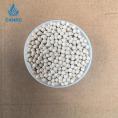
Details
Product Introduction:
The functional differences of 3A, 4A and 5A molecular sieve (zeolite structure) are mainly reflected in the following aspects:
1. Chemical formula and pore size:
3A molecular sieve: chemical formula2/3K2O·1/3Na2O·AI2O3·2SiO2·4.5H2O,The aperture is approximately 0.3nm (3 Å, where 1 Å=0.1nm).
4A molecular sieve: chemical formulaNa2O·Al2O3·2SiO2·4.5H2O,The aperture is approximately 0.4nm.
5A molecular sieve: chemical formula 3/4CaO·1/4Na2O·Al2O3·2SiO2·4.5H2O,The aperture is approximately 0.5-0.57nm.
2. Adsorption capacity:
3A molecular sieve: mainly used for adsorbing water, does not adsorb any molecules with a diameter greater than 0.3nm.
4A molecular sieve: In addition to adsorbing water molecules, it can also adsorb non-ionic surfactants. Its adsorption capacity is very meaningful for adding more surfactants in the production of high concentration laundry detergent through agglomeration molding.
5A molecular sieve: With a larger pore size, it can adsorb not only water and molecules with a diameter less than 0.5nm, but also C3-C4 normal alkanes, chloroethane, bromoethane, butanol, etc.
3. Adsorption capacity:
3A molecular sieve: Due to its small pore size and relatively small adsorption capacity, it is only suitable for low water content scenarios.
4A molecular sieve: With a large adsorption capacity, it is suitable for scenarios with medium water content. Its pore size is slightly larger, which can more effectively adsorb water from the electrolyte.
5A molecular sieve: With a larger adsorption capacity, it is suitable for high water content scenarios. However, in terms of electrolyte dehydration, due to the larger pore size of 5A molecular sieve, it may not be as precise in adsorbing water as 4A molecular sieve.
4. Application characteristics:
3A molecular sieve: Due to its small pore size and strong selectivity, it is suitable for electrolyte systems with extremely low requirements for moisture content.
4A molecular sieve: It is one of the most commonly used molecular sieves for electrolyte water removal. Its pore size is moderate, which can effectively remove moisture from the electrolyte without adsorbing other useful components. In addition, studies have shown that adding 4A molecular sieve to the electrolyte can improve the electrochemical performance of batteries, such as improving the cycling performance of graphite electrodes and reducing impedance.
5A molecular sieve: Although it can also be used for electrolyte dehydration, due to its large pore size, it may not be as precise in adsorbing water as 4A molecular sieve. In addition, 5A molecular sieves are mainly used to adsorb larger molecules such as C3-C4 n-alkanes, and their application in electrolyte dehydration is relatively limited. They are mainly used for gas dehydration.
Summary:
In terms of electrolyte dehydration, 4A molecular sieve has become the most commonly used choice due to its moderate pore size and large adsorption capacity. It can effectively remove moisture from the electrolyte without adsorbing other useful components. In contrast, 3A molecular sieves are suitable for scenarios with extremely low water content requirements, while 5A molecular sieves have relatively fewer applications in electrolyte dehydration.

Instructions for using water removal molecular sieve:
1. The addition amount is generally between 5% and 15% of the solvent's mass, depending on the solvent's moisture content. If the moisture content is high, more should be added, and if the moisture content is low, less should be added;
2. The soaking time should be determined according to the situation. During the soaking process, it is necessary to shake for a period of time to improve the effect. The soaking time for low moisture is about 4-8 hours, and for high moisture, it needs to be soaked for 12-24 hours; After the water removal is completed, it needs to be filtered;
3. If there are high requirements for moisture or moisture cannot be removed, the molecular sieve needs to be replaced to continue removing water. The replacement process does not require filtration;
Usage environment:
1. It can be used in both open environments and glove boxes;
2. To improve the effectiveness of use, it can be vacuum dried at 120 degrees for 5-10 hours;
3. After use in an open environment, seal it properly; When used in a glove box, it is important to note that transferring to the glove box may cause an increase in water and oxygen levels;
matters needing attention:
1. Molecular sieves are often used for removing water from solvents or additives. If added to electrolytes, it may cause metal leaching, and caution should be exercised;
2. Long term immersion of molecular sieves in solvents may lead to solvent decomposition.
R&Dサポートが必要ですか?
主要な製品カテゴリを確認し、バッテリー材料をCanrdのR&Dサービスにつなげます。
実験材料
カテゴリバッテリー研究向けの正極、負極、電解液、セパレーターなど。
正極・負極・電解液材料を見る →実験装置
カテゴリパイロットライン、治具、試験ワークフロー向けのバッテリー実験装置。
バッテリー実験装置を見る →電極とセル
カテゴリR&D検証向けのカスタム電極、乾燥セル、セル部材。
カスタムバッテリー電極とセルを見る →ナトリウム電解液
カテゴリナトリウム電池研究と検証向けのナトリウムイオン電解液。
ナトリウム電池電解液を見る →R&Dサービス
サービス材料評価からセル作製、故障解析までの一貫したバッテリーR&Dサービス。
Canrd R&Dサービスを見る →材料評価
サービスバッテリー材料の特性評価、電気化学試験、適合性評価。
バッテリー材料を評価する →電極作製
サービス対象化学系とプロセスに合わせたカスタム電極シートやロール。
電極作製を依頼する →セル作製
サービスR&D検証向けの乾燥セル、組立セル、カスタムセル形式。
カスタム研究セルを作製する →お問い合わせ
ページCanrdが製品、材料、サービスをプロジェクトに合わせて提案します。
製品とR&Dサポートを受ける →
