The formation of inactive lithium (Li) in lithium metal batteries (LMBs) mainly originates from the undesirable components of the solid electrolyte interface (SEI) and the growth of lithium dendrites.
Lithium nitrite (
LiNO₃) as an electrolyte additive has shown great potential to alleviate interfacial instability and lithium dendrite growth by in situ constructing a nitride-rich SEI.
However, the limited solubility of LiNO₃ in carbonate electrolytes (~0.01 mg mL⁻¹) restricts its practical application.
Recently, Chen Gen from Central South University, Renzhi Ma from the National Institute for Materials Science in Japan, and Liu Xiaohe from Zhengzhou University proposed a bifunctional I⁻-MgAl layered double hydroxide (LDH) for synergistic dissolution of LiNO₃ and recovery of inactive lithium.
The anion exchange capacity of LDH promotes the replacement of I⁻ with NO₃⁻ to form NO₃⁻-MgAl LDH, while generating I₃⁻/I⁻ redox media in the electrolyte.
This replacement not only achieves the dissolution of LiNO₃, optimizes SEI components as a sustainable nitrogen source, but also enables the extracted I₃⁻/I⁻ redox pair to react spontaneously with inactive lithium, significantly improving the Coulombic efficiency.
Therefore, the designed electrolyte significantly extends the service life of Li||
LiFePO₄, Li||NCM, and Li@Cu||LiFePO₄ batteries.
The unique structure of LDH can precisely control the storage and release of NO₃⁻ and I⁻, providing a revolutionary electrolyte design framework for next-generation batteries, achieving multifunctional integration by integrating the properties of two-dimensional materials with electrochemical mechanisms.
This result was published in the journal "Science Bulletin" under the title "Storage and release of NO₃⁻ and I⁻ via layered double hydroxide in carbonate electrolyte for stable lithium metal battery", with Wang Fenglin and Zheng Zhicheng as the first authors.
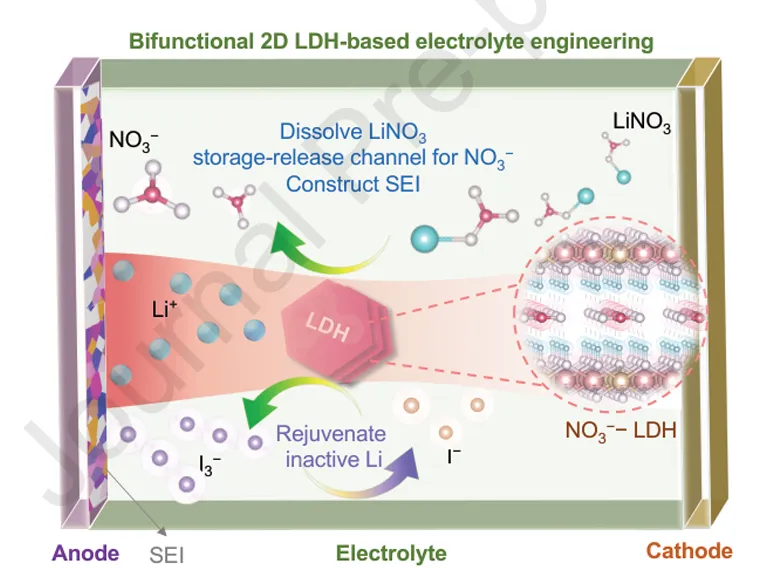
Key Points
Here, we utilize the anion exchange capacity of two-dimensional layered double hydroxide (LDH) to achieve the dissolution of LiNO₃ in the electrolyte and the recovery of inactive lithium (including dead lithium and undesirable components in SEI) through synergistic effects.
1. Anion Exchange and LiNO₃ Dissolution
By introducing I⁻-MgAl LDH into carbonate electrolyte, I⁻ is replaced by NO₃⁻ by utilizing the anion exchange property of LDH to form NO₃⁻-MgAl LDH.
This process not only realizes the dissolution of LiNO₃ in carbonate electrolyte, but also enables NO₃⁻ to serve as a sustainable nitrogen source and optimize the components of SEI.
The replaced I⁻ further generates I₃⁻/I⁻ redox pair in the electrolyte.
2. Formation and Function of I₃⁻/I⁻ Redox Pair
The I₃⁻/I⁻ redox pair generated by the replacement reaction is spontaneously reactive in the electrolyte.
I₃⁻ can react with Li₂O and dead lithium in the SEI, converting them into soluble
LiI and IO₃⁻ (reaction equation: 3Li₂O + 3I₃⁻ → 6Li⁺ + IO₃⁻ + 8I⁻).
At the same time, I₃⁻ can convert dead lithium fragments into LiI (reaction formula: 2Li I₃⁻ = 2Li⁺ 3I⁻), thereby realizing the chemical conversion and reuse of dead lithium.
3. LiI Re-embedding and SEI Optimization
The generated LiI acts as a medium for active lithium ions (Li⁺) and iodide ions (I⁻), and can react with delithiated cathode materials (such as LiFePO₄) during charging.
This reaction regenerates I₃⁻ and reinsert Li⁺ into the cathode material, thereby restoring the electrochemical activity of inactive lithium (for example: 2Li⁺ 3I⁻ 2FePO₄ = 2LiFePO₄ I₃⁻).
This process not only reduces irreversible capacity loss, but also significantly improves the cycle stability of the battery.
4. Sustained Release of NO₃⁻ and SEI Construction
NO₃⁻-MgAl LDH can continuously release NO₃⁻ in the electrolyte to form a
Li₃N-rich SEI.
Li₃N has high ionic conductivity and excellent electrochemical stability, which can reduce the desolvation energy of Li⁺, optimize the ion diffusion energy barrier and mechanical strength.
These properties effectively inhibit the growth of lithium dendrites and improve the stability of lithium metal anode.
5. Synergistic Effect and Improved Electrochemical Performance
Through the anion exchange capacity of LDH, the synergistic effect of NO₃⁻ and I₃⁻/I⁻ is achieved.
On the one hand, NO₃⁻ optimizes the interfacial stability of the lithium metal surface by constructing a Li₃N-rich SEI; on the other hand, the I₃⁻/I⁻ redox pair recovers inactive lithium through chemical conversion.
This synergistic mechanism significantly improves the Coulombic efficiency of lithium metal batteries (up to 97.9%) and achieves a capacity retention rate of 85% after 300 cycles in Li||LiFePO₄ batteries, while also showing excellent cycle stability in Li||
NCM523 batteries.

Figure 1: Schematic diagram of MgAl layered double hydroxide (LDH) structure and electrolyte design principle.
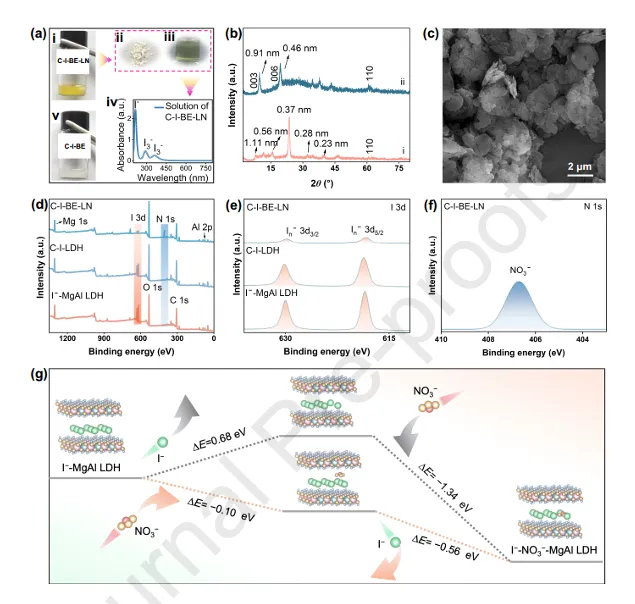
Figure 2: Schematic diagram and analysis of LiNO₃ dissolution in MgAl LDH via anion exchange of I⁻ with NO₃⁻.
(a) Digital photos: (i) CI-BE-LN electrolyte; (ii) CI-BE-LN solid powder after filtration and washing with
DMC; (iii) CI-BE-LN separation solution after filtration; (iv) UV-visible spectrum of the separation solution; (v) CI-BE electrolyte.
(b) X-ray diffraction (XRD) patterns of CI-BE and CI-BE-LN powders.
(c) Scanning electron microscopy (SEM) image of CI-BE-LN powder.
(d) Full X-ray photoelectron spectroscopy (XPS) spectra of I⁻-MgAl LDH, CI-LDH, and CI-BE-LN.
(e) The 3D spectrum.
(f) N 1s spectrum.
(g) Two possible pathways of anion exchange between I⁻-MgAl LDH and NO₃⁻ in electrolyte predicted by density functional theory (DFT) calculations.

Figure 3: Mechanism of recovery of inactive lithium.
(a) UV-visible spectra of CI-BE-LN electrolyte, cycled lithium immersed in CI-BE-LN, and FePO₄ after being immersed in CI-BE-LN.
(b) XRD patterns of cycled lithium before and after immersion in CI-BE-LN and subsequently after immersion in FePO₄.
(c) XRD patterns of FePO₄ and its immersion in CI-BE-LN.
(d) Energy change (ΔE) of the reaction of I₃⁻ with Li₂O in SEI and dead lithium metal.
(e) Energy change (ΔE) of the I₃⁻/I⁻ redox couple to recover inactive lithium.
(f) Schematic diagram of adding I⁻-MgAl LDH to carbonate electrolyte to dissolve LiNO₃ and activate inactive lithium.

Figure 4:
Symmetric Cells
(a) Coulombic efficiency (CE) of Li||Cu asymmetric cells with different electrolytes at a capacity of 1.0 mAh cm⁻² at 0.5 mA cm⁻². Inset is the voltage-capacity curve of lithium deposited on
copper foil at 0.5 mA cm⁻².
(b) Constant-current cycling performance of the Li||Li symmetric cell with a capacity of 1.0 mAh cm⁻² at 0.5 mA cm⁻².
(c) Li plating/de-lithiation voltage curves of Li||Li battery at different current density and areal capacity.
(d) Cyclic voltammetry (CV) curves of the Li||Cu battery at a scan rate of 1 mV s⁻¹.
(e) Electrochemical impedance spectroscopy (EIS) of the Li||Cu battery after 12 cycles.
(f) Comparison of ionic conductivity and lithium ion transference number of different electrolytes.
(g), (h) Activation energies of Rint and Rct obtained from the Nyquist plot.
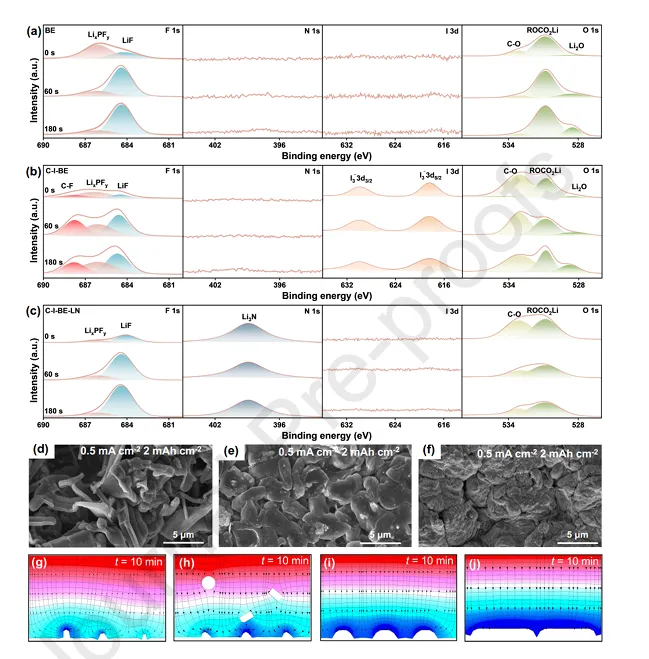
Figure 5: Characterization of Li₃N-enhanced SEI.
(a) Deep XPS spectra of the lithium metal surface after 12 cycles in BE, (b) CI-BE, and (c) CI-BE-LN electrolytes.
(d) SEM images of lithium deposition using BE, (e) CI-BE, and (f) CI-BE-LN electrolytes.
(g) Snapshot of COMSOL simulation of lithium deposition using BE electrolyte.
(h) Snapshot of lithium deposition simulation when dead lithium is present in SEI.
(i) Snapshot of COMSOL simulation of lithium deposition using CI-BE electrolyte.
(j) Snapshot of COMSOL simulation of lithium deposition using CI-BE-LN electrolyte.
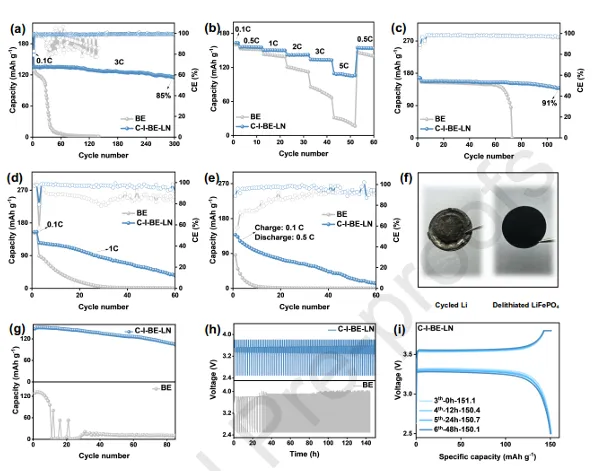
Figure 6: Electrochemical performance.
(a) Cycling performance of Li||LiFePO₄ batteries with different electrolytes at 3 C.
(b) Rate performance of Li||LiFePO₄ battery at a step rate from 0.5 to 5 C.
(c) Cycling performance of Li||NCM523 battery at 0.5 C.
(d) Cycling performance of Li@Cu||LiFePO₄ battery with limited lithium capacity of 2.0 mAh cm⁻² (N/P = 2).
(e) Cycling performance of Cu||LiFePO₄ battery at 0.1 C charge and 0.5 C discharge.
(f) Digital images of LiFePO₄ in cycled and delithiated states.
(g) Cycling performance of batteries assembled using cycled lithium and delithiated LiFePO₄ at 1 C.
(h) The corresponding charge-discharge curves of the cyclic Li||delithiation state LiFePO₄ battery.
(i) Discharge and charge curves of Li||LiFePO₄ cells after standing for 12, 24, and 48 h.
Conclusion
In this study, two-dimensional calcined I⁻-MgAl layered double hydroxide (LDH) was used to regulate NO₃⁻/I⁻ dynamics in carbonate electrolytes through its tunable anion exchange capacity, thereby promoting the dissolution of LiNO₃ and recovering inactive lithium.
Combining experimental and theoretical analysis, LDH played a key role in the storage and sustained release of NO₃⁻, constructing a Li₃N-rich SEI to inhibit lithium dendrite growth.
At the same time, the I₃⁻/I⁻ redox pair was able to chemically transform pre-existing lithium dendrites and derived dead lithium into electroactive species.
The proposed strategy of using CI-LDH and LiNO₃ as electrolyte additives significantly improved the lithium ion transport kinetics and optimized the lithium deposition morphology.
As a result, we finally achieved a significant improvement in the lithium ion stripping/deposition Coulombic efficiency of up to 97.9% in Li||Cu batteries, as well as an excellent performance of 85% capacity retention after 300 cycles at 3C for Li||lithium iron phosphate (Li||LiFePO₄) and 91% capacity retention after 110 cycles at 0.5C for Li||ternary cathode (Li||NCM523).
This strategy provides a transformative framework for designing electrolyte additives based on unique two-dimensional nanomaterials, providing diverse insights for the optimization of next-generation batteries.
Frequently Asked Questions (FAQ)
Q1: Why is LiNO₃ hardly soluble in traditional carbonate electrolytes, and how does LDH solve this problem?
A1: Traditional carbonate electrolytes have limited solvation capacity for LiNO₃, resulting in a solubility of only ~0.01 mg mL⁻¹. The bifunctional I⁻-MgAl LDH utilizes its anion exchange capacity to replace I⁻ with NO₃⁻, forming NO₃⁻-MgAl LDH and promoting the dissolution of LiNO₃, which solves the solubility limitation.
Q2: What is the unique advantage of the I₃⁻/I⁻ redox pair in recovering inactive lithium compared to other methods?
A2: Unlike physical methods that only remove dead lithium, the I₃⁻/I⁻ redox pair can chemically convert inactive lithium (including Li₂O in SEI and dead lithium fragments) into soluble LiI, which can be further reused to restore electrochemical activity, realizing efficient recovery rather than simple removal.
Q3: How does the Li₃N-rich SEI constructed by NO₃⁻ improve the stability of lithium metal anodes?
A3: Li₃N has high ionic conductivity and excellent electrochemical stability. It reduces the desolvation energy of Li⁺, optimizes the ion diffusion energy barrier and mechanical strength, thereby inhibiting lithium dendrite growth and reducing SEI cracking and electrolyte decomposition.
Q4: What makes the LDH-based electrolyte strategy different from other electrolyte additive designs in Synthesis articles?
A4: This strategy focuses on the synergistic effect of LDH’s anion exchange capacity with NO₃⁻/I⁻, realizing both LiNO₃ dissolution and inactive lithium recovery. Unlike other additive designs that only optimize SEI or inhibit dendrites, it integrates two-dimensional material properties with electrochemical mechanisms, with unique focuses on LDH-regulated anion dynamics and inactive lithium reuse.
Q5: Can this electrolyte strategy be applied to commercial lithium metal batteries, and what are the key challenges?
A5: It has great application potential—this study has achieved excellent performance in Li||LiFePO₄ and Li||NCM523 batteries, which are common commercial battery systems. The key challenges lie in the large-scale synthesis of I⁻-MgAl LDH with stable anion exchange capacity and reducing the cost of electrolyte preparation.
-End-
Canrd Brief Introduce
Canrd use high battery R&D technology(core members are from CATL) and strong Chinese supply chain to help many foreign companies with fast R&D. We provide lab materials,electrodes, custom dry cells, material evaluation, perfomance and test, coin/pouch/cylindrical cell equipment line, and other R&D services.
Email:janice@canrd.com
Phone/Wechat/WhatsApp/Skype: 86 18928276992
Website : www.canrud.com