

 contact@canrd.com
 +86 18928276992
 Home/Resources/Knowledge/Battery Process/Cp vs Cpk vs Ppk: What Is the Difference in Battery Manufacturing SPC?
Cp vs Cpk vs Ppk: What Is the Difference in Battery Manufacturing SPC?
Canrd August 15, 2026 164
1. Introduction: Why SPC & MSE Are Indispensable for Lithium Battery Mass Production
Lithium-ion pouch cell manufacturing consists of dozens of linked core processes: cathode/anode slurry mixing, coating, rolling, slitting, tab welding, winding, X-ray inspection, aluminum plastic shell forming, liquid injection, formation, secondary sealing and capacity grading. Even tiny variation in upstream procedures will trigger severe downstream defects:
- Unstable PVDF/CMC-SBR slurry viscosity causes electrode coating pinholes, white spots or powder shedding
- Coating weight drift leads to inconsistent cell capacity and poor cycle life
- Uncontrolled winding overhang results in internal short-circuit risks
- Unreliable measurement gages make Cpk/Ppk data invalid for PPAP submission
Many battery quality engineers only calculate capability indices (Cp/Cpk/Ppk/Cmk) mechanically, ignoring two core premises: stable process confirmed via control charts and qualified measurement system verified by MSE (MSA). Without these two prerequisites, all capability values lose reference value.
This guide is built on Canrd’s real 2Ah LFP-graphite pouch cell CQP (Control Quality Plan), integrating on-site workshop equipment data, electrode adhesive system parameters, and full-process manufacturing flow. It systematically distinguishes 6 core quality indices, matches Xbar-R/I-MR charts to each battery process, and provides actionable variation reduction solutions for slurry mixing, electrode fabrication and cell assembly teams.
2. Core Definition & Classification: Cp/Cpk/Pp/Ppk/Cmk/Cgk with Battery Workshop Scenarios
We split the six indices into three independent evaluation systems, with clear battery manufacturing application scenarios:
| Index | Evaluation Object | Variation Calculation Scope | Typical Battery Production Usage |
|---|---|---|---|
| Cp | Stable process theoretical potential capability | Within-subgroup short-term variation (single shift, single machine, single material batch) | Cathode/anode coating weight short-term capability test during APQP trial production |
| Cpk | Stable process actual capability (includes center offset) | Within-subgroup short-term variation | Core index required by EV customers for PPAP documents; slurry solid content capability analysis |
| Pp | Overall long-term process theoretical performance | Total variation (cross-shift, different raw material lots, equipment aging, operator differences) | Long-term mass production monthly process performance audit |
| Ppk | Overall long-term actual process performance (includes center offset) | Total full-process variation | Final cell thickness, sealing thickness annual capability report |
| Cmk | Single independent machine short-term capability | Isolated machine variation (eliminate operator/material interference) | Acceptance test of new vacuum planetary mixer, coating machine, roll press after overhaul |
| Cgk | Single inspection gage measurement capability | Gage bias repeatability & reproducibility variation | Qualification of viscosity tester, X-ray overhang detector, tab pull force tester |
Key One-Sentence Distinction
- Cp/Cpk/Pp/Ppk = Evaluate theentire end-to-end battery production process (covers all 5M1E factors: Man, Machine, Material, Method, Environment)
- Cmk = Evaluate only a single production equipment, exclude all external interference factors
- Cgk = Evaluate only inspection & testing gages, independent of manufacturing process variation
Critical Misconception Reminder
Many factories misuse single machine Cmk data as full-process Cpk for PPAP submission, which will be rejected by automotive and energy storage customers. Machine capability only reflects equipment precision, while full-process capability covers all production links from raw material mixing to finished cell testing.
3. In-Depth Calculation Logic: Short-Term vs Total Process Variation
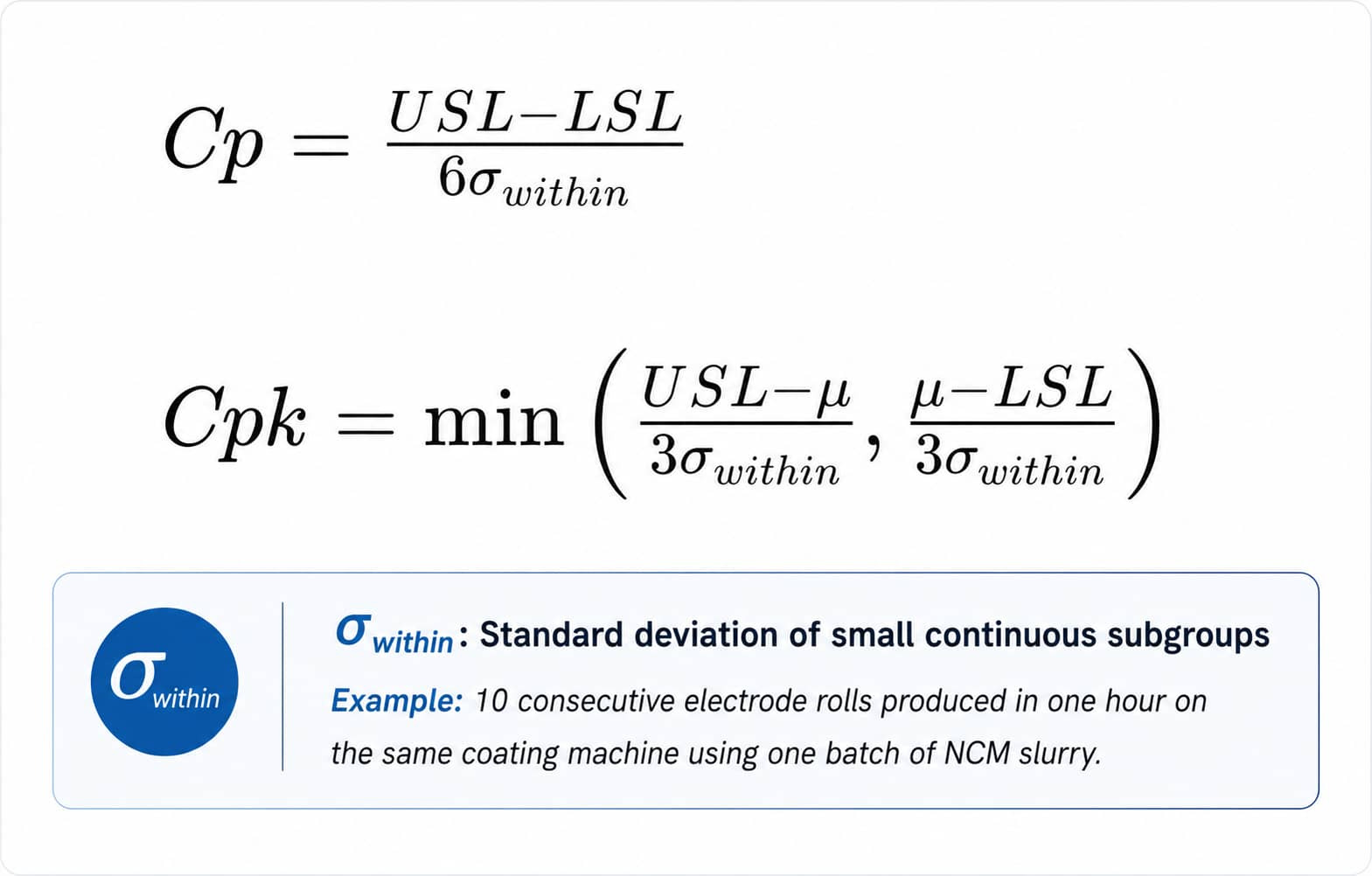
3.1 Cp & Cpk (Short-Term Within-Subgroup Variation)
Formula:
- Core feature: Ignore cross-group variation (different shifts, raw material batches)
- Battery Case: If cathode single-side coating weight spec = 14.7~15.3 mg/cm², short-term Cp=1.75 but Cpk=1.32, this indicates the coating process spread is narrow enough, yet the coating gap drifts upward to approach USL, requiring coating machine calibration.
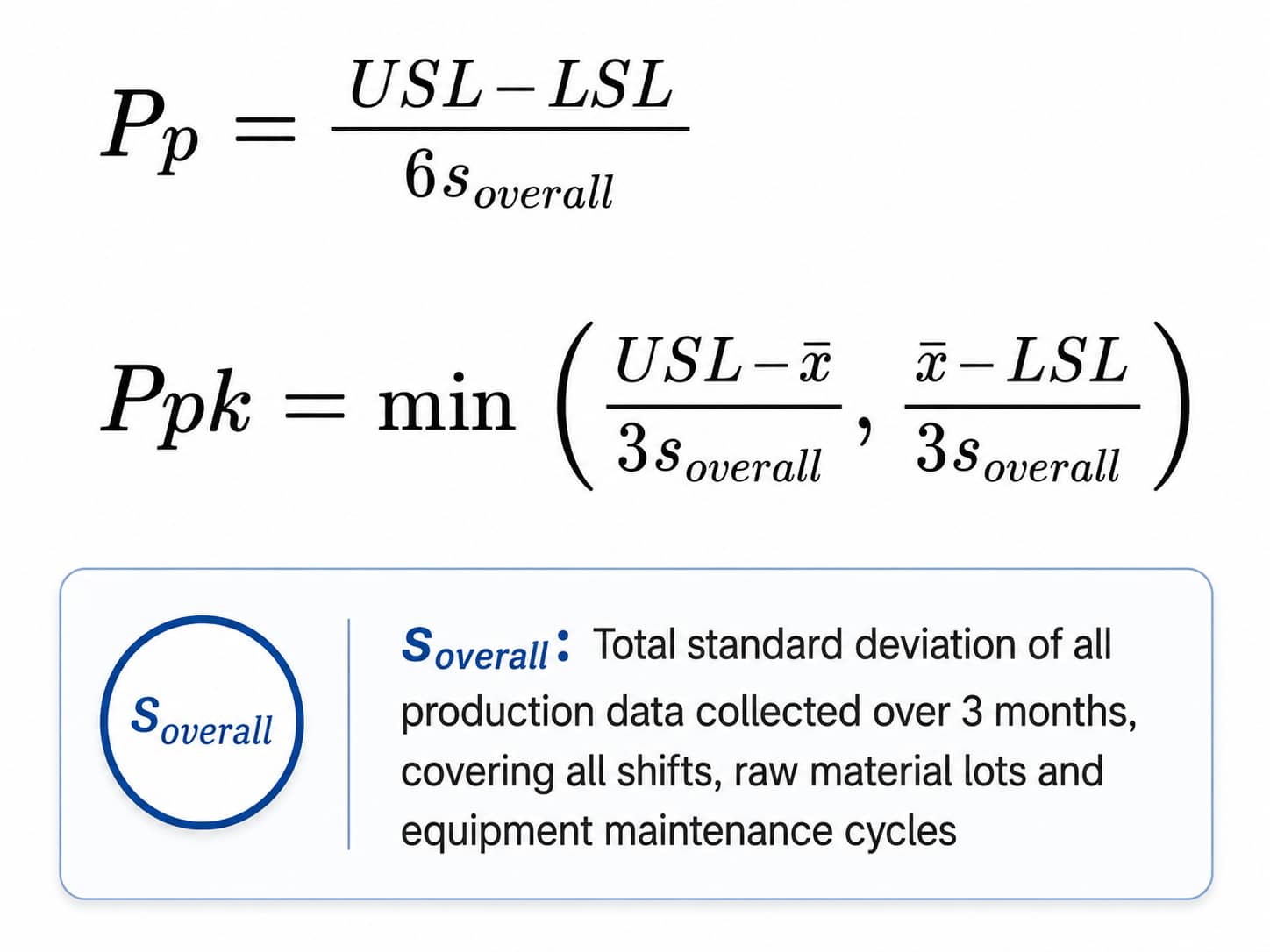
3.2 Pp & Ppk (Long-Term Total Variation)
Formula:
- Core feature: Capture all hidden variation that short-term Cpk cannot reflect
- Practical Rule: In stable battery production, Cpk > Ppk; if Ppk is far lower than Cpk, cross-shift raw material or equipment drift is the root cause and must be rectified.
4. Stability First: Control Chart Selection (Xbar-R / I-MR) for Each Battery Manufacturing Step
Capability indices are meaningless without stable process control charts. Canrd’s CQP defines clear chart matching rules for every core workshop procedure:
4.1 Xbar-R Chart (For rational subgroup sampling, continuous mass production characteristics)
Applied Processes & CTQ Indicators:
- Cathode/anode coating: Single/double side coating weight, electrode thickness
- Roll pressing: Post-calender electrode thickness
- Liquid injection: Electrolyte filling weight
- Sealing: Top & side seal thickness, peel strength
- Finished cell: Overall thickness, width, length dimension
4.2 I-MR Chart (For individual sampling, destructive testing, low-frequency or high-cost inspection)
Applied Processes & CTQ Indicators:
-
Slurry mixing: PVDF cathode slurry / CMC-SBR anode slurry viscosity
-
Slitting: Electrode edge burr size
-
Tab welding: Welding pull tension strength
-
X-ray inspection: Winding positive/negative electrode overhang value
-
Secondary sealing: Degassing residual gas volume
Sampling Rule: Collect one single sample per inspection cycle, monitor individual measured value (I) and moving range between two adjacent samples (MR). Typical Case: Cathode slurry viscosity spec 8000–10000 mPa·s monitored by I-MR chart; sudden viscosity spike signals incomplete PVDF dissolution or insufficient vacuum degassing during mixing.
5. Cmk: Single Machine Short-Term Capability (Mixers, Coaters, Calenders Acceptance Test)
Standard Cmk Sampling Requirements for Battery Equipment
- Fix all external variables: Same raw material batch, single operator, constant temperature/humidity workshop environment
- Continuously produce 50 identical samples within 2 hours without machine adjustment
- Eliminate cross-shift and raw material variation interference
Common Cmk Application Scenarios in Canrd Workshop
- New 200L vacuum planetary mixer acceptance test: Test slurry viscosity repeatability to judge mixing uniformity
- Coating machine overhaul re-verification: Measure continuous coating weight variation
- Roll press calender maintenance inspection: Verify post-rolling electrode thickness consistency
Acceptance Threshold Reference
For core electrode manufacturing equipment: Cmk ≥1.67; auxiliary packaging equipment: Cmk ≥1.33.
6. Cgk & Complete MSE (MSA): Gage Capability for Viscosity Meters, X-Ray Testers & Pull Tester
Critical Rule: Cgk cannot replace full MSE five-property analysis
Many battery factories only calculate Cgk to complete gage qualification, ignoring GR&R, bias, linearity, stability testing, which leads to distorted capability data. Canrd’s MSE system requires 5-dimensional gage evaluation supplementary Cgk comprehensive index:
- Position variation: Bias, Linearity, Stability (measure gage accuracy)
- Width variation: Repeatability & Reproducibility (GR&R, measure gage precision)
- Cgk: Integrated single index to quantify overall gage capacity (combines accuracy & precision)
Matching Gage & Battery Inspection Items
-
NDJ-5S rotational viscosity meter: Test slurry viscosity Cgk & GR&R
- X-ray winding inspection machine: Test electrode overhang measurement linearity
-
Welding tension pull tester: Tab welding strength repeatability test
-
Micrometer & height gage: Electrode thickness, aluminum plastic shell pocket depth bias test
Calibration vs MSE Clear Distinction
- Calibration: Only verify gage precision under laboratory standard conditions
- MSE/Cgk: Evaluate gage actual performance in real battery workshop temperature, humidity and operation scenarios A calibrated viscosity meter still fails MSE if operators apply inconsistent stirring speed during slurry sampling, which will make all slurry viscosity SPC charts invalid.
7. Complete Canrd CQP Workflow (IQC-PMP-MSE-SPC-OCAP-OQC) for 2Ah LFP Graphite Pouch Cell
Canrd’s closed-loop quality control chain eliminates disconnected SPC and measurement management, fully applicable to pouch cell mass production:
- IQC: Raw material incoming inspection (LFP, graphite, PVDF, separator aluminum plastic film)
- PMP (Process Management Plan): Define all CTQs for mixing, coating, assembly, injection, formation
- MSE: Complete MSA five-property Cgk qualification for all inspection gages before production
- SPC: Deploy Xbar-R/I-MR charts for CTQs, monitor real-time process variation
- OCAP (Out-of-Control Action Plan): Standard abnormal response workflow for all SPC out-of-control signals
- OQC: Finished cell capacity, IR, K-value grading final release
All capability analysis (Cp/Cpk/Pp/Ppk/Cmk) must be completed after MSE qualification and SPC stability confirmation in this workflow.
8. Real Manufacturing Capability Analysis Cases (Slurry Mixing / Coating / Calendering / Injection / Sealing)
Case 1: Cathode PVDF Slurry Mixing (I-MR & Ppk)
- CTQ: Slurry viscosity 8000–10000 mPa·s
- Problem: Monthly Ppk=1.12 < 1.33, short-term Cpk=1.68
- Root Cause: Cross-batch PVDF dissolution time inconsistent (total cross-group variation raises overall fluctuation)
- Optimization: Standardize 4 hours constant-speed stirring procedure for PVDF glue solution to narrow cross-batch viscosity gap
Case 2: Anode Coating Weight (Xbar-R & Cpk)
- Spec: Anode single-side coating weight 6.81–7.08 mg/cm²
- Stable process Cpk=1.72, fully meets EV customer PPAP ≥1.67 requirement
- Control measure: Xbar-R chart sampling every 2 hours, auto coating gap compensation system linked to SPC data
Case 3: Electrolyte Liquid Injection Weight (Xbar-R)
- Spec: 10.9–11.1g per 2Ah cell
- Internal guard band limit: 10.95–11.05g (tighter than OQC spec to reserve drift margin)
- SPC Function: Detect gradual injection pump dosing drift before cells fail capacity grading
Case 4: Aluminum Plastic Shell Side Sealing Thickness (Ppk Annual Audit)
- Mass production 3-month Ppk=1.28; trigger OCAP to adjust heat sealing temperature and pressure parameters
9. Critical Distinction: Specification Limits (USL/LSL) vs Control Limits (UCL/LCL)
This is the most frequent error in lithium battery SPC work:
- USL / LSL (Specification Limits): Fixed by cell design, customer drawing standards, define acceptable product size/performance range
- UCL / LCL (Control Limits): Automatically calculated from real production process data, reflect natural inherent manufacturing variation Key Fact: A batch of cells can fully comply with USL/LSL spec but show out-of-control signals on SPC charts (indicating hidden process drift that will cause future mass defects). Stable process high capability means UCL/LCL are far inside USL/LSL guard band range.
10. Common SPC & MSE Mistakes in Battery Factories & Fixing Solutions
- Calculate Cpk without confirming SPC stability Fix: Run control chart for at least 30 subgroups, eliminate all special-cause out-of-control points before capability calculation
- Use single machine Cmk data as full-process Cpk for PPAP Fix: Collect cross-shift, cross-machine full-process samples for Cpk calculation
- Complete gage calibration but skip MSE GR&R & Cgk test Fix: Implement quarterly MSE five-property analysis for all core inspection equipment
- Apply identical Xbar-R chart for all CTQs regardless of sampling type Fix: Follow Canrd CQP matching rule: subgroup sampling = Xbar-R; single/destructive sampling = I-MR
- Set universal fixed Cpk=1.67 threshold for all battery processes Quick: Default acceptance: Core electrode CTQ ≥1.67; auxiliary packaging process ≥1.33
11.1 Standardized SPC Execution Workflow for Battery Pilot & Mass Production
- Screen all CTQs from PMP (slurry viscosity, coating weight, winding overhang, sealing thickness etc.)
- Complete full MSE & Cgk qualification for corresponding inspection gages
- Confirm sampling method, sampling frequency and chart type (Xbar-R / I-MR)
- Collect continuous production data to draw control charts, eliminate special cause variation
- Verify process stability, calculate Cp/Cpk (short-term) and Pp/Ppk (long-term)
- Analyze variation gap between Cpk and Ppk, locate raw material/equipment/operator root causes
- Formulate OCAP abnormal response plan for all SPC out-of-control signals
- Monthly recurring SPC audit and capability recalculation during mass production
12. Frequently Asked Questions
Q1: What’s the core difference between Cpk and Ppk for pouch cell sealing thickness?
A: Cpk only reflects short-term single-short sealing machine capability, Ppk accumulates 3-month cross-shift, cross-machine total variation. If Ppk is much lower than Cpk, different operators adjust heat sealing parameters inconsistently.
Q2: When must we use I-MR chart in electrode slurry mixing workshop?
A: Slurry viscosity test belongs to single-sample inspection without rational subgroups, so I-MR is mandatory; Xbar-R cannot capture single batch viscosity abnormal fluctuation.
Q3: Can we submit Cmk data instead of Cpk for new coating machine PPAP?
A: Not allowed. Cmk only proves single machine short-term precision; customers require full-process Cpk covering raw material slurry, coating, post-calender full production links.
Q4: NDC value <5 after gage MSA test for X-ray overhang machine, how to solve?
A: NDC<5 means insufficient gage resolution. Priority solution: Upgrade high-precision X-ray detector; temporary measure: Increase single test sample quantity and combine GR&R data for auxiliary judgment.
Q5: Why internal process guard band limits are tighter than finished OQC specifications?
A: Reserve margin for equipment drift, raw material variation and measurement error, prevent cells from approaching spec limits during long-term storage and cycle testing.
13. Conclusion
Cp, Cpk, Pp, Ppk quantify the comprehensive variation capacity of the complete lithium battery manufacturing process, while Cmk evaluates independent production equipment precision and Cgk judges the reliability of testing gages. They cannot be separated from SPC stability analysis and MSE measurement system verification.
For pouch cell factories, the core value of implementing Canrd’s complete CQP SPC & MSE system is not only to obtain qualified capability reports for PPAP and customer audits, but to realize forward variation control from slurry mixing to finished cell packaging. By matching Xbar-R and I-MR charts to each core workshop process, identifying variation root causes through the gap between short-term Cpk and long-term Ppk, and standardizing machine Cmk and gage Cgk qualification rules, manufacturers can effectively reduce electrode powder shedding, winding short-circuit risks, inconsistent cell capacity and other batch defects, improving mass production consistency and product cycle performance.
The fundamental logic of lithium battery quality management: Trustworthy measurement system → stable controlled process → meaningful process capability index → standardized abnormal variation response.
Previous
What Do XRD, SEM, TE...Related Products & Services
Use Canrd products and R&D services to turn battery knowledge into practical experiments.
Coin Cell Case
ProductCoin cell cases for validating materials and electrochemical concepts from the article.
Use coin cell cases in your next test →Sodium Electrolyte
CategoryElectrolytes for sodium-ion battery research, compatibility tests, and cell validation.
Shop sodium electrolyte for validation →Cell Fabrication
ServiceGet support building dry cells, assembled cells, or custom formats for R&D validation.
Request cell fabrication support →Experimental Materials
CategoryBrowse materials for follow-up experiments, benchmarking, and product development.
Browse experimental battery materials →
