
Lithium Battery Electrode Calendering Process
canrd July 17, 2026 121
This industrial engineering guide breaks down the full lithium electrode calendering workflow, explains how compaction density and porosity tune battery performance, introduces standard rolling equipment, analyzes typical production quality issues, and links upstream coating and downstream slitting articles to build a complete lithium cell manufacturing topic cluster.
Lithium battery electrode calendering is an indispensable post-coating mass production step after electrode drying. Many engineers overlook that rolling is not just a simple flattening operation—every adjustment to compaction density, roller temperature and line tension directly changes electronic conductivity, energy density, rate capability and cycle life of finished cells. Improper calendering settings amplify pre-existing coating flaws and create new quality problems that damage slitting, tab welding and winding yields.
Why is electrode calendering critical to lithium battery performance? How to select the optimal compaction density to balance energy density and rate performance, and fix common rolling quality issues via parameter tuning? This article focuses on continuous industrial rolling lines and small lab rolling machines. All coating slurry formulas, coating line operations and coating defect troubleshooting are covered in our serial electrode coating articles; full slitting, ultrasonic welding and cell winding procedures are detailed in the subsequent electrode slitting manufacturing guide.
Where Calendering Fits in the Full Lithium Manufacturing Workflow
Complete sequential production topic cluster: Cathode & Anode Slurry Mixing → Lithium Battery Electrode Coating Process → Electrode Coating Defect Troubleshooting → Electrode Calendering Process→ Electrode Slitting & Tab Welding → Cell Winding / Stacking Calendering acts as the critical transition station between coated wet electrodes and cut finished pole pieces. All surface abnormalities formed during coating will be aggravated under rolling pressure, while mismatched rolling parameters generate new flaws that ruin downstream processing.
Why Electrode Calendering Is Critical for Battery Performance
Most production teams only treat calendering as a thickness adjustment step, but rolling fundamentally reshapes the micro-structure of coated electrodes and determines core cell metrics. Below are five key performance improvements driven by standardized calendering, all supported by industrial test data:
1. Boost Electronic Conductivity
Unrolled electrodes contain massive voids between active material particles and conductive carbon. High-pressure rolling squeezes particles into tight contact, shrinking internal conductive resistance. Mass test data shows electrode impedance drops by 30–50% after proper compaction.
2. Increase Volumetric Energy Density
Controlled compaction removes redundant inter-particle voids, packing more active material per unit volume. Standard LCO electrodes gain around 13% volumetric energy density after qualified calendering.
3. Strengthen Coating-to-Foil Adhesion
Uniform rolling pressure presses the coating layer firmly onto copper/aluminum foil. Peel strength rises from 12.3 N (uncalendered) to 15.6 N after optimized rolling, effectively eliminating cycling powder shedding risks.
4. Balance Ionic Conductivity & Electrode Porosity
Over-compaction fully seals micro-pores and blocks lithium-ion transport; under-compaction leaves excessive voids and sacrifices energy density. Calendering tunes residual porosity to reserve electrolyte channels while maximizing material loading.
5. Protect Long-Term Cycle Life & Particle Integrity
Reasonable compaction locks active particles in stable stacking structures, reducing volume expansion during charge-discharge cycles and retaining electrolyte inside pores for sustained ion exchange.

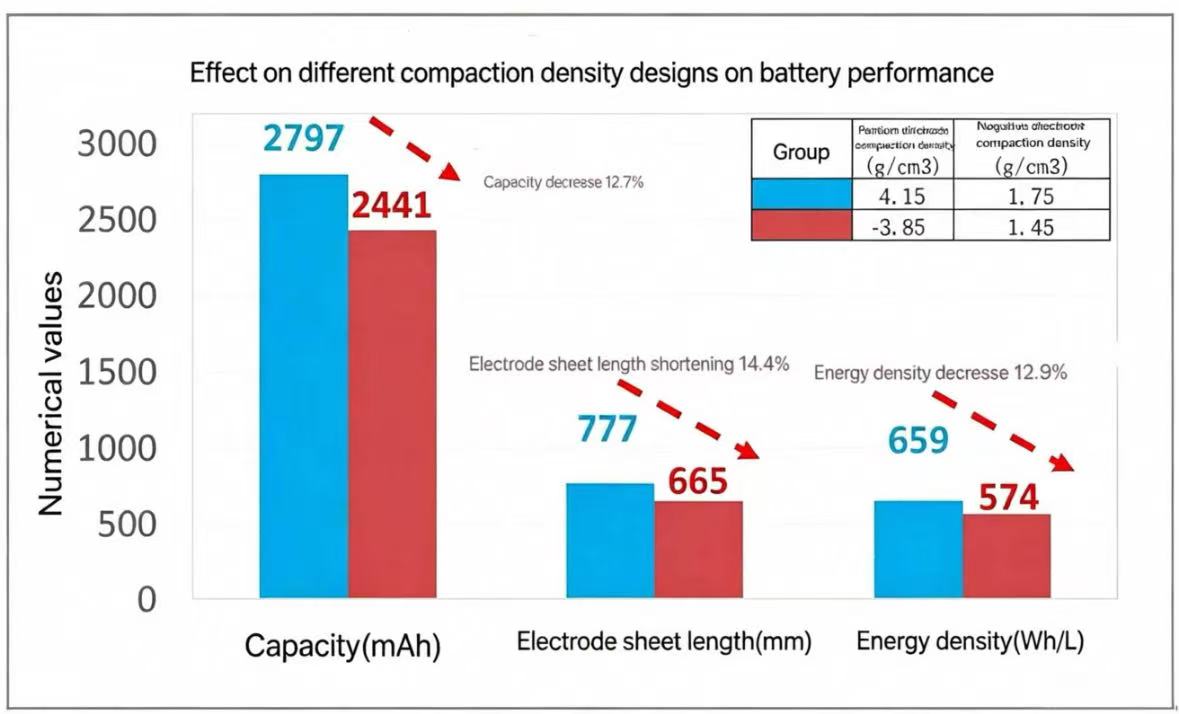
Effects of Electrode Calendering on Key Battery Metrics
Trade-Off Between Compaction Density, Energy Density and Rate Performance
Compaction density is the core control index of the whole rolling process, with obvious performance trade-offs for all cathode/anode materials:
- Low compaction (3.4–3.6 g/cm³): High porosity, excellent fast-charging rate, low volumetric energy density
- Medium compaction (3.8–4.1 g/cm³, standard LCO/NCM range): Balanced energy density and rate capability, mainstream EV production standard
- Ultra-high compaction (>4.2 g/cm³): Max volumetric energy density, poor high-rate discharge due to blocked ion channels
Long Cycle & Electrolyte Retention Impact
Appropriate residual porosity from calendering stores sufficient electrolyte, sustaining stable lithium ion migration over thousands of cycles. Over-compacted electrodes suffer rapid capacity decay after 500–800 cycles from electrolyte depletion.
Mechanical Strength Upgrade
Rolled electrodes have flat, uniform surfaces without loose coating fragments, avoiding separator piercing during winding and stacking.
How to Select the Optimal Compaction Density
Compaction density cannot be infinitely increased, and material systems decide the ideal target value:
- Ternary NCM Cathode: 3.6–4.0 g/cm³, balance fast charging and energy storage
- LCO Cathode for Consumer Batteries: 3.8–4.1 g/cm³, prioritize high volumetric energy density
- LFP Cathode: 1.4–1.6 g/cm³, higher porosity required for long cycle life
- Graphite Anode: 1.5–1.7 g/cm³, reserve expansion buffer space during lithiation Core selection logic: Match density to end-use scenarios (EV fast charge / consumer electronics / energy storage) instead of blindly pursuing high compaction.
Main Electrode Calendering Equipment
Three categories of rolling devices for mass production, pilot labs and R&D sample preparation; equipment introduction kept concise to prioritize performance impact and process logic.
1. Continuous Industrial Double-Roll Calender (Mass Production Standard)
Working Flow
Example-dimensional distances → co-opry → psychoanalyzeability → Ms → Ignoring position → ID addresses
Core Components
Heated polished steel rollers, hydraulic pressure system, real-time laser thickness scanner, full-width tension control module
Key Application
EV power battery high-speed production (max 60 m/min line speed)

2. Semi-Automatic Batch Calender (Pilot Line Use)
Fixed pressure single-pass rolling, no continuous unwinding; for small-batch formula verification, low operation speed, medium equipment cost.
3. Manual Lab Roller Press (Coin Cell R&D Only)
Hand-adjusted gap, no tension control, poor thickness uniformity, only for cut small electrode sheets in university labs.
Calendering Equipment Comparison Table
| Equipment Type | Thickness Precision | Max Line Speed | Main Production Scenario |
| Industrial Continuous Calender | Ultra-precise with online laser detection | ~60 m/min | EV battery mass manufacturing |
| Semi-Automatic Calender | Medium offline testing | Static batch operation | Pilot formula trial |
| Lab Manual Roller Press | Poor, no auto adjustment | Manual static rolling | Lab coin cell samples |
Standard Industrial Calendering Step-by-Step Workflow
- Pre-Roll Inspection: 100% surface screening to filter defective coated electrodes (critical link connecting upstream coating process)
- Equipment Calibration: Clean rollers, zero laser thickness sensor, set target compaction density and roller temperature
- Unwinding & Pre-Heating: Stabilize web tension, mild heating to soften coating binder
- Target Compaction Rolling: Hydraulic pressure adjusts roller gap to hit designed density
- Cooling Stress Release: Cool compacted electrodes to eliminate internal film stress
- Online Quality Scanning: CCD surface camera laser thickness full-width detection
- Tension Rewinding: Uniform roll output ready for slitting
Before Calendering: How Coating Defects Amplify During Rolling
| Original Coating Defect | Rolling-Induced Deterioration | Downstream Impact |
|---|---|---|
| Surface Cracking | Crack expansion across coating layer | Mass powder shedding during slitting |
| Edge Curling | Severe edge wrinkling after compaction | Slitting width deviation, high burr rate |
| Bubble Pinholes | Permanent surface indentations | Uneven tab welding contact |
| Local Powder Shedding | Large-area coating delamination | Internal cell short circuit risk |
Core Controllable Calendering Process Parameters
All parameters directly adjust compaction density, porosity and electrode flatness, split into four core groups:
- Hydraulic Roller Pressure: Primary factor deciding final compaction density
- Roller Gap & Heating Temperature: Soften binder to prevent rolling cracking
- Full-Line Tension (Unwind / Intermediate / Rewind): Avoid edge wrinkling and foil offset
- Production Line Speed: Matched with upstream coating line for consistent compaction
Common Quality Issues During Electrode Calendering
1. Edge Wrinkling After Rolling
Root Causes: Mismatched front/rear tension, uneven roller heating, inherited coating edge curling Optimization: Recalibrate full tension system, balance roller temperature, optimize upstream drying gradient
2. Surface Indentations & Pits
Root Causes: Roller surface foreign particles, coating bubble pinholes amplified by pressure Optimization: Daily roller cleaning, eliminate slurry bubbles at coating stage
3. Coating Cracking & Delamination Post-Rolling
Root Causes: Insufficient roller pre-heating, one-time over-high compaction pressure, low binder content in slurry Optimization: Raise pre-heat temperature, adopt two-stage gradient rolling, adjust coating slurry binder ratio
4. Full-Width Thickness Deviation
Root Causes Unbalanced left-right roller hydraulic pressure, unstable coating line speed Optimization: Auto calibrate roller welter road real-time feedback
5. Striped Rolling Marks
Root Causes: Scratched roller surface, residual dry slurry deposits Optimization: Regular roller polishing and shift cleaning
6. Over-Compaction (Ultra-Low Porosity)
Root Causes: Excessive hydraulic pressure, narrow roller gap Optimization: Reduce rolling pressure to restore ion transport pores
7. Under-Compaction (Loose Coating)
Root Causes: Insufficient rolling load, wide roller gap Optimization: Gradually increase hydraulic pressure to reach target compaction density
Why Calendering Directly Affects Downstream Slitting Quality
- Thickness deviation after rolling → inconsistent slitting width, dimensional out-of-tolerance
- Severe edge wrinkling → metal burrs increase sharply during blade cutting
- Surface indentations & pits → poor tab welding contact resistance
- Uneven compaction across electrode width → local lithium precipitation, separator piercing during winding
Systematic Calendering Quality Control Standards
- Pre-Roll Coating Screening: Block all cracked, bubbled or partially shed coated electrodes
- Daily Equipment Maintenance: Roller polishing, tension calibration, laser detector zeroing
- Two-Stage Gradient Rolling Process: Light pre-compaction formal rolling to avoid cracking
- Real-Time Online Inspection: Auto alarm when thickness or surface flaws exceed tolerance
- Post-Roll Sampling Test: Randomly test compaction density, porosity and peel strength per production roll
Frequently Asked Questions
Q1: What is electrode compaction density?
A: Compaction density refers to the mass of active material per unit volume of rolled electrode, the core index balancing battery energy density and fast-charging performance.
Q2: Why is electrode porosity important after calendering?
A: Reserved micro-pores store electrolyte and provide lithium ion migration channels; too low porosity blocks high-rate discharge.
Q3: Does higher compaction density always bring better battery performance?
A: No. Excessively high density reduces porosity, weakens fast charging capability and shortens cycle life, requiring material-specific trade-off design.
Q4: Can coating defects be fixed via calendering?
A: No. Rolling pressure only amplifies coating flaws like pinholes and cracks, defective electrodes must be scrapped before entering the calender line.
Q5: How to select optimal compaction density for different cathode materials?
A: NCM adopts 3.6–4.0 g/cm³ for balance; LCO uses 3.8–4.1 g/cm³ for high energy; LFP chooses low density 1.4–1.6 g/cm³ for long cycles.
Conclusion
Electrode calendering is not an isolated rolling process; it acts as a vital manufacturing bridge connecting electrode coating and subsequent slitting procedures. Its core value lies in tuning compaction density and electrode micro-structure to balance volumetric energy density, electronic conductivity, fast-charging rate and long cycle life.
All rolling quality issues stem from three sources: unoptimized compaction parameters, unstable line tension/roller temperature, and pre-existing coating surface defects amplified by mechanical pressure. Targeted tension, temperature and hydraulic pressure adjustments can eliminate most rolling abnormalities without scrapping finished rolls.
Previous
Lithium Battery Elec...Related Products & Services
Use Canrd products and R&D services to turn battery knowledge into practical experiments.
Coin Cell Case
ProductCoin cell cases for validating materials and electrochemical concepts from the article.
Use coin cell cases in your next test →Sodium Electrolyte
CategoryElectrolytes for sodium-ion battery research, compatibility tests, and cell validation.
Shop sodium electrolyte for validation →Cell Fabrication
ServiceGet support building dry cells, assembled cells, or custom formats for R&D validation.
Request cell fabrication support →Experimental Materials
CategoryBrowse materials for follow-up experiments, benchmarking, and product development.
Browse experimental battery materials →