



Practical EIS data fitting, a must-have skill for battery professionals!
1.Zview software: the golden partner of battery research
🔧 Software advantages: Accurate modeling: drag and drop equivalent circuit elements with one click, support complex models such as CPE and Warburg. Batch processing: suitable for comparing battery impedance changes under different SOC/temperatures. Paper-level drawing: directly export fitting curves and parameter tables, eliminating Origin secondary processing.
💡 Applicable scenarios: lithium battery SEI film analysis, electrode interface dynamics research, fast charging performance evaluation
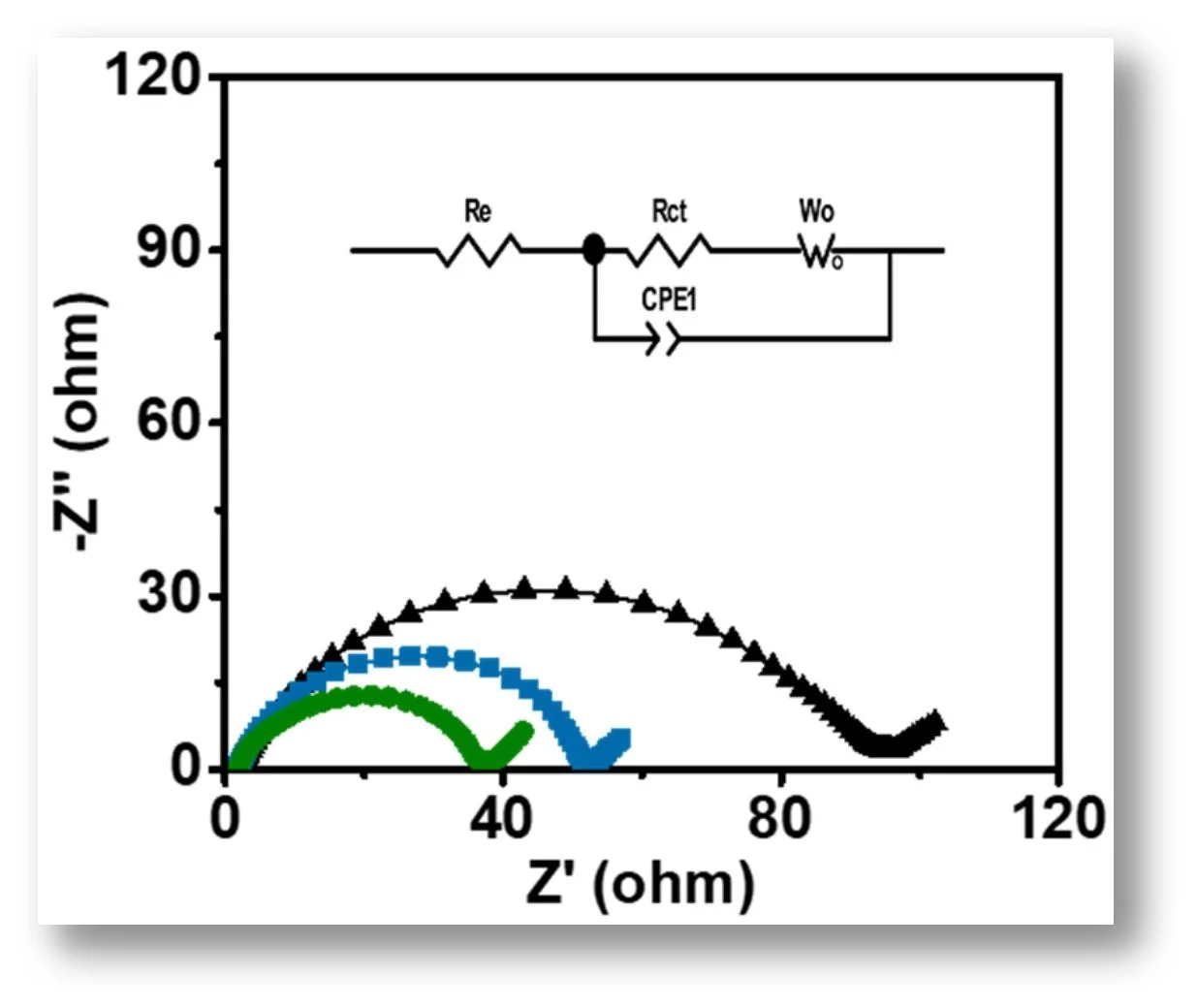
2.Data preparation
✅ Data format requirements: Three-column TXT file: frequency | real part | imaginary part (units are unified in Hz and Ω). Avoid pitfalls: delete high-frequency inductive reactance oscillation points (>10kHz) and low-frequency abnormal "tail", and use KK transformation to verify the rationality of the data.
🔍 Import steps: Click the toolbar "Open Data Files" and select the file. One-click AutoScale: adjust the scale to make the Nyquist diagram clearly visible. Activate data: check the file name and use the green cursor to select the analysis area.
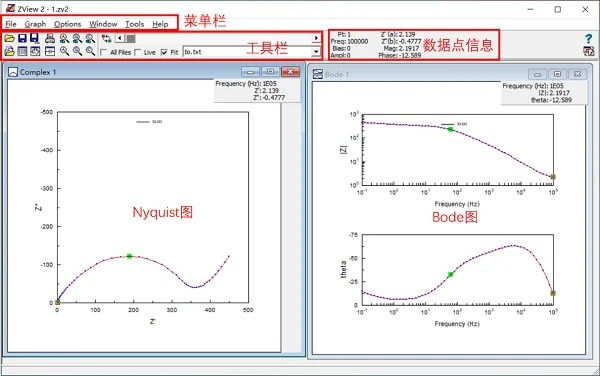
3.Equivalent circuit modeling (Figure 8)
🔋 Commonly used battery circuit templates: Basic version: RΩ (Rct//CPE) Warburg (corresponding to ohmic impedance charge transfer diffusion). Advanced version: add Rsei (SEI film impedance) or inductance L (high-frequency interference).
🎯 Operation tips: Right-click and drag components: freely switch between series/parallel, long press and rename components (such as Rct→"positive charge transfer"). Save template: Common circuits are saved as .zv2 files and can be called directly next time.

4.Step-by-step fitting (Figures 11-14)
🔧 Instant fitting: Select the high-frequency semicircular area, click "Instant Fit" to select the R//CPE model, and obtain the initial values of Rct and CPE. Select the low-frequency oblique line, select the Warburg component, and drag the initial value to the circuit.
⚡ Global fitting: Set all parameters to "(±)Free" mode. Click "Simulate→Fitting" and observe the χ² value (<1e-3 is fine, beware of overfitting).

5.Scientific research avoidance guide
⚠️ High-frequency problems: Fitting divergence: Check whether the data contains a negative imaginary part (correct the real part by multiplying it by -1). Parameters have no physical meaning: The n value of CPE should be between 0.5-1, and abnormal values indicate that the circuit model is wrong. Low-frequency diffusion anomaly: Try using the "finite layer thickness Warburg" model instead.
💡 Heart method: Equivalent circuit ≠ math game! Each component must correspond to the real physical process of the battery. 6. Drawing skills
📈 Drawing tips: Nyquist diagram: Use different colors to distinguish experimental data from fitting curves, and mark key frequency points (such as 10Hz corresponds to Rct). Bode diagram: Show the phase peak separation interface process, and embed the equivalent circuit diagram in the illustration. Parameter table: Mark the error range (such as Rct=25±0.3Ω) and use asterisks to mark significant differences.
-End-
Canrd Brief Introduce
Canrd use high battery R&D technology(core members are from CATL) and strong Chinese supply chain to help many foreign companies with fast R&D. We provide lab materials,electrodes, custom dry cells, material evaluation, perfomance and test, coin/pouch/cylindrical cell equipment line, and other R&D services.
Email:janice@canrd.com
Phone/Wechat/WhatsApp/Skype: 86 18928276992
Website : www.canrud.com

Related Products & Services
Use Canrud products and R&D services to turn battery knowledge into practical experiments.
Coin Cell Case
ProductCoin cell cases for validating materials and electrochemical concepts from the article.
Use coin cell cases in your next test →Sodium Electrolyte
CategoryElectrolytes for sodium-ion battery research, compatibility tests, and cell validation.
Shop sodium electrolyte for validation →Cell Fabrication
ServiceGet support building dry cells, assembled cells, or custom formats for R&D validation.
Request cell fabrication support →Experimental Materials
CategoryBrowse materials for follow-up experiments, benchmarking, and product development.
Browse experimental battery materials →