



New Electrolyte Conduction Method for ASSs (Fan)
Innovative Achievements
Recently, Professor Fan Lizhen from the University of Science and Technology Beijing published a research paper titled "Fluorinated amorphous halides with improved ionic conduction and stability for all - solid - state sodium - ion batteries" in the internationally renowned journal Nature Communication.
This research mainly proposes a general design strategy to enhance the electrical conductivity of sodium halides by regulating the concentration of vacancies and charge carriers within the electrolyte structure. By using a simple sodium - chlorine defect composition (Na/Cl - DC) method to optimize the concentration balance of vacancies and charge carriers within the structure, the ionic conductivity of a series of sodium halide electrolytes (Na2 xMxZr1 −xCl6, M=Yb,Er, x=0,0.25,0.4) has been increased several - fold.
Moreover, through a fluorination - induced amorphization strategy, the (electro)chemical stability, interfacial compatibility, and ionic conductivity of the material have been enhanced simultaneously. The improvement in the conductivity of amorphous fluorinated electrolytes is mainly due to the increase in the degree of local structural disorder and the optimization of the prismatic sodium coordination environment.
When matched with the uncoated Na3V2(PO4)3 cathode and the Na3PS4 - coated Na15Sn4 anode, an all - solid - state battery using Na0.5ZrCl4F0.5 as the composite cathode electrolyte can stably cycle 300 times at room temperature, with a capacity retention rate as high as 94.4%.
This research provides a general method for developing inorganic ion conductors with both high ionic conductivity and long - cycle stability, and promotes the practical application process of all - solid - state sodium - ion batteries.

Highlights of this Article
- Key Point 1: Vacancy/Charge Carrier Concentration Equilibrium Promotes Na - ion Transport
The influence of the content of charge carriers and vacancies on sodium - ion diffusion was elucidated by designing three application scenarios that correlate defect concentration with ion transport efficiency. When the sodium - ion content in the chloride solid - electrolyte framework is > threshold (TNa ) and the vacancy content is < threshold (Tvacancy), sodium - ion hopping is hindered due to the limited number of available vacancies. Therefore, the ion - conduction process within the electrolyte structure is mainly dominated by vacancies at this time. Conversely, when the sodium - ion content is < TNa and the vacancy content is > Tvacancy, ion hopping is restricted by the reduced content of effective charge carriers. Therefore, the ion - conduction process shifts to be dominated by charge carriers. Only when the content of sodium ions and vacancies within the structure both approach their respective critical thresholds do we consider that the sodium - ion conduction efficiency is the highest.
Experimentally, by using the sodium - chlorine defect composition (Na/Cl - DC) method, the content of vacancies and charge carriers within the structure can be precisely regulated without introducing additional elements. Eventually, products such as Na0.5ZrCl4.5, Na0.6Er0.4Zr0.6Cl4.2, and Na0.4Yb0.25Zr0.75Cl4.15 were prepared, exhibiting room - temperature electrical conductivity several times higher than that of the original samples.

Figure 1. Schematic diagram of the influence of different vacancy and sodium - ion contents on the ion - conduction process.
- Key Point 2: Chemical fluorination - induced amorphization promotes the improvement of stability and ion conduction
To further improve the electrochemical compatibility between the defect - optimized Na0.5ZrCl4.5 solid electrolyte and the electrode, F− anions with different contents were introduced into the Na0.5ZrCl4.5−yFy (0≤y≤1) structure by the mechanochemical synthesis method. XRD results show that the diffraction peaks decrease significantly with the increase of F - doping content, indicating that these fluorinated electrolytes tend to be amorphized during the synthesis process. Raman spectroscopy results did not detect additional impurity phases, further indicating successful chemical fluorination. SEM images reveal that the amorphous Na0.5ZrCl4F0.5 is mainly composed of irregular micro - nano particles (<5 μm). When the F - doping content is close to 0.5, the electrolyte reaches its highest conductivity value at 25∘C (1.12×10⁻⁴ S cm−1). The abnormal increase in the conductivity of the above F - ion substituted samples is mainly attributed to the local chemical structure disorder, the enhancement of prismatic Na coordination, and the change of chemical bond length in the amorphous electrolyte. The conductivity of the fluorinated electrolyte remains stable after exposure to environmental humidity, showing good humidity resistance. The improvement of its humidity stability can be attributed to the formation of stronger Zr/Na - F bonds in the structure. The oxidation stability of the fluorinated electrolyte was further evaluated by cyclic voltammetry. Na0.5ZrCl4F0.5 shows the lowest integrated current of 1.34 mAV g−1 at a scan rate of 0.1 mV/s, indicating that the fluorination strategy can enhance the oxidation stability of the electrolyte under high voltage. X - ray photoelectron spectroscopy (XPS) test results show that when electrochemically oxidized to 5 V, there are no obvious oxidation peaks in the Cl− and F− spectra of the fluorinated electrolyte, highlighting its good antioxidant performance, which is mainly attributed to the stronger electronegativity of fluorine anions.
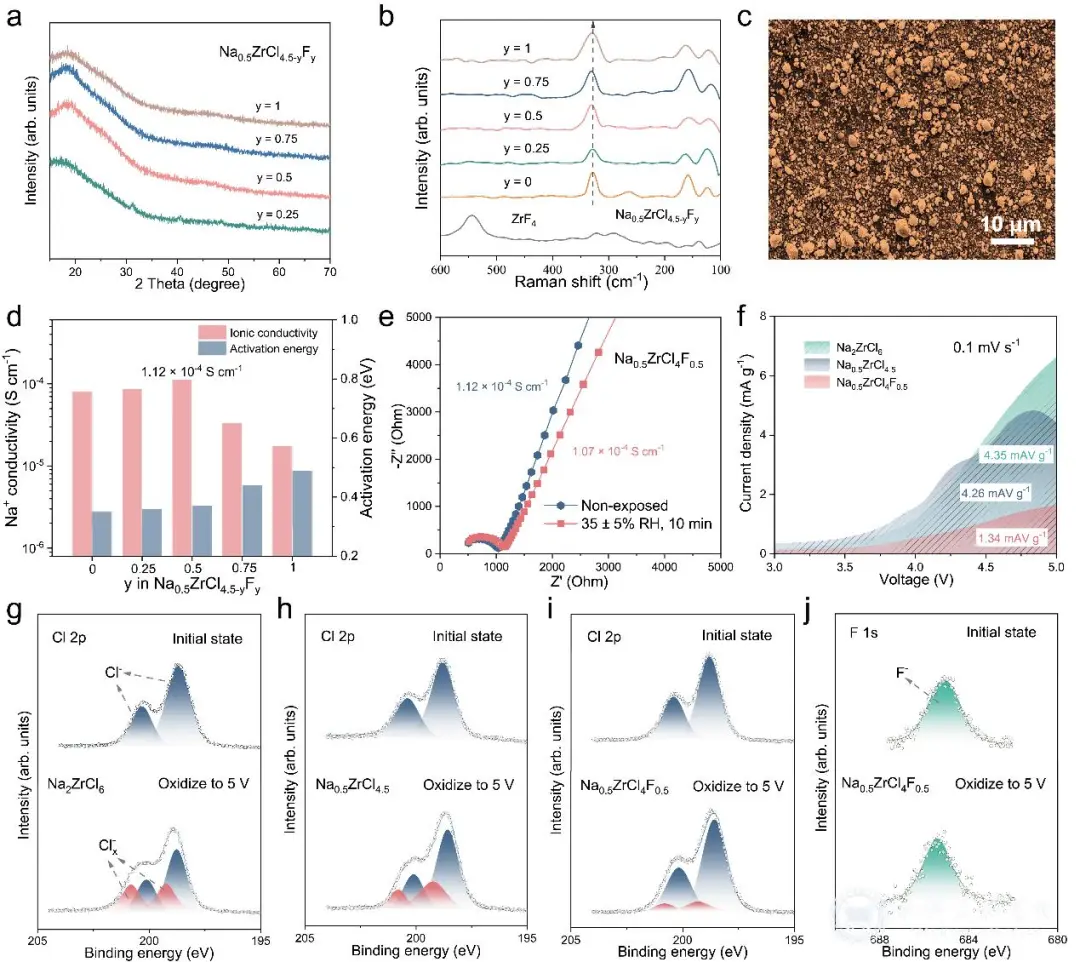
Figure 2. Chemical fluorination of Na0.5ZrCl4.5 halide solid electrolyte (Na0.5ZrCl4F0.5).
- Key Point 3: Application in All - Solid - State Sodium - Ion Batteries
Na3V2(PO4)3 (NVP, with a theoretical capacity of 117 mAh g−1) was used as the cathode active material to further evaluate the electrochemical behavior of the fluorinated electrolyte in all - solid - state sodium - ion batteries. At room temperature and a rate of 0.1 C, the initial Coulombic efficiency (ICE) of the Na0.5ZrCl4F0.5 - based all - solid - state sodium battery can reach 94.5%, and the discharge capacity is 86.4 mAh g−1. At a rate of 0.3 C, the Na0.5ZrCl4F0.5 - based all - solid - state battery shows a higher specific discharge capacity (46.5 mAh g−1), which is significantly better than that of Na0.5ZrCl4.5 - and Na2ZrCl6 - based batteries. In addition, the battery based on the fluorinated sample still exhibits a high capacity retention rate of 94.4% after 300 cycles at 0.1 C. The enhanced conductivity and improved interfacial compatibility of the fluorinated electrolyte are the keys to promoting the improvement of the electrochemical performance of all - solid - state batteries.

Figure 3. Na3V2(PO4)3 - based all - solid - state batteries with different sodium halides as composite cathode electrolytes.
Conclusion
In summary, this study proposes a design strategy for the coordinated regulation of vacancy and charge - carrier concentrations, which effectively improves the ionic - conduction performance of sodium - ion halide solid electrolytes (Na2 xMxZr1−xCl6, M=Yb,Er, x=0,0.25,0.4). This method establishes critical - threshold conditions by optimizing the dynamic balance between the vacancy concentration within the crystal lattice and the number of mobile charge carriers, significantly enhancing the diffusion efficiency of Na , and enabling the conductivity of sodium - chlorine defect - composed (Na/Cl - DC) electrolytes to exceed that of conventional systems.
Furthermore, introducing fluorine into zirconium - based chloride electrolytes not only improves electrochemical stability and electrode - interface compatibility, but also simultaneously increases conductivity (1.1×10⁻⁴ S cm−1, 25∘C) and humidity resistance through the formation of amorphous phases and the strengthening of Zr - F bonds. The fluorination - induced amorphization effect overcomes the adverse effects of fluorine doping on conductivity by increasing the degree of local chemical - structure disorder and optimizing the prismatic sodium - coordination environment, further improving the migration ability of Na .
The all - solid - state sodium - ion battery constructed with Na3V2(PO4)3 as the cathode and Na0.5ZrCl4F0.5 as the electrolyte shows a capacity retention rate of approximately 94% after 300 cycles at a discharge rate of 0.1 C (11.7 mA g−1).
This research provides an innovative design concept for developing sodium - ion halide electrolytes with both high ionic conductivity and (electro)chemical stability, and promotes breakthroughs in the durability and safety of all - solid - state sodium - ion batteries.
--End--
Canrd Brief Introduce:
Canrd use high battery R&D technology(core members are from CATL) and strong Chinese supply chain to help many foreign companies with fast R&D.
We provide lab materials, electrodes, custom dry cells, material evaluation, perfomance and test, coin/pouch/cylindrical cell equipment line, and other R&D services.
📱 WhatsApp/WeChat: 86 189 2827 6992
📧 Email: janice@canrd.com
🛒 Product Website: www.canrud.com

Related Products & Services
Use Canrud products and R&D services to turn battery knowledge into practical experiments.
Coin Cell Case
ProductCoin cell cases for validating materials and electrochemical concepts from the article.
Use coin cell cases in your next test →Sodium Electrolyte
CategoryElectrolytes for sodium-ion battery research, compatibility tests, and cell validation.
Shop sodium electrolyte for validation →Cell Fabrication
ServiceGet support building dry cells, assembled cells, or custom formats for R&D validation.
Request cell fabrication support →Experimental Materials
CategoryBrowse materials for follow-up experiments, benchmarking, and product development.
Browse experimental battery materials →