


Lithium-ion Full Cell Manufacturing Process Training
1.The function and selection requirements of adhesives
1.1.The function of adhesives
Cathode and anode slurries:
Provide viscosity to ensure that particles in the slurry do not easily settle and maintain slurry stability
Provide viscosity for good fluidity
Provide viscosity to facilitate effective dispersion of materials

Cathode and anode electrodes:
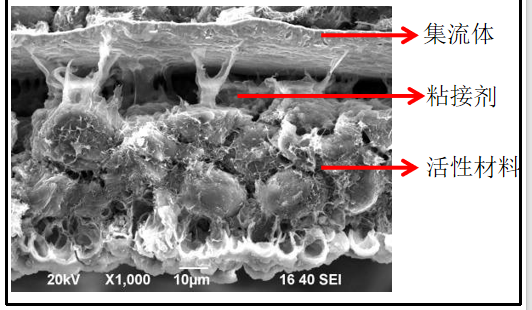
Provide adhesive force to ensure good contact between active materials, conductive carbon, and current collectors.
Provide adhesive force to ensure good contact between particles.
The rolling process is resistant to deformation and breakage.
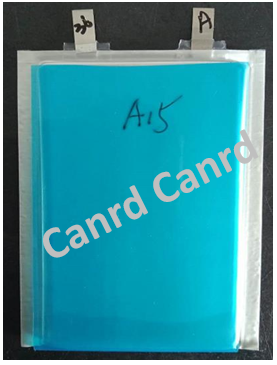
Pouch Cell :
Good adhesion to metal foils and will not peel off the metal foils due to the use of electrolyte, charging, and discharging.
Good electrochemical stability within a wide voltage range.
High melting point and a low swelling rate. Even under high temperatures, the combined structure of the adhesive and the active material needs to remain stable. Adhesives usually undergo swelling, and if the swelling exceeds a certain degree, it will affect the conductivity between the active material and the current collector, leading to capacity fade of the battery. Therefore, it is necessary to control its swelling rate.
Excellent ion transport properties and electronic conductivity.
2.Common classifications and introductions
2.1.Common classifications of adhesives
2.1.1.Commonly Used adhesives:
PVDF— Commercially Used Cathode adhesive
CMC,SBR—Commercially Used Anode adhesive
PTFE—Adhesive for Supercapacitors
2.1.2.New adhesives
PAA-High-Strength Silicon Anode Adhesive
PAN—Improved Rate Capability and Low-Temperature Performance
PMMA—Experimental Type
PAI-Experimental Type
PI—Experimental Type
PVA(Polyvinyl Alcohol) -Experimental Type
Sodium Alginate - Experimental Type
2.2.PVDF
PVDF is a polymer material with a high dielectric constant. It exhibits excellent chemical stability, temperature characteristics, mechanical properties, and processability, which positively contribute to enhancing bonding performance. PVDF is widely used in lithium-ion batteries as an adhesive for both positive and negative electrodes. The PVDF monomer consists of two hydrogen atoms and two fluorine atoms (—CH2—CF2). The electrons of the hydrogen atoms tend to be biased towards other atoms, making them donors. The covalent bond electron cloud is biased towards the fluorine atoms, thus fluorine atoms are referred to as acceptors. Among the crystalline forms of PVDF, the α-form is the most stable, while the remaining part is amorphous. The amorphous region serves as a good matrix for polar molecules, allowing lithium ions to penetrate through the swollen thin layer of PVDF.

2.3.CMC
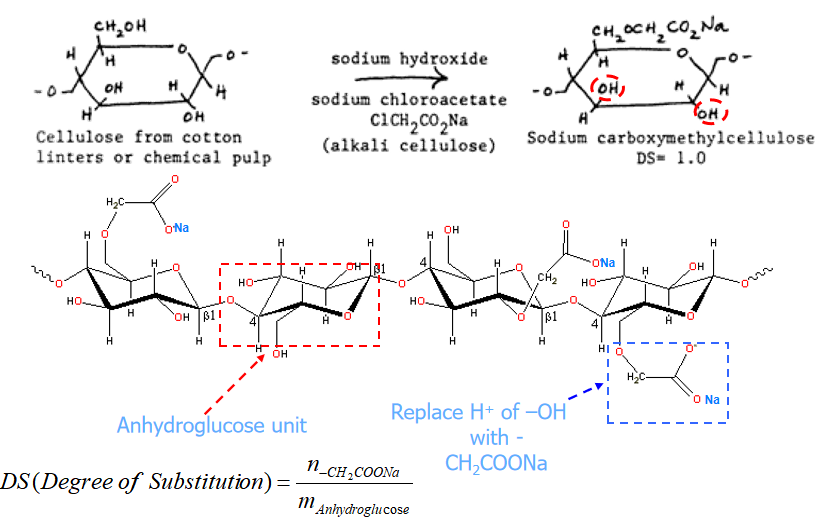
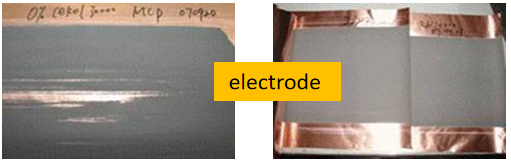
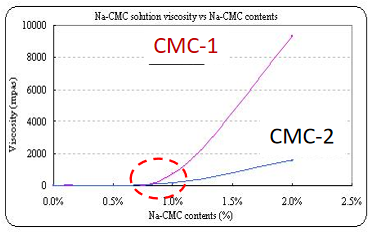
CMC can effectively increase the viscosity of the slurry,improve its fluidity, and enhance the coating appearance.

2.4.SBR
SBR plays a binding role in the electrod
SBR is insoluble in water, it exists in the form of an emulsion


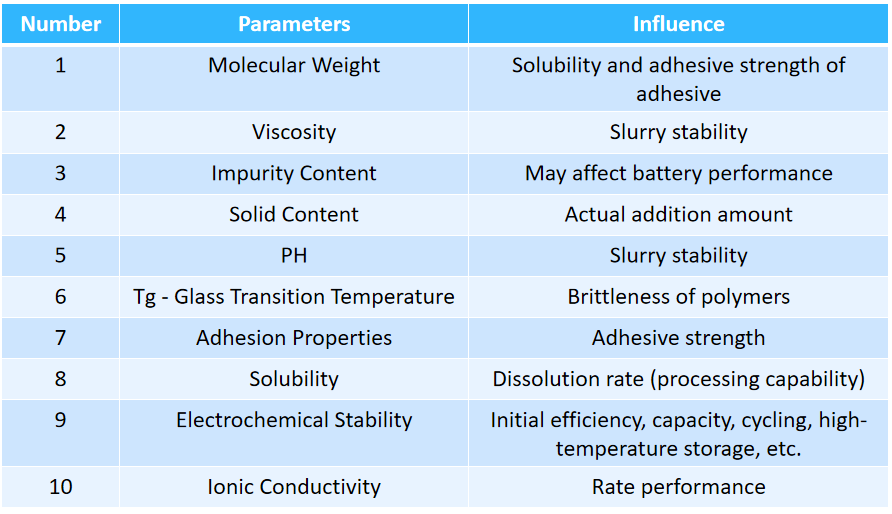
3.Physical parameters
4.test method
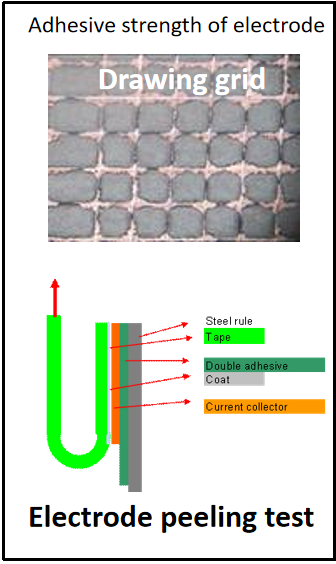
The following four methods re the most commonly used adhesive testing methods in the industry
The swelling of the adhesive can be tested by making the adhesive into a sheet and then soaking it in electrolyte
The ionic conductivity of the adhesive can be analyzed by making it into a battery and conducting EIS testing
Viscosity test

Solid content test

Slurry stability

5.Development direction of adhesives
Functionalization
Improvement in rate performance and low-temperature performance
Enhanced adhesive strength
High energy density (low usage)
Suppression of expansion (surface coating - such as silicon anode, lithium-sulfur)
Low cost
Low cost or reduced usage
Easier processing
Better solubility
Flexible electrode for easy rolling
6.Common problems with coating and previews for next course
6.1.Common issues in slurry coating

6.2. Preview of next course content
How to choose among the numerous brands of PVDF, CMC, and SBR?
If PVDF solution discolors, can it still be used?
Gelation often occurs in high-nickel slurries. How can we solve this problem?
Why are there few commercialized new adhesives? What are the reasons?
Other topics of interest to everyone
7.Canrd Brief Introduce
Canrd use high battery R&D technology(core members are from CATL) and strong Chinese supply chain to help many foreign companies with fast R&D. We provide lab materials, electrodes, custom dry cells, material evaluation, perfomance and test, coin/pouch/cylindrical cell equipment line, and other R&D services.
📱 WhatsApp/WeChat: 86 189 2827 6992
📧 Email: janice@canrd.com
🛒 Product Website: www.canrud.com

Related Products & Services
Use Canrud products and R&D services to turn battery knowledge into practical experiments.
Coin Cell Case
ProductCoin cell cases for validating materials and electrochemical concepts from the article.
Use coin cell cases in your next test →Sodium Electrolyte
CategoryElectrolytes for sodium-ion battery research, compatibility tests, and cell validation.
Shop sodium electrolyte for validation →Cell Fabrication
ServiceGet support building dry cells, assembled cells, or custom formats for R&D validation.
Request cell fabrication support →Experimental Materials
CategoryBrowse materials for follow-up experiments, benchmarking, and product development.
Browse experimental battery materials →