

 contact@canrd.com
 +86 18928276992
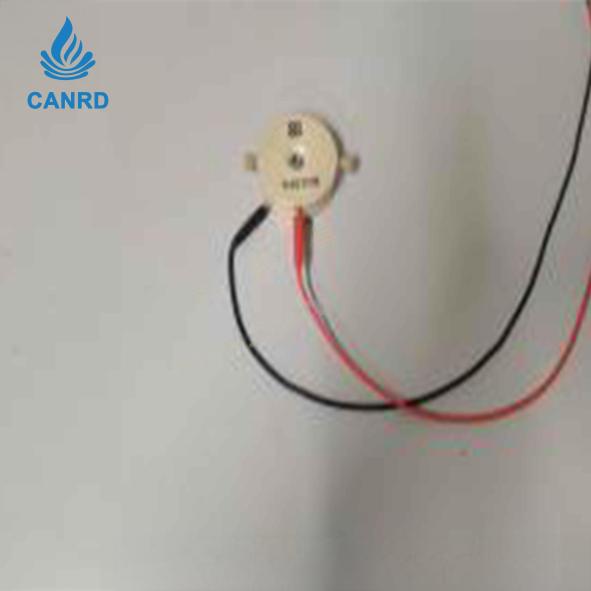
In situ Raman testing cell for lithium-air batteries (K-Raman-01)
Details
Raman spectroscopy is a type of scattering spectroscopy. The Raman spectral analysis method is based on the Raman scattering effect discovered by Indian scientist C.V. Raman, which analyzes the scattered spectra with different frequencies from the incident light to obtain information on molecular vibration and rotation, and is used as an analytical method for molecular structure research.
1. Product application
1) Widely applicable to various lithium-ion battery cathodes/anodes; electrochemical in situ Raman spectroscopy research on sodium-ion battery cathodes/anodes and potassium-ion battery cathodes/anodes.
2) The mold is not only suitable for in situ Raman characterization during charging and discharging, but also for phase transition research during cyclic voltammetry and linear sweep voltammetry.
3) The mold enables vertical imaging of the electrode surface.
4) The mold can be used for two/three-electrode testing.
5) The chamber is suitable for air batteries.
6) Ventilation reaction is performed through upward ventilation.
7) Convenient to use and easier to focus.
2. Product features
1) The chamber has a diameter of 50 mm, a height of 18 mm, a window glass thickness of 0.5 mm, and a window diameter of 8 mm. The sample is in close contact with the window, and the sample diameter can be up to 18 mm.
2) The chamber is sealed with an O-ring, which provides good sealing performance at the window.
3) The chamber is made of PEEK, which is resistant to acid and alkali, and can withstand high temperatures.
4) Easy operation, small size, and convenient disassembly and assembly.
5) Widely applicable to various current collector materials, and the window material can be replaced as needed.
6) The window of this product can be replaced: quartz window, sapphire, quartz glass.
7) Can be equipped with high and low temperature devices.
8) The Raman signal can be maximized by focusing the laser spot. Widely used in major mainstream Raman brands, no instrument modification required. Suitable for lasers of various wavelengths.
9) Adjustable electrode area.
10) High transmittance of optical window and minimal signal loss.
3. Specific usage process:
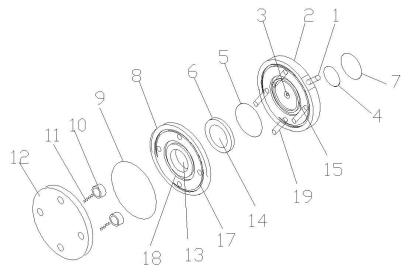
Prepare the cathode material and coat it on an aluminum foil to make a cathode material-coated plate (5), with the area of the cathode material coating larger than the area of the window through-hole (3). Vacuum dry the coated aluminum foil and cut it to the size corresponding to the bottom surface of the groove (15) of the working electrode plate (2). Put the cathode material-coated plate (5) into the groove (15) of the working electrode plate (2) and press it with the insulation ring (6) on the electrode plate (8). Assemble the battery (9) in the order of aluminum foil-separator-electrolyte-lithium metal, and make the battery (9) in contact with the bottom surface of the electrode plate (8). Then, press the cap (10) and spring (11), and finally add the reference electrode plate (12). Tighten the fixing rod of the working electrode plate (2) with a bolt to complete the mold assembly. Place the mold below the confocal Raman microscope, connect the test wires, and focus the laser. After collecting the signal of the sample, start the test. When testing the Raman spectrum of lithium-air battery materials, open the inlet (1) and outlet (2) after completing the mold assembly, allowing the gas to come into contact with the cathode material for reaction. Start the test after a period of time.
Need R&D Support?
Browse key product categories and connect battery materials with Canrd's R&D services for testing, fabrication, and project support.
Experimental Materials
CategoryCathode, anode, electrolyte, separator, and other materials for battery research.
Shop cathode, anode & electrolyte materials →Lab Equipment
CategoryBattery lab equipment for pilot lines, fixtures, and testing workflows.
Browse battery lab equipment →Electrodes & Cells
CategoryCustom electrodes, dry cells, and battery cell components for R&D validation.
View custom battery electrodes & cells →Sodium Electrolyte
CategorySodium-ion electrolyte options for sodium battery research and validation.
Shop sodium battery electrolytes →R&D Services
ServiceFull-chain battery R&D services from material evaluation to cell fabrication and failure analysis.
Explore Canrd R&D services →Material Evaluation
ServiceCharacterization, electrochemical testing, and compatibility evaluation for battery materials.
Evaluate your battery materials →Electrode Fabrication
ServiceCustom electrode sheets and rolls based on your target chemistry and process needs.
Request electrode fabrication →Cell Fabrication
ServiceDry cells, assembled cells, and custom-format cell builds for R&D validation.
Build custom research cells →Contact
PageAsk Canrd to match products, materials, and services for your project.
Get product and R&D support →