

 contact@canrd.com
 +86 18928276992
 Home/Resources/Knowledge/Battery Process/Battery Electrode Rolling Defects and Pinch Differential Tension Solutions
Battery Electrode Rolling Defects and Pinch Differential Tension Solutions
Canrd July 21, 2026 430
Introduction
Uneven rolling stretching is one of the most common and costly defects in lithium-ion battery roll-to-roll manufacturing. It directly causes battery electrode wrinkling, warping, foil deformation, and strip breakage during the electrode rolling process, severely reducing production yield and compromising downstream assembly consistency.
Most electrode rolling quality issues stem from inconsistent elongation between coated area and bare foil area. Traditional correction methods such as tape pasting and local heating struggle to balance precision, efficiency, and production cost, becoming a major bottleneck for high-speed, high-precision battery production.
Pinch differential tension technology is a proven industrial solution designed specifically to fix uneven foil stretching, stabilize electrode flatness, and eliminate rolling defects at the source. This article explains why rolling unevenness occurs, flaws in traditional processes, and how pinch tension control delivers measurable production improvements.
Why Does Uneven Rolling Stretching Occur in Battery Electrodes?
Uneven electrode elongation is an inherent structural problem during rolling compaction, caused by drastic differences in physical properties between coated and uncoated foil regions.
During the electrode rolling process, the electrode coated with active materials bears continuous mechanical compaction pressure. The coating layer is compressed and densified, forcing the coated area to produce obvious tensile elongation and length deformation.
In contrast, the bare foil area has no active material coating and receives no compaction stress. The pure aluminum or copper foil maintains its original yield strength and produces almost no stretching.
This unbalanced deformation creates a length deviation across the entire electrode strip. The coated region becomes longer while the bare foil region stays unchanged, eventually leading to internal stress, surface wrinkling, and strip breakage during high-speed line operation.
Common Problems Caused by Uneven Foil Stretching
Uncontrolled foil stretching and electrode deformation trigger a series of cascading quality and production issues, affecting the entire battery manufacturing workflow:
-
Surface defects: Electrode wrinkling, edge warping, and uneven flatness after rolling
-
Production interruption: Frequent electrode strip breakage leading to line downtime
-
Low finished yield: Deformed electrodes cannot proceed to electrode drying and coating post-processing
-
Assembly inconsistency: Unflat poles cause misalignment during cell winding and stacking
-
Extra manufacturing cost: Manual rework, consumable loss, and wasted production capacity
Traditional Electrode Rolling Correction Methods & Their Limitations
Manufacturers have long adopted two mainstream methods to compensate for uneven elongation in electrode rolling, yet both have obvious drawbacks for mass high-speed production.
1. Tape Pasting Compensation
Workers paste adhesive tapes on the bare foil area to increase local thickness and balance rolling pressure. This method relies heavily on manual operation, with low precision and unstable consistency. Residual glue on the foil surface also causes coating contamination and material shedding risks.
2. Local Heating Correction
Local thermal stretching is used to extend short bare foil sections. However, thermal control accuracy is poor, easily causing over-stretching, foil thinning, and inconsistent electrode compaction density.
What Is Pinch Differential Tension Technology?
Pinch differential tension technology is a high-precision servo tension control system customized for lithium battery roll-to-roll production. It abandons passive compensation and adopts an active stretching calibration logic to solve rolling tension imbalance and electrode deformation problems.
The core principle is to generate a precise micro speed difference through front and rear servo pinch rolls, actively stretching the low-rigidity bare foil to match the length of the elongated coated area. It standardizes electrode flatness and eliminates rolling defects from the source, fully adapting to high-speed electrode coating and rolling production lines.
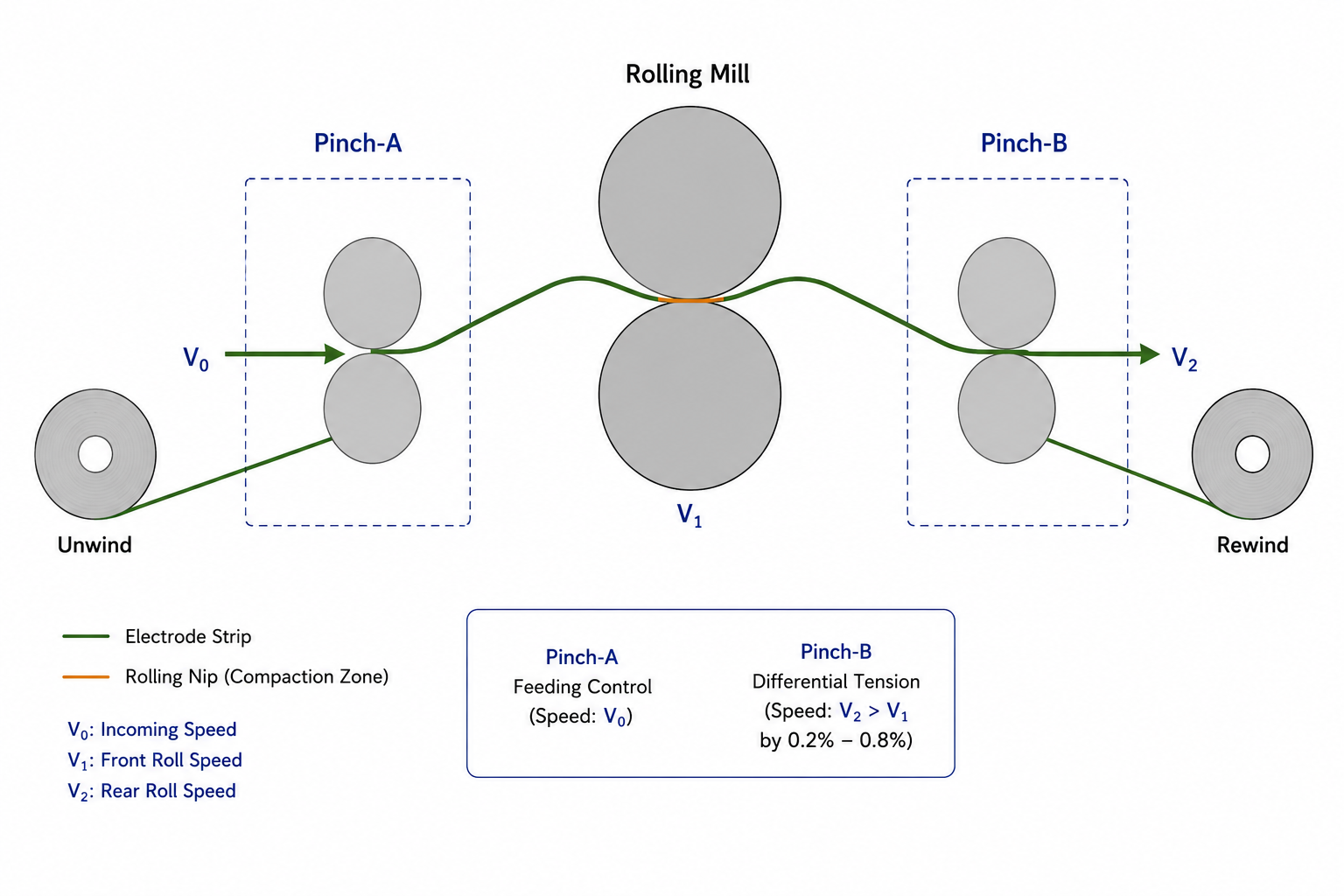
Working Principle of Pinch Differential Tension Technology
The unique advantage of this technology lies in its targeted differential stretching logic, which solves the root cause of uneven deformation rather than remedying surface defects.
After rolling compaction, the coated region has already reached a higher yield strength due to dense active material compaction, so it resists secondary stretching.In contrast, the bare foil remains plastically deformable with low rigidity. This physical difference enables selective stretching only on the bare foil area under controlled differential tension.
The complete working process is divided into four standardized steps:
1. Dual Pinch Roll Layout
Two sets of high-precision servo pinch rolls are installed at the front and rear of the rolling mill. The front roll group stabilizes feeding speed and basic strip tension; the rear roll group supports independent servo speed regulation.
2. Precise Micro Speed Difference Generation
The rear pinch rolls run slightly faster than the front rolls, creating a stable and controllable speed difference of 0.2% to 0.8%. This tiny tension gap will not damage the foil structure but provides accurate stretching traction.
3. Selective Bare Foil Stretching
Under differential tension, only the soft bare foil area is uniformly stretched. The high-strength coated area remains stable without secondary deformation, realizing targeted length compensation.
4. Electrode Flatness Calibration
The length of bare foil and coated area is completely consistent after tension adjustment. Internal stress, wrinkling, and warping defects are fully eliminated to obtain ultra-flat finished electrodes.
Core Benefits of Pinch Differential Tension Technology
Compared with traditional correction processes, pinch tension control brings comprehensive upgrades in precision, cost, efficiency, and quality stability for electrode rolling production:
1. High-Precision Adjustable Tension Control
Full servo intelligent regulation supports real-time fine-tuning of speed difference and stretching amplitude. It adapts to copper foil/aluminum foil electrodes of different thicknesses and diverse coating specifications, solving all types of rolling defects caused by uneven elongation.
2. Zero Consumables & High-Speed Compatibility
Eliminates tape pasting and heating auxiliary processes completely, saving long-term consumable and labor costs. The tension calibration process synchronizes with rolling operation without reducing line speed, matching high-efficiency roll-to-roll manufacturing requirements.
3. Zero Damage & Stable Yield Improvement
Micro-stretching only acts on the bare foil area, causing no damage to the active material coating. It maintains standard compaction density and avoids coating cracking, powder shedding, and foil thinning defects.
Process Comparison: Pinch Technology vs Traditional Correction Methods
The following intuitive comparison clearly shows the advantages of pinch differential tension technology in industrial production:
| Feature | Pinch Differential Tension | Tape Pasting Correction | Local Heating Correction |
|---|---|---|---|
| Correction Accuracy | ★★★★★ (Servo precise control) | ★★ (Manual empirical operation) | ★★★ (Unstable thermal difference) |
| Consumable Cost | Zero cost | High continuous tape cost | Medium energy consumption cost |
| Surface Quality Risk | No residue, no coating damage | Glue residue & contamination | Foil thinning & thermal deformation |
| Automation Level | Fully automatic adjustment | Manual dependent | Semi-automatic limited adjustment |
| High-Speed Line Adaptation | Fully compatible | Restricts production speed | Low-speed only |
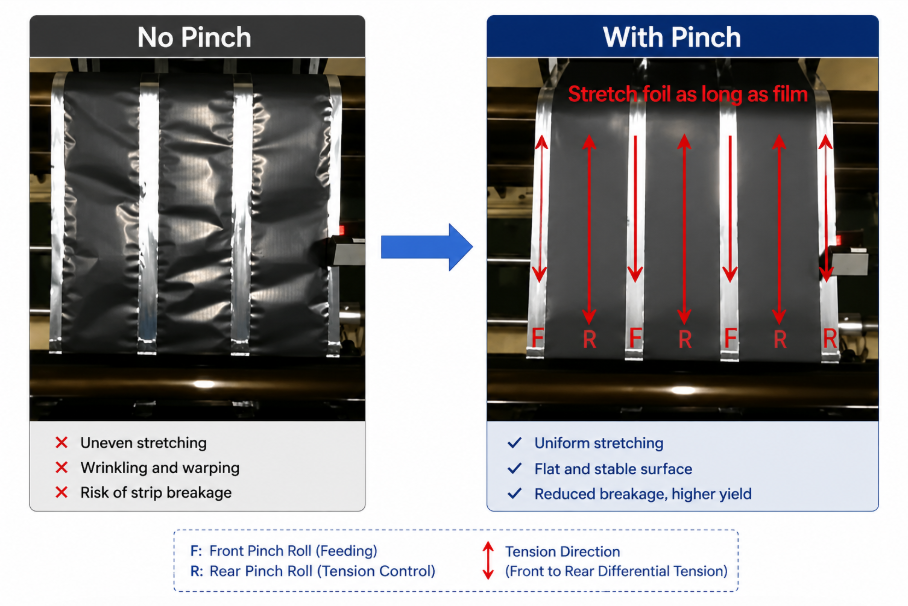
Industrial Application Scenarios
With stable and reliable performance, pinch differential tension technology has been widely applied in mainstream lithium battery manufacturing scenarios, covering full-type battery production lines:
-
Power battery electrode production
-
Energy storage system (ESS) battery manufacturing
-
Consumer lithium battery roll-to-roll production
-
Laboratory pilot precision production lines
-
Ultra-thin foil high-precision rolling workshops
Verified Production Data &; Improvement Effect
Mass industrial production data proves that pinch tension technology brings significant quantitative improvements to rolling quality and production efficiency:
| Production Index | Before Adoption | After Adoption | Improvement Effect |
|---|---|---|---|
| Electrode wrinkling/warping defect rate | High frequent occurrence | Near zero | Reduced by over 90% |
| Production line strip breakage times | Frequent downtime | Rare occurrence | Reduced by over 95% |
| Auxiliary consumable cost | High tape consumption cost | Zero consumable cost | 100% cost saving |
| Electrode finished product yield | Baseline level | Significant improvement | Yield increased by 8–12% |
| Overall rolling production efficiency | Standard efficiency | Efficient continuous production | Increased by approximately 15% |
Practical Considerations & Technical Limitations
To ensure long-term stable operation and accurate correction effect, pinch differential tension technology has clear applicable conditions and limitations, ensuring objective and reliable industrial application:
Applicable Scenarios
Suitable for normal electrodes with complete coating and intact foil base, applicable for conventional uneven elongation and flatness defects in standard rolling processes.
Limitation & Inapplicable Situations
-
Not applicable for electrodes with pre-existing foil cracks or severe damage
-
Cannot remedy defects caused by insufficient servo motor synchronization accuracy
-
Not recommended for ultra-extremely thin foil with ultra-low tensile resistance
-
Incorrect speed difference calibration (exceeding 0.2%–0.8% range) may cause excessive foil stretching
Parameter Setting Reference
For conventional electrodes: 0.2%–0.4% speed difference for thin foil; 0.4%–0.8% speed difference for thick coating electrodes, realizing precise matching of tension and stretching volume.
FAQs
1. What causes uneven rolling stretching of battery electrodes?
It is caused by yield strength difference: the coated area is compressed and elongated during rolling, while the unstressed bare foil does not stretch, resulting in length deviation, electrode wrinkling and warping.
2. How does pinch tension technology fix electrode rolling defects?
It uses controllable 0.2%–0.8% servo speed difference to selectively stretch the deformable bare foil, matching the length of the compacted coated area and eliminating deformation differences.
3. Will this technology damage battery electrode coating or foil?
No. The system only applies safe micro-stretching to the bare foil without touching the coating layer, retaining original compaction density and electrode structural integrity.
4. Is pinch differential tension suitable for high-speed rolling lines?
Yes. Fully automatic servo adjustment requires no downtime or auxiliary operations, perfectly matching high-speed roll-to-roll electrode production.
Conclusion
Uneven rolling stretching is the root cause of most battery electrode flatness defects, strip breakage, and low yield problems in lithium battery manufacturing. Traditional tape and heating correction methods can no longer meet the requirements of modern high-precision, high-efficiency battery production due to low accuracy, high cost, and unstable quality.
As a mature industrial-grade solution, pinch differential tension technology solves uneven elongation from the root cause through selective differential tension control. It delivers zero consumable cost, high-precision correction, and significant yield improvement, becoming the standard optimization process for high-end electrode rolling production lines.
Stable rolling quality directly determines downstream processing performance. Learn how rolling quality influences downstream slitting performance in our complete battery manufacturing guide.
Previous
Silicon Anode Batter...Related Products & Services
Use Canrd products and R&D services to turn battery knowledge into practical experiments.
Coin Cell Case
ProductCoin cell cases for validating materials and electrochemical concepts from the article.
Use coin cell cases in your next test →Sodium Electrolyte
CategoryElectrolytes for sodium-ion battery research, compatibility tests, and cell validation.
Shop sodium electrolyte for validation →Cell Fabrication
ServiceGet support building dry cells, assembled cells, or custom formats for R&D validation.
Request cell fabrication support →Experimental Materials
CategoryBrowse materials for follow-up experiments, benchmarking, and product development.
Browse experimental battery materials →