



Battery Manufacturing Process: Battery Slurry Mixing
Battery Slurry Mixing Process Guide for Lithium-Ion Cell Manufacturing
Battery slurry mixing is one of the first and most important steps in lithium-ion battery manufacturing. A well-mixed slurry directly affects electrode coating quality, electrode consistency, battery capacity, internal resistance, and cycle performance.
In this guide, we explain what battery slurry mixing is, why it matters, how the process works, which equipment is commonly used, what parameters should be controlled, and how to identify common slurry problems before coating.
What Is Battery Slurry Mixing?
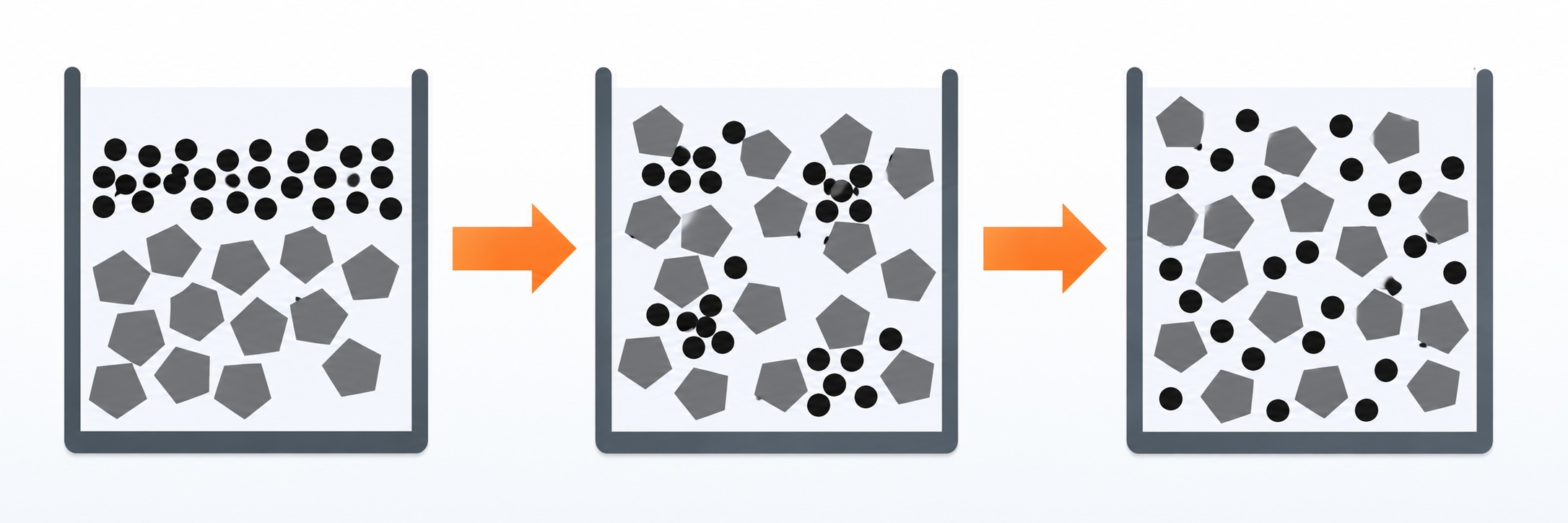
Battery slurry mixing is the process of combining active materials, conductive additives, binders, solvents, dispersants, and other functional additives into a uniform and stable suspension.
For cathode slurry, common components may include:
- Cathode active material
- Conductive carbon black
- PVDF binder
- NMP solvent
- Additives or dispersants
For anode slurry, common components may include:
- Graphite or other anode active material
- Conductive additive
- CMC thickener
- SBR binder
- Water-based solvent
- Other additives
The goal of slurry mixing is not simply to “mix everything together.” The real goal is to form a stable slurry with good wettability, good dispersion, and good suspension stability.
Why Slurry Mixing Is Important
Slurry quality directly affects the next process: electrode coating.
If the slurry is not well mixed, it may lead to:
- Uneven electrode coating
- Surface pits or bubbles
- Poor electrode thickness consistency
- Uneven active material distribution
- Poor adhesion between coating and current collector
- Increased internal resistance
- Poor battery consistency
- Lower capacity or unstable cycle performance
In battery manufacturing, many later quality problems actually start from poor slurry preparation. That is why slurry mixing is a key process in both battery R&D and pilot-scale production.
Three Key Indicators of Good Battery Slurry
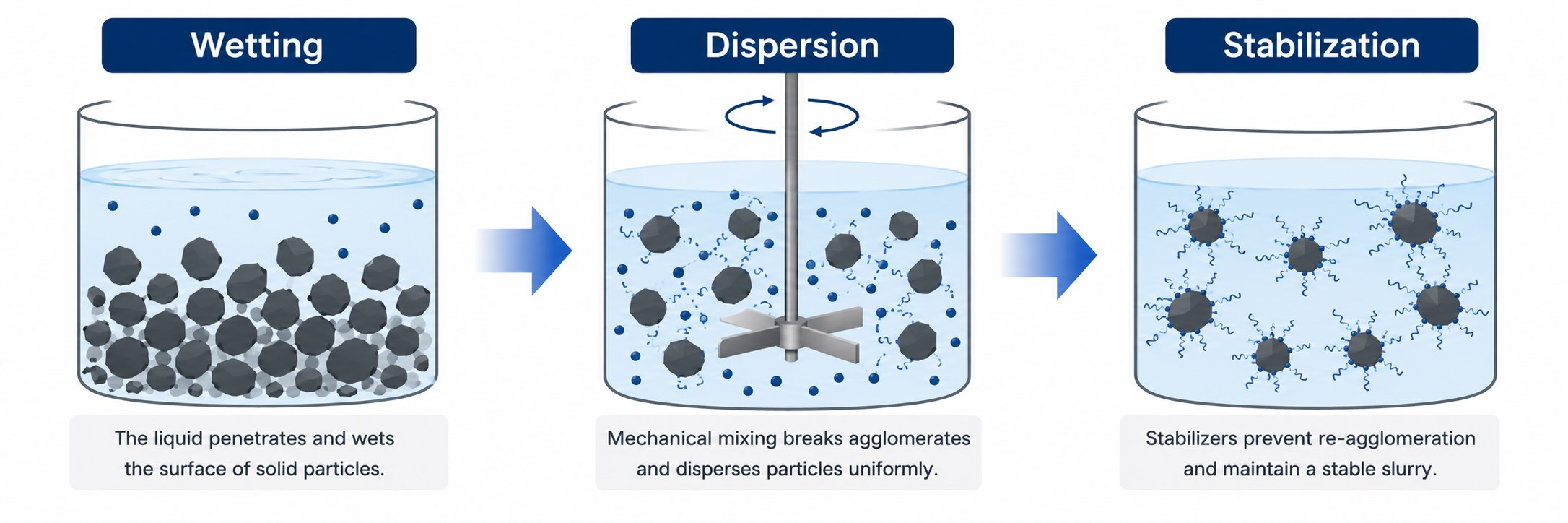
A good battery slurry usually needs to meet three basic requirements:
1. Wettability
Wettability means how well the liquid solvent can wet the solid powder particles.
Good wettability helps the solvent enter the particle surface and reduces the difficulty of later dispersion. If wettability is poor, powder particles may float, agglomerate, or require much longer mixing time.
In simple terms:
Good wettability makes the slurry easier to disperse.
2. Dispersion
Dispersion means breaking up powder agglomerates and distributing particles evenly in the liquid system.
During mechanical mixing, stirring, kneading, and shearing forces help separate particle clusters and suspend them in the slurry.
Good dispersion helps improve:
- Electrode coating uniformity
- Active material distribution
- Conductive network formation
- Battery performance consistency
Poor dispersion may cause agglomeration, uneven coating, and unstable electrochemical performance.
3. Stabilization
Stabilization means the slurry can remain uniform for a certain period without serious sedimentation, separation, or particle re-agglomeration.
Binders and dispersants help stabilize particles in the slurry. For example:
- PVDF is commonly used in cathode slurry
- CMC and SBR are commonly used in water-based anode slurry
A stable slurry is easier to coat and helps maintain consistent electrode quality.
Materials and Equipment Used in Slurry Mixing
Common Materials
Typical slurry components include:
| Component | Function |
| Active material | Provides battery capacity |
| Conductive additive | Improves electronic conductivity |
| Binder | Provides adhesion and slurry stability |
| Solvent | Forms the liquid system |
| Dispersant / additive | Improves dispersion and processing performance |
Common Mixing Equipment

Different R&D and production stages may use different mixing methods.
| Mixing Method | Common Use | Advantages | Limitations |
|---|---|---|---|
| Magnetic stirring | Small lab tests | Low material consumption | Weak dispersion ability |
| Ultrasonic dispersion | Lab-scale dispersion | Good for small samples | Limited scale-up ability |
| Planetary mixing | R&D and production | Strong mixing and dispersion | Requires more material |
| Vacuum planetary mixer | Battery slurry preparation | Removes bubbles and improves uniformity | Higher equipment cost |
For professional battery slurry preparation, planetary mixing is commonly used because it provides stronger kneading, shearing, and dispersion effects.
How the Battery Slurry Mixing Process Works
A typical battery slurry mixing process includes the following steps:
Step 1: Prepare the Binder Solution
For cathode slurry, PVDF is usually dissolved in NMP to form a PVDF glue solution.
This step is important because PVDF needs enough time and proper stirring conditions to dissolve evenly.
If the PVDF solution is not well prepared, the slurry may show poor viscosity control, poor stability, or poor electrode adhesion.
Step 2: Add Powders in the Correct Order
Active materials, conductive additives, and other powders should be added according to the process design.
The addition order matters because different powders have different particle sizes, surface areas, and wettability.
For example, high-BET materials are more likely to agglomerate and may require longer dispersion time.
Step 3: Mechanical Mixing and Dispersion
The mixer generates mechanical actions such as:
- Rotation
- Revolution
- Kneading
- Shearing
- High-speed dispersion
These forces help wet the powder, break up agglomerates, and form a uniform slurry.
Step 4: Temperature Control
During mixing, slurry temperature may increase due to mechanical friction.
Temperature control is important because it can affect:
- Solvent evaporation
- Binder stability
- Slurry viscosity
- Dispersion quality
Many battery slurry mixers use cooling water circulation to control slurry temperature during mixing.
Step 5: Vacuum Degassing
Bubbles in the slurry can cause coating defects.
Before coating, vacuum degassing is often used to remove bubbles from the slurry.
If bubbles remain in the slurry, they may create pits or pinholes on the electrode surface during coating.
Step 6: Slurry Monitoring Before Coating
Before coating, the slurry should be checked to ensure that it is suitable for use.
Common monitoring items include:
- Viscosity
- Solid content
- Fineness / particle dispersion
- Bubble condition
- Slurry appearance
- Flowability
- Sedimentation stability
Key Parameters to Control
Battery slurry mixing quality depends on several important parameters.
| Parameter | Why It Matters |
|---|---|
| Solid content | Affects coating thickness, drying, and electrode loading |
| Viscosity | Affects flowability and coating uniformity |
| Mixing speed | Affects dispersion and shear force |
| Mixing time | Affects particle wetting and agglomerate breakup |
| Temperature | Affects slurry stability and solvent behavior |
| Vacuum level | Helps remove bubbles |
| Addition sequence | Affects wetting and dispersion efficiency |
| Binder content | Affects adhesion, resistance, and energy density |
For anode slurry, viscosity is often controlled according to the formulation, material type, and coating requirements. There is no single universal “best viscosity.” The right range depends on the material system and process conditions.
Common Slurry Problems and Causes
1. Bubbles in the Slurry
Possible causes:
- Insufficient vacuum degassing
- Excessive mixing speed
- Air introduced during powder addition
- Poor slurry flowability
Possible effects:
- Pits on electrode surface
- Poor coating appearance
- Uneven mass loading
- Poor electrode consistency
2. Agglomeration
Possible causes:
- Poor wettability
- High-BET materials
- Insufficient dispersion time
- Inappropriate mixing sequence
- Weak mixing equipment
Possible effects:
- Uneven active material distribution
- Coating defects
- Poor electrochemical consistency
3. Poor Flowability
Possible causes:
- Viscosity too high
- Solid content too high
- Binder ratio not optimized
- Material morphology differences
Possible effects:
- Difficult coating
- Uneven coating surface
- Poor thickness consistency
4. Binder-Related Problems
Binder selection and dosage are important.
Too much binder may improve adhesion, but it can also reduce energy density and increase internal resistance because most binders do not provide battery capacity.
A good binder should ideally have:
- Strong adhesion
- Low required dosage
- Good compatibility with active materials
- Good slurry stability
- Minimal negative impact on conductivity
5. Sedimentation or Separation
Possible causes:
- Poor slurry stability
- Large particle size difference
- Insufficient binder or dispersant effect
- Long storage time
- Poor compatibility between components
Possible effects:
- Non-uniform coating
- Inconsistent electrode loading
- Poor batch consistency
Example: NCM523 Cathode Slurry Mixing Process
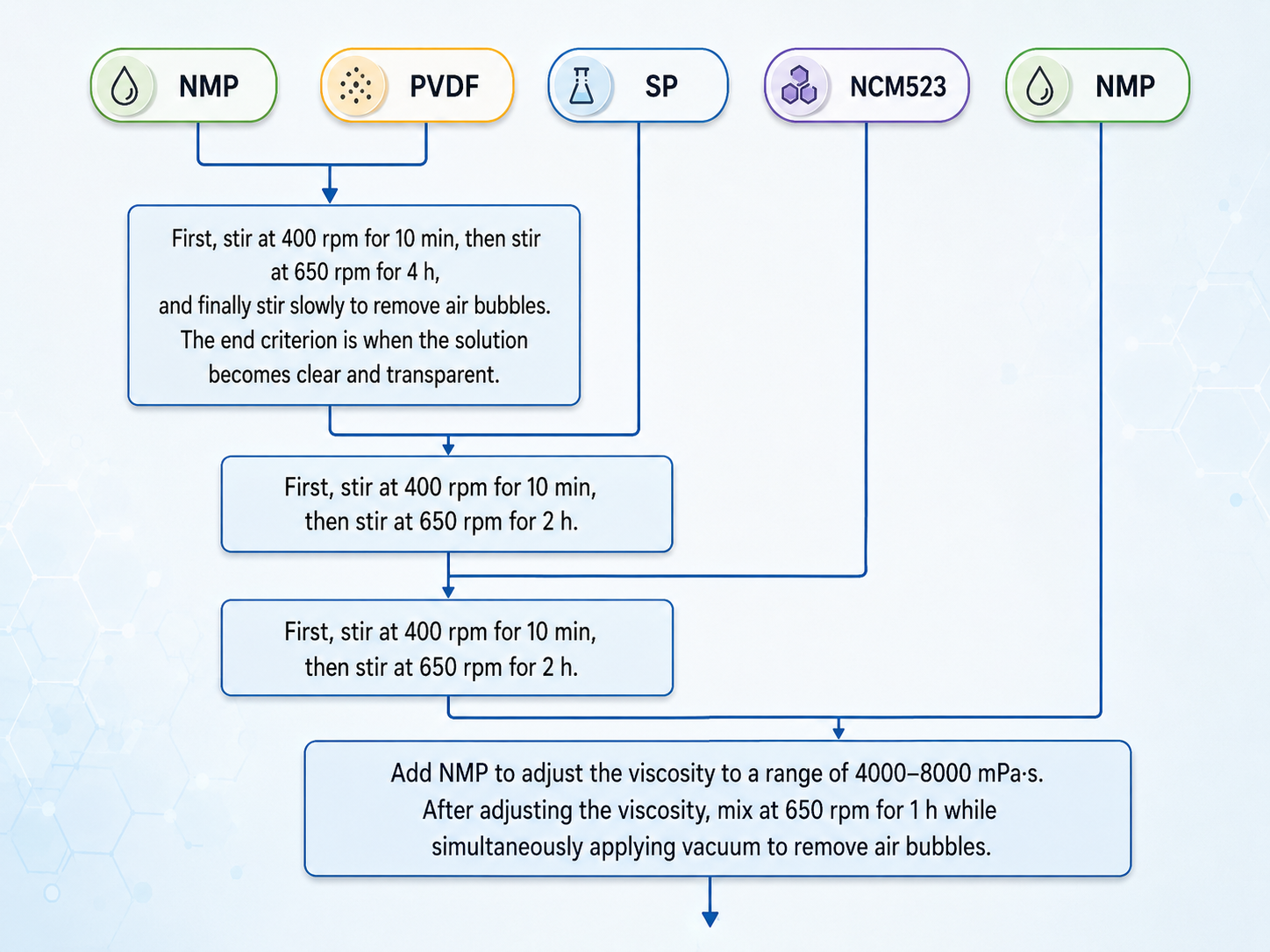
The following example shows a typical NCM523 cathode slurry preparation process using NCM523 active material, conductive carbon SP, PVDF binder, and NMP solvent.
This case helps explain how the general slurry mixing workflow is applied in a real cathode slurry preparation process.
Formula Example
| Material | Function | Percentage | Actual Feeding Amount |
|---|---|---|---|
| NCM523 | Cathode active material | 96.0% | 261.1 g |
| SP | Conductive carbon | 2.0% | 5.4 g |
| PVDF | Binder | 2.0% | 5.4 g |
| NMP | Solvent | - | 128.0 g |
| Total | - | 100.0% | 400.0 g |
Step 1: Prepare the PVDF Binder Solution

First, PVDF is added into NMP to prepare the binder solution.
The mixture is stirred at 400 rpm for 10 minutes, then mixed at 650 rpm for 4 hours. After mixing, the solution is slowly stirred to remove trapped air bubbles.
The PVDF glue solution is ready when it becomes clear and transparent.
This step is important because fully dissolved PVDF helps improve slurry viscosity stability, electrode adhesion, and coating consistency.
Step 2: Add Conductive Carbon SP

After the PVDF binder solution is prepared, conductive carbon SP is added into the solution.
The slurry is first stirred at 400 rpm for 10 minutes, then dispersed at 650 rpm for 2 hours.
This step helps disperse SP evenly and build a conductive network in the cathode slurry. If SP is not well dispersed, the final electrode may show uneven conductivity and poor electrochemical consistency.
Step 3: Add NCM523 Active Material
Next, NCM523 cathode active material is added into the slurry.
The mixture is stirred at 400 rpm for 10 minutes, then dispersed at 650 rpm for 2 hours.
The purpose of this step is to distribute NCM523 particles evenly in the binder and conductive carbon system. Good dispersion helps improve electrode coating uniformity, active material distribution, and cell performance consistency.
Step 4: Adjust Slurry Viscosity with NMP
After the active material is fully dispersed, additional NMP is added to adjust the slurry viscosity.
In this process, the viscosity is adjusted to approximately 4,000-8,000 copper units, depending on coating requirements.
Proper viscosity is important for smooth coating, stable slurry flow, and uniform electrode thickness.
Step 5: Vacuum Degassing Before Coating
After viscosity adjustment, the slurry is mixed at 650 rpm for 1 hour while vacuum is applied to remove air bubbles.
Vacuum degassing is important because bubbles in the slurry may cause coating defects such as pinholes, pits, and uneven electrode surfaces.
Before entering the coating process, the slurry should be uniform, stable, and free of visible bubbles.
Step 6: Final Slurry Check
Before coating, the slurry should be checked for:
- Viscosity
- Bubble condition
- Dispersion uniformity
- Slurry appearance
- Flowability
- Sedimentation stability
Only a well-dispersed and bubble-free slurry should be used for electrode coating.
Quality Control Methods for Battery Slurry
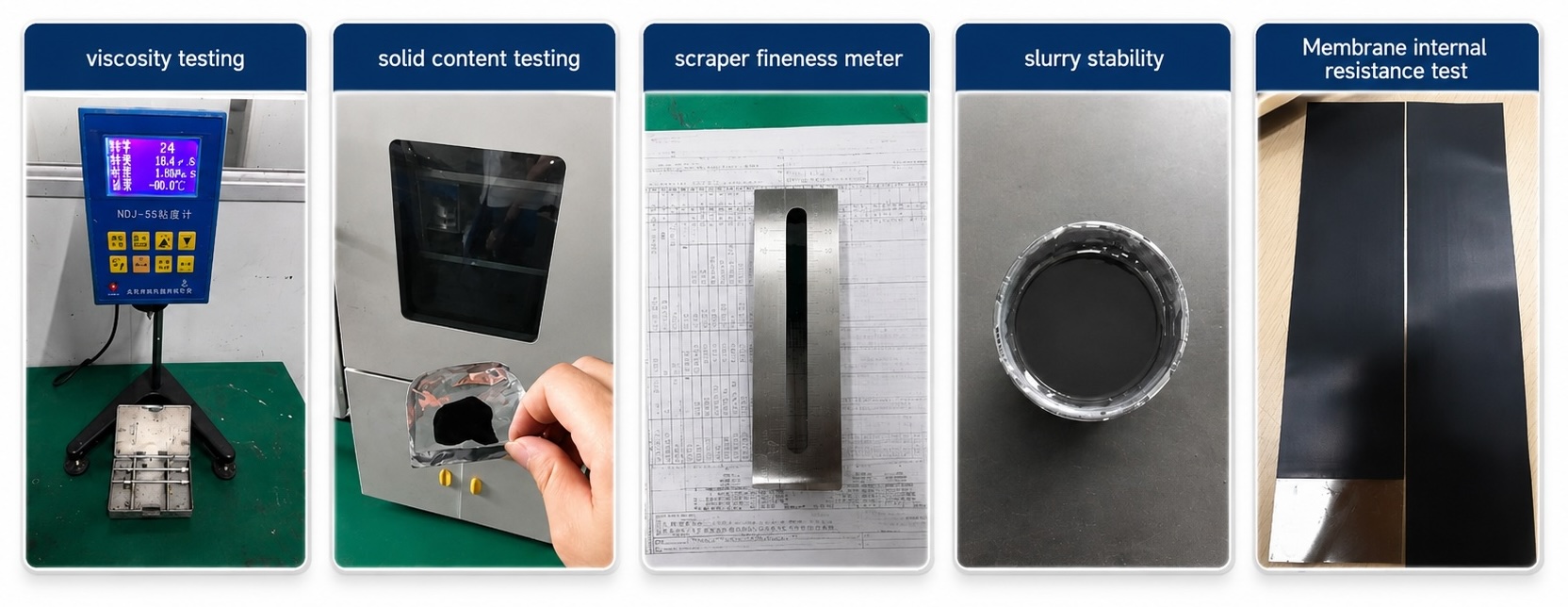
Before the slurry enters the coating process, several quality checks are recommended.
1. Visual Inspection
Check whether the slurry looks uniform and smooth.
Look for:
- Bubbles
- Lumps
- Sedimentation
- Color separation
- Gel particles
- Poor flowability
2. Viscosity Test
Viscosity affects coating performance directly.
If the viscosity is too low, the slurry may flow too easily and cause unstable coating.
If the viscosity is too high, coating may become difficult and uneven.
3. Solid Content Test
Solid content affects electrode loading, drying time, and final electrode structure.
Stable solid content is important for batch-to-batch consistency.
4. Fineness / Dispersion Test
A fineness test can help evaluate whether large agglomerates remain in the slurry.
Poor dispersion may cause coating defects and performance inconsistency.
5. Coating Trial
A small coating trial is often the most direct way to evaluate slurry quality.
Check:
- Coating surface
- Thickness uniformity
- Mass loading
- Adhesion
- Drying behavior
- Surface defects
Recommended Equipment and Materials
For lithium-ion battery slurry preparation, the following equipment and materials are commonly used:
- Vacuum planetary mixer
- High-speed disperser
- Slurry mixing tank
- Vacuum pump
- Cooling water circulation system
- Viscosity meter
- Coating machine
- Electrode drying oven
- PVDF binder
- CMC / SBR binder system
- Conductive carbon black
- Battery active materials
Canrud provides battery R&D materials, lab equipment, custom electrodes, dry cells, coin cells, pouch cells, and battery cell fabrication support for research labs and pilot-scale projects.
FAQ: Battery Slurry Mixing
1. What is battery slurry mixing?
Battery slurry mixing is the process of dispersing active materials, conductive additives, binders, solvents, and additives into a uniform and stable suspension for electrode coating.
2. Why are bubbles in battery slurry a problem?
Bubbles can create pits or pinholes on the electrode surface during coating. This may affect coating appearance, electrode uniformity, and later battery consistency.
3. What causes battery slurry agglomeration?
Agglomeration may be caused by poor wettability, high-BET materials, insufficient mixing time, weak dispersion equipment, or an unsuitable addition sequence.
4. What is the role of PVDF in cathode slurry?
PVDF helps provide viscosity, slurry stability, and adhesion between the electrode coating and current collector.
5. What is the role of CMC and SBR in anode slurry?
CMC mainly helps with thickening and slurry stability, while SBR mainly provides adhesion. The exact ratio depends on the material system and electrode design.
6. Does too much binder affect battery performance?
Yes. Excessive binder may increase internal resistance and reduce energy density because binders usually do not contribute capacity.
7. How do you judge whether slurry viscosity is suitable?
A suitable viscosity should provide good flowability, stable coating, smooth electrode appearance, and uniform mass loading. The proper range depends on the material system and formulation.
8. What equipment is best for battery slurry mixing?
For professional battery R&D and pilot production, vacuum planetary mixers are commonly used because they provide strong mixing, dispersion, and vacuum degassing functions.
Conclusion
Battery slurry mixing is a key step in lithium-ion battery manufacturing. Good slurry quality depends on proper wettability, dispersion, stabilization, equipment selection, process control, and quality inspection.
A well-prepared slurry helps improve electrode coating quality, electrode consistency, and final battery performance. For battery research labs and pilot lines, controlling slurry mixing quality is essential before moving to coating, drying, calendering, and cell assembly.
Need battery slurry mixing equipment, electrode materials, or custom electrode fabrication support? Contact Canrud for battery R&D solutions and quotation.
Related Products & Services
Use Canrud products and R&D services to turn battery knowledge into practical experiments.
Coin Cell Case
ProductCoin cell cases for validating materials and electrochemical concepts from the article.
Use coin cell cases in your next test →Sodium Electrolyte
CategoryElectrolytes for sodium-ion battery research, compatibility tests, and cell validation.
Shop sodium electrolyte for validation →Cell Fabrication
ServiceGet support building dry cells, assembled cells, or custom formats for R&D validation.
Request cell fabrication support →Experimental Materials
CategoryBrowse materials for follow-up experiments, benchmarking, and product development.
Browse experimental battery materials →