
Home/Resources/Knowledge/Battery Process/Glove Box for Battery Research: What It Is, Why You Need It, and How to Use It
Glove Box for Battery Research: What It Is, Why You Need It, and How to Use It
Canrud July 20, 2026 61
Calendering is the core forming process after electrode coating, which directly determines lithium-ion batteries’ energy density, cycle life and rate capability. This document systematically sorts out calendering forming mechanism, multi-dimensional performance trade-offs, full production workflow, classified compaction density standards and standardized testing specifications for both laboratory R&D and mass manufacturing.
1 What Is Electrode Calendering
Calendering, the core forming step post electrode coating, is a critical lithium-ion battery manufacturing process. Cathode and anode compaction density set during calendering directly dictates cell volumetric energy density, cycle life and rate performance. High-pressure roller compression tunes electrode porosity and particle contact, reshaping electron conduction, lithium-ion transport, electrolyte absorption and active material structural stability.
This paper is customized for university researchers and industrial R&D engineers. Full research contents cover:
- Physical densification mechanism of calendering
- Quantitative test data of battery performance under different compaction gradients
- Complete assembly & workflow of mass-production calender lines
- Standard lab & mass-production operation protocols
- Targeted compaction density framework for diverse battery routes
- Process pros, cons and common industrial troubleshooting
2 Fundamental Forming Mechanism of Calendering
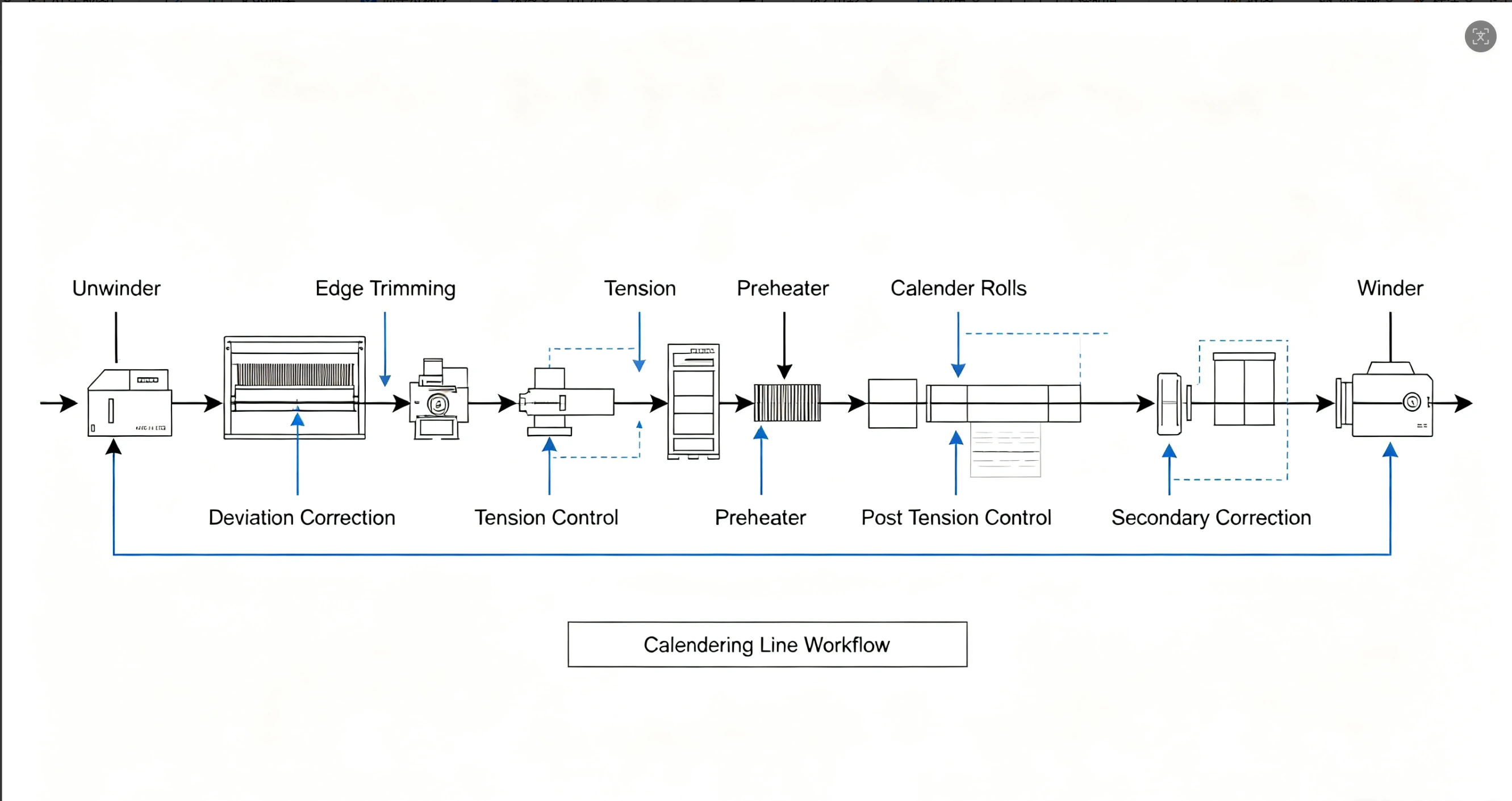
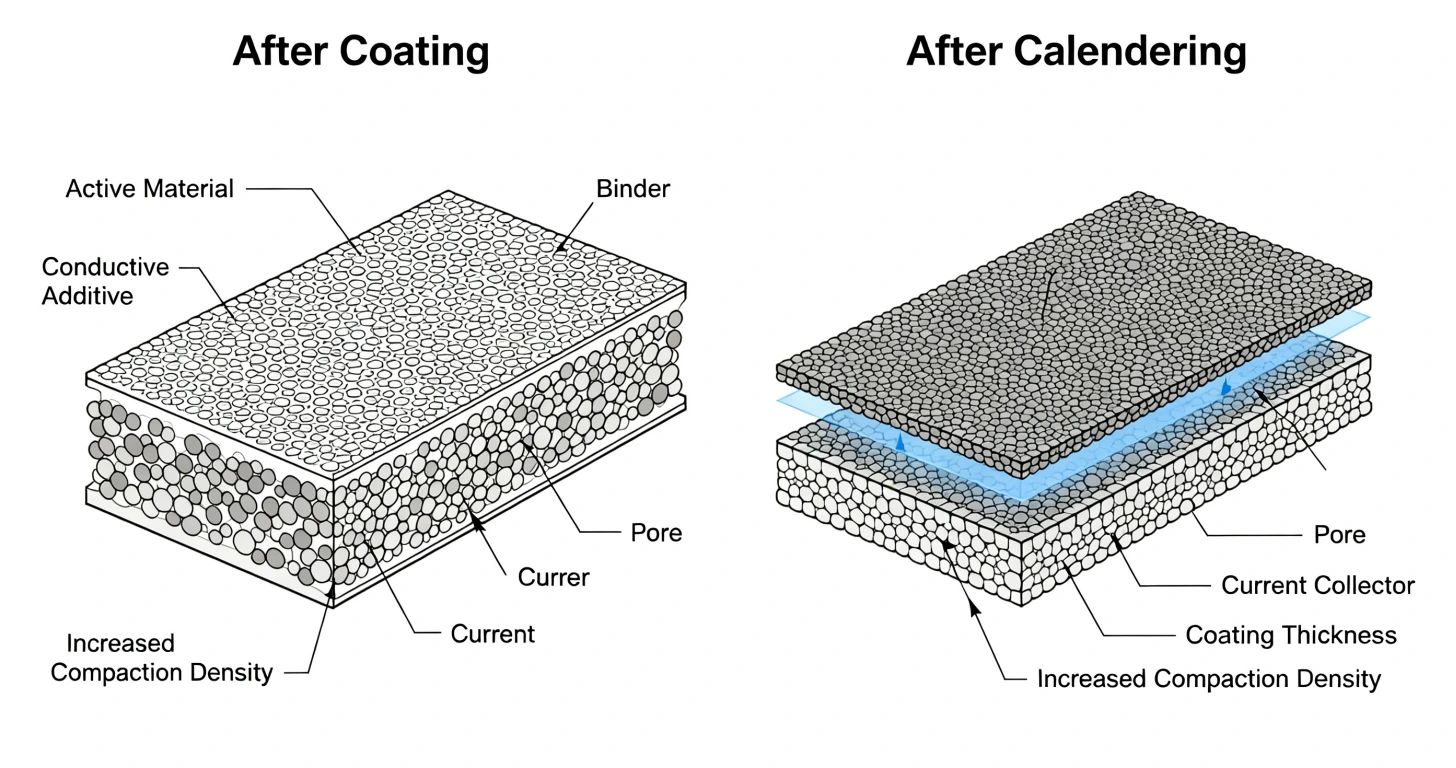
Coated electrodes are composed of active particles, conductive carbon black and polymer binders coated on copper/aluminum foil, with plenty of internal pores after drying. A standard calender unit consists of unwinding roller set, compression roller pair and winding unit. Hundreds of tons of hydraulic pressure extrudes electrode coatings, compresses internal voids and reduces coating thickness to raise compaction density.
Full Calender Production Line Workflow
Additionally → Additionally → Advanced Deficiency → PRODUCT → PRODUCED → PRODUCED → PRODUCE A → A / A / / / / / / / / / /
Two Core Physical Changes After Calendering
- Continuous conductive network formation Particles are tightly squeezed, and conductive carbon fills interparticle gaps to build unbroken electron transmission channels.SEM Comparison Before & After Calendering
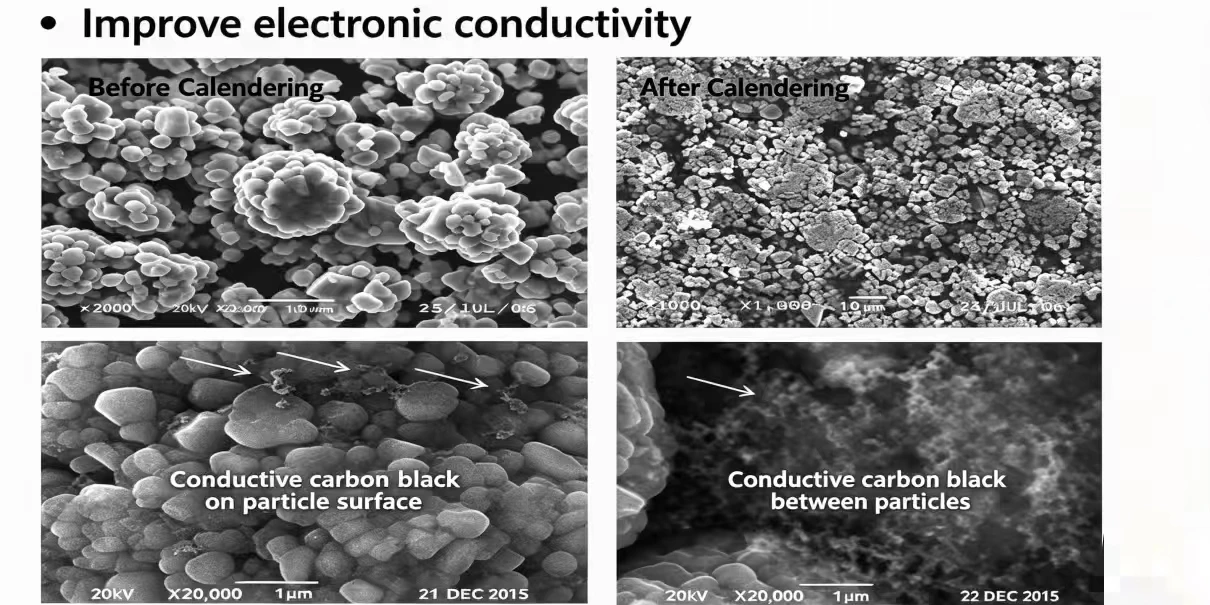
- Higher active material loading capacity Compressed coating reduces thickness, so longer electrodes can be wound inside fixed shell volume to load more active substances.
3 Performance Data Under Low / Medium / High Compaction
Test basis: LCO cathode + graphite anode, slurry formula LiCoO₂: Super P: PVDF = 97.5% : 1.4% : 1.1%
| Performance Parameter | Low Compaction |
Medium Compaction |
High Compaction |
|---|---|---|---|
| Coating Porosity | 35%~45% | 22%~30% | 15%~21% |
| Film Resistivity (Ω·cm) | 16~18 | 11.3~13 | 11.2~11.5 |
| Electrode Adhesion (N/m) | 12.3 | 14.2 | 15.6 |
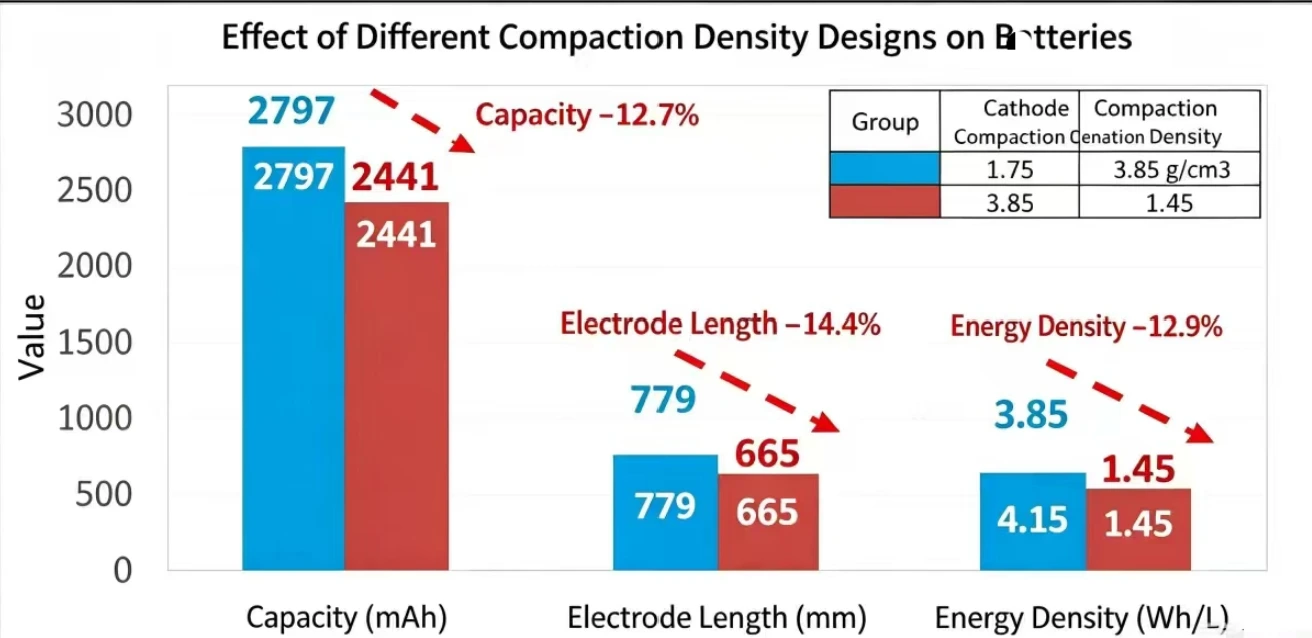
| Single Cell Capacity (mAh) | 2441 | 2680 | 2797 |
| Usable Electrode Length (mm) | 665 | 720 | 777 |
| Volumetric Energy Density (Wh/L) | 574 | 620 | 659 |
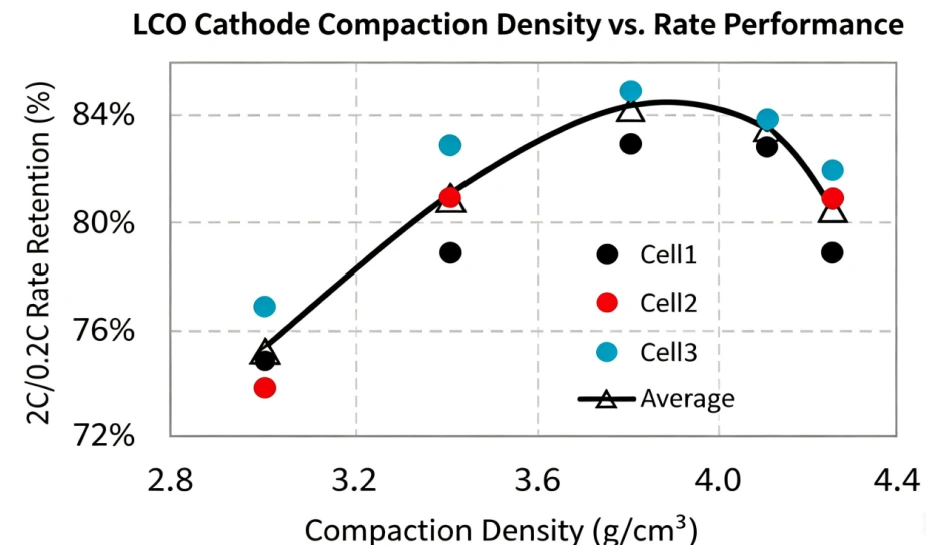
| 2C/0.2C Rate Retention | 74%~77% | 82%~84% | 78%~81% |
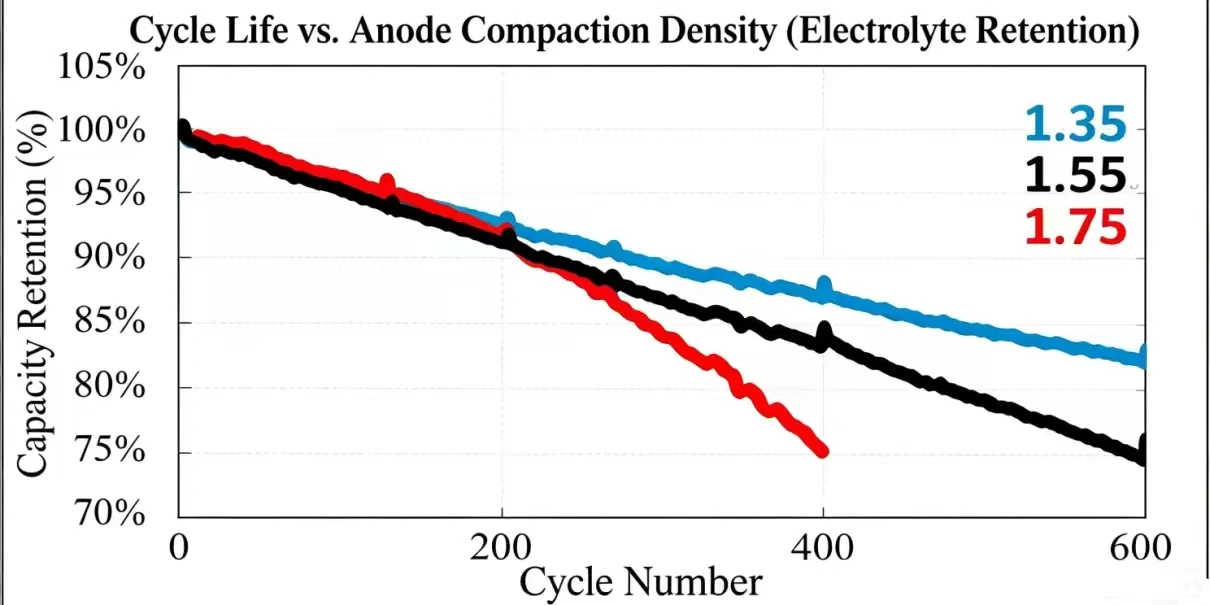
| Capacity Retention (600 Cycles) | 83% | 78% | 75% |
| Particle Integrity | Intact, no crack | Slight deformation | Severe cracking |
| Applicable Scenario | Long-cycle energy storage | Consumer electronic cells | Ultra-high energy density cells |
3 Three Core Benefits of Appropriate Calendering
3.1 Lower Electrode Resistance
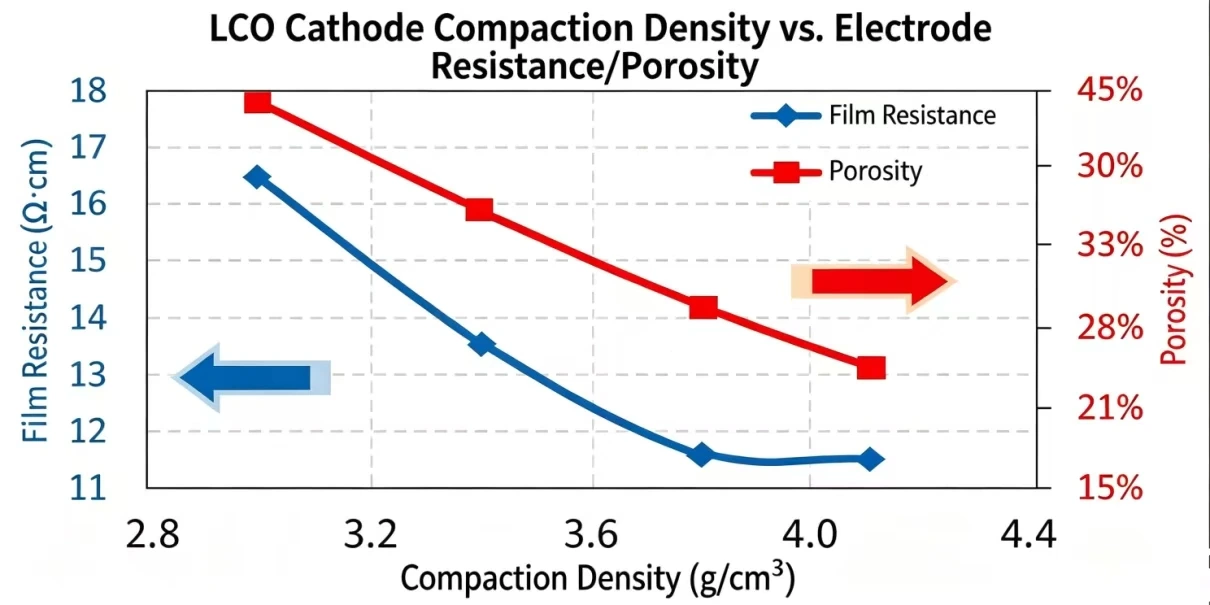
Uncalendered electrodes have loose particle distribution and discontinuous conductive channels. As compaction density rises, contact resistance drops sharply; resistance plateaus when LCO cathode density exceeds 3.8 g/cm³.
3.2 Boost Volumetric Energy Density
Thinner coating allows more active materials inside fixed casing. Test data: lifting cathode density from 3.85 to 4.15 g/cm³ brings +12.7% capacity, +14.4% electrode length, +12.9% volumetric energy density.
Performance Data Comparison Chart
3.3 Improved Coating-to-Foil Adhesion
Calendering presses binders, particles and current collectors tightly together. Adhesion rises from 12.3 N/m (uncalendered) to 15.6 N/m, effectively eliminating coating shedding during slitting & winding.
4 Four Key Performance Trade-offs in Calendering
4.1 Ionic Conductivity vs Compaction Density
Higher density reduces pores and ion transport paths, while thinner coating shortens lithium diffusion distance. Excess compaction cuts electrolyte storage and shortens cycle life.
4.2 Optimal Medium Compaction for Rate Performance
Medium compaction (3.8~4.1 g/cm³ for LCO) delivers the highest 2C/0.2C retention above 83%. Low density causes high ohmic drop; over-compaction blocks ion channels.
Compaction vs Rate Retention Curve
4.3 Low Compaction Extends Cycle Life
Lower anode density reserves more pores to hold electrolyte, suppress excessive SEI growth. Anode at 1.35 g/cm³ retains 83% capacity after 600 cycles, versus only 75% at 1.75 g/cm³.
Anode Compaction vs Cycle Retention
4.4 Over-Compaction Destroys Particle Structure
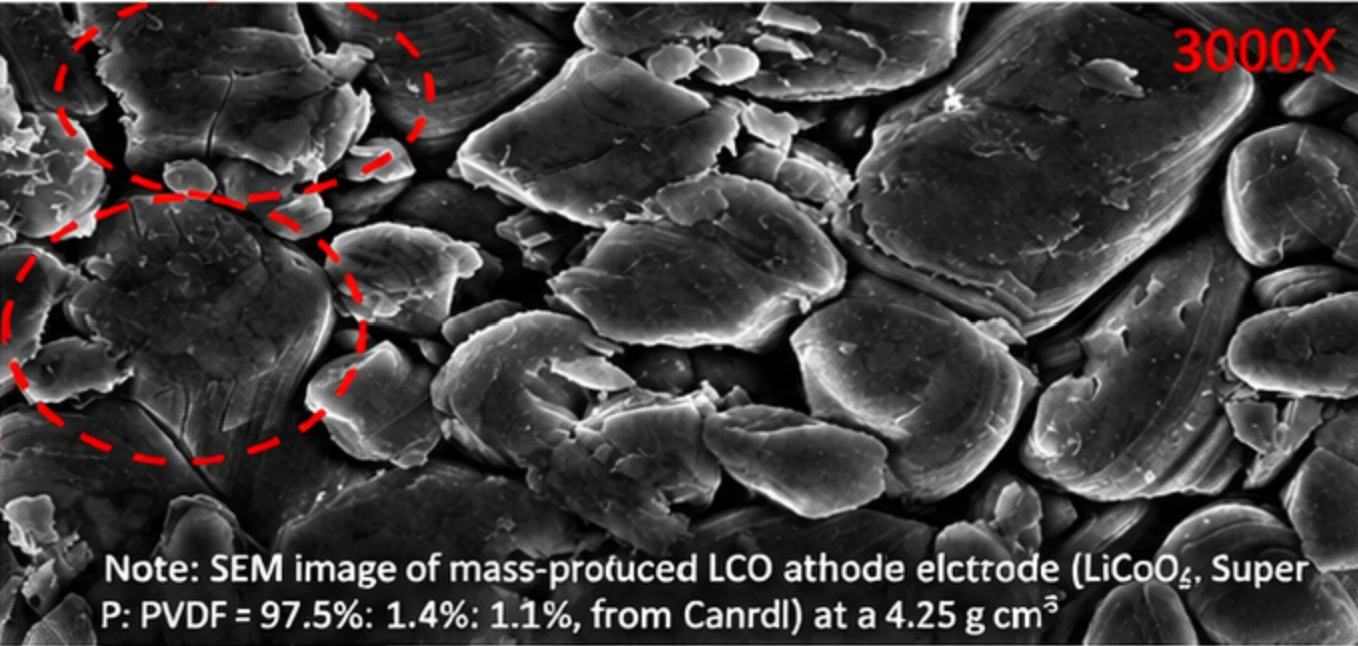
Rolling pressure reaches up to 1000 MPa. Cathode density over 4.25 g/cm³ triggers massive particle cracking, continuous SEI generation and irreversible lithium loss.
SEM of Cracked LCO Particles at High Compaction
5 Pros & Cons of Calendering
5.1 Advantages of Standard Calendering
- Reduce film resistance and form complete conductive networks
- Thin coating to improve volumetric energy density and cell capacity
- Strengthen coating adhesion to aluminum/copper foil, reduce shedding defects
- Uniformly distribute conductive carbon black inside electrodes
5.2 Disadvantages of Excessive Compaction
- Low porosity limits electrolyte storage, accelerating cycle decay
- Active particle fracture, irreversible lithium loss from continuous SEI film
- Narrow ion channels degrade high-rate discharge performance
- Brittle electrodes easily crack during slitting and winding
6 Targeted Compaction Density Selection Framework
6.1 Long-Cycle Energy Storage Batteries
Low compaction: Cathode 3.0~3.4 g/cm³ | Anode 1.35 g/cm³ Prioritize high porosity and electrolyte retention, trade partial energy density for cycle stability over 1000 cycles.
6.2 High-Energy Consumer Cells (Phone / Tablet)
High compaction: Cathode 4.1–4.15 g/cm³ | Anode 1.70–1.75 g/cm³ Maximize active material loading; match high-stability electrolyte additives to offset cycle attenuation.
6.3 High-Rate Power Batteries (Drone / Power Tool)
Medium compaction: Cathode 3.8–4.0 g/cm³ | Anode 1.50–1.55 g/cm³ Balance electronic conductivity and ion transport pores for fast charging & stable cycling.
6.4 Silicon-Carbon Anode Systems
Max compaction limit: Anode 1.3~1.45 g/cm³ Reserve buffer voids to accommodate 280%~300% silicon volume expansion and avoid particle pulverization.
7 Practical Operation Guidelines: Lab & Mass Production
7.1 Full Standard Production Workflow
Additionally → Advanced Definition → PRODUCT → PRODUCT → PRODUCT → PRODUCT → PRODUCED → LEDS → LEDS Lab mini calenders can omit preheating & edge trimming modules, only retain unwind-compress-wind core structure.
7.2 Standard Compaction Density Range
- LCO Cathode
- Long-cycle storage: 3.0~3.4 g/cm³
- General consumer cells: 3.8~4.1 g/cm³
- Ultra-high energy: 4.1–4.2 g/cm³ (Strict upper limit: <4.25 g/cm³)
- Graphite Anode
- Long-cycle design: 1.30~1.40 g/cm³
- General power cells: 1.50~1.60 g/cm³
- High-energy design: 1.65~1.75 g/cm³
- Si/C AnodeMax density: 1.3~1.5 g/cm³, reserved voids for volume expansion
7.3 Mandatory Pre & Post-Calendering Tests
- Physical indicators: Coating thickness, compaction density, porosity, peeling strength
- Electronic test: Electrode sheet resistivity
- Microscopic characterization: SEM observation of particle morphology, conductive network and cracks
- Electrochemical testing: Rate performance, long-cycle retention, EIS impedance spectroscopy
8 Frequently Asked Industrial Questions
Q1: Higher compaction always brings higher energy density?
A: Single cell capacity rises with density, but over-compaction sacrifices porosity and cycle life. High density only fits high-energy consumer products; energy storage batteries require balanced porosity and density instead of maximum compaction.
Q2: Risks of LCO cathode above 4.25 g/cm³?
A: Ultra-high rolling pressure splits secondary particles. Electrolyte penetrates cracks to generate continuous SEI, consuming lithium irreversibly and cutting cycle life by nearly half.
Q3: How to balance rate capability and cycle life via calendering?
A: Adopt medium compaction (3.8~4.0 g/cm³ LCO cathode). It guarantees tight particle contact for low resistance while retaining enough pores for lithium transport and electrolyte storage.
Q4: Why Si/C anodes cannot use high compaction?
A: Silicon expands up to 300% during lithiation. High density leaves no buffer space, leading to repeated particle crushing and permanent capacity decay. Anode density must stay below 1.5 g/cm³.
Q5: Function of preheating process?
A: Preheat softens PVDF/CMC binders, lowering required rolling pressure and particle cracking risk. It also enhances interfacial bonding between active materials and metal foil.
Conclusion
Electrode calendering acts as a decisive forming procedure in lithium-ion battery manufacturing. Rational compaction density design hinges on balanced trade-offs among electronic conductivity, ionic transport, cycle stability and particle structural integrity, together with standardized production workflows and strict pre/post-process characterization.
Proper calendering treatment optimizes electrode conductive networks, elevates volumetric energy density and strengthens coating adhesion, while over-compaction will trigger irreversible drawbacks including particle fragmentation, insufficient electrolyte storage and degraded long-cycle & high-rate performance. Matching targeted compaction parameters to your R&D goals — energy storage, consumer electronics, power devices or silicon-carbon systems — is critical to strike the ideal performance balance.
For academic labs and industrial pilot production lines, mastering calendering principles, parameter selection and full-line operation standards lays a solid foundation for consistent coating, cell assembly and reliable battery electrochemical output.
Looking for lab & mass-production calenders, electrode process technical guidance or customized electrode sample fabrication? Reach out to Canrd for professional lithium battery R&D solutions and tailored quotations.
Previous
Electrolyte Selectio...Related Products & Services
Use Canrd products and R&D services to turn battery knowledge into practical experiments.
Coin Cell Case
ProductCoin cell cases for validating materials and electrochemical concepts from the article.
Use coin cell cases in your next test →Sodium Electrolyte
CategoryElectrolytes for sodium-ion battery research, compatibility tests, and cell validation.
Shop sodium electrolyte for validation →Cell Fabrication
ServiceGet support building dry cells, assembled cells, or custom formats for R&D validation.
Request cell fabrication support →Experimental Materials
CategoryBrowse materials for follow-up experiments, benchmarking, and product development.
Browse experimental battery materials →